Family Relationships Tips & Advice

Internal Family Systems in Marriage: 42 Years In

Key Takeaways

Internal Family Systems in Marriage: What My 42nd Anniversary Taught Me About My Own Parts

  • The person who snaps at your spouse is usually a protective part of you, not the whole of you. Internal family systems in marriage begins the moment you can tell the difference.
  • Protective parts come in two flavors: managers that keep everything smooth and controlled, and firefighters that put out the pain fast through yelling, drinking, gambling, scrolling, or shutting down.
  • The people pleaser part is expensive. Setting your needs aside by choice is normal. Setting them aside because conflict feels dangerous slowly costs you the marriage you wanted.
  • Being misunderstood is not an emergency. When you can let your partner be wrong about you for sixty seconds, she stops feeling dismissed and you stop reacting like a five-year-old.
  • Protective parts relax when the wounded part underneath gets healed. That’s why methods like IFS and EMDR do more than communication tips ever will.

Forty-two years married this August, and I still catch a part of me trying to run the show.

There’s a sensation that shows up first. Tension in my chest and jaw. And then I’ve already said something before I knew I was going to say it, and it’s usually defensive, and it’s usually some version of turning it around so it’s about her instead of me.

I’m a couples therapist. I’ve spent decades helping people through infidelity, betrayal, disconnection, the whole range of it. And none of that makes me immune. We therapists aren’t immune to anything our clients deal with. What has actually made a difference in my own marriage is learning to recognize which part of me is talking.

Below is what I’ve learned about my own patterns, the two protective parts that cause me the most trouble at home, and what changes when I catch them in time.

Your Protective Parts Show Up Before You Do

In the internal family systems model, the reaction you have with your partner is almost never coming from the whole of you. It’s coming from a part. And that part is fast, faster than thought, because its whole job is to get between you and a wound before you feel the wound.

We all have wounded parts and we all have protective parts. We also have a Self with a capital S, the part with the capacity for calmness, curiosity, compassion, courage, clarity. Self is the part of you that can notice all the other parts without being taken over by them.

The protectors sort roughly into two kinds. Managers work ahead of time. If someone carries a feeling of not being good enough, the manager keeps it together, keeps it presentable, keeps the insecure part hidden. Firefighters show up after the pain has already started, and they put the fire out by leaving. Yelling is leaving. Getting defensive is leaving. Gambling, drinking, scrolling your phone while your wife is talking to you, going completely silent, all leaving.

I’m more of a fighter than a flight-er. I get short. I can raise my voice. Not that one is better than the other, I just tend to bark back.

Here’s what most people get wrong about all of this. They decide their reactive part is the problem and go to war with it. That doesn’t work. That part is loyal. It has been protecting you since you were small and it isn’t going to stand down because you’ve decided it’s inconvenient. The other thing people miss is that the quiet ones are protectors too. The partner who never raises his voice and just goes flat isn’t calm. That’s a firefighter doing the same job with better manners.

The People Pleaser Part Costs More Than the Conflict Would Have

My other protector doesn’t yell at all. It manages. It tries to calm me down by calming everybody else down, and it does it at my expense.

I don’t want conflict. I don’t want to disappoint people. I want people to like me. Don’t we all? There’s a big expense to living that way, though, and it took me a long time to see it.

There’s a real difference between choosing to put my needs aside for a moment because somebody else’s needs matter more right now, which is a normal part of any marriage, and putting my needs aside because a part of me is scared of what happens if I don’t. First one is generosity. Second one is protection wearing generosity’s clothes.

So I ask myself a question now. Is that people pleaser lurking around somewhere? And if the answer is yes, I ask the follow-up: what do I actually want here, and what do I need to say that might rock the boat but at least means I showed up?

I’ve become what I call healthily selfish with my wife. I say what I’m feeling even when she might not like hearing it. I’m not trying to be mean. I’m trying to be me.

Here’s the part I didn’t see coming. I like her more. Not because she changed. She’s the same lovely lady I’ve been married to for forty-two years. I like her more because I’m no longer editing myself around her, which means I’m no longer quietly building a case against her for things she never asked me to give up. The people pleaser doesn’t just cost you your voice. It slowly makes your partner into the reason you don’t have one.

Being Misunderstood Is Not an Emergency

The perfectionist part of me believes that if I’m not right, I’ll be seen as inadequate or as a disappointment. So when my wife says something about me that I know isn’t accurate, that part moves fast to correct the record.

What I used to do was interrupt her. “No, you’re wrong about that, this is what’s going on, blah, blah, blah.” And here’s what happens next, every single time: it doesn’t matter whether she was accurate or not. She feels dismissed. Nobody who feels dismissed has ever gone on to have a good conversation.

When I’m on my game, it goes differently. I can feel the part that wants to be seen in a good light, especially when I did the right thing and got misunderstood anyway. I can breathe. I can soothe myself in the moment. And then I can say something like, “You didn’t hear me say what I think I said, but you didn’t hear it, so you felt ignored, and that made you really upset.” I can make room for her experience, because my protective part hasn’t hijacked me. Then it becomes my turn to advocate for myself. And if she still doesn’t see it my way, that’s not the end of the world either.

Underneath all of it is a five- or six-year-old. My parents fought, and that little boy decided it wasn’t safe to have any conflict. I know it’s safe now. That part doesn’t know. So I don’t argue with him. I comfort him.

Which brings me to the piece that matters most and gets skipped the most. You can practice this awareness for years and still get hijacked, because a protector will not fully relax while the wound it’s guarding is still raw. That’s why the healing work matters. Internal family systems, EMDR, other methods that get to the core, so the wounded part can finally process what happened and the protector gets to put down a job it’s been doing since kindergarten. I’ve done this as a client, not only as a therapist. I’m getting better at it and I’ve got a long way to go. I think we all do.

How to Start Catching Your Own Parts This Week

You don’t need a full treatment plan to start. You need to be able to spot the handoff, the moment a part takes the wheel.

Find your tell. Mine is tension in the chest and jaw right before I speak. Yours might be heat in your face, a flat feeling, a sudden urge to check your phone. Name the physical signal and you get a half-second of choice back.

Ask which part is talking. Fighter or pleaser? Manager smoothing things over, or firefighter trying to end the pain right now? Just naming it takes some of its power.

Let one misperception stand for sixty seconds. Next time your partner says something inaccurate about you, don’t correct it immediately. Breathe. Reflect back what she felt. Then take your turn.

Say one true thing you’d normally swallow. Small one. Watch what happens to your resentment level over the next week.

Get the wound looked at, not only the behavior. If the same protector keeps taking over no matter how aware you are, that’s information about what still needs healing.

Start with the first one today. Everything else depends on catching the handoff.

If you’re finding that the same fight keeps happening no matter how much awareness you bring to it, that’s usually the point where working with someone helps. That’s the work I do with couples, and it’s the work I’ve done on myself.

Forty-two years in, and the thing I’d say to anyone in an intimate relationship is this: this is one of the most rewarding and most challenging arenas you’ll ever grow in. The growth is in developing the emotional muscle so your protective parts don’t take over, and in healing the wounded parts so those protectors don’t have to work so hard.

If your reactions with your partner feel bigger than the moment deserves, reach out. That pattern has a history, and history can be healed.

Here’s to another year. This is Todd Creager, making the world safe for love.

Ready to stop fighting the same fight?

If the same reaction keeps taking over your marriage no matter how much you understand about it, there’s a wound underneath it that hasn’t been healed yet. That’s what I help couples and individuals with. Reach out to book a consultation, or grab my free resources on rebuilding connection at toddcreager.com. [LINK]

What if your next argument could bring you closer instead of driving you apart?


Learn how in Todd Creager’s Loving & Connecting Masterclass.
Lifetime access. Real results.

Frequently Asked Questions

Q: What is internal family systems therapy in the context of marriage? A: Internal family systems (IFS) works from the idea that everyone has multiple parts: wounded parts carrying old pain, protective parts that keep those wounds out of reach, and a core Self with the capacity for calmness, curiosity, and compassion. In a marriage, most conflict is protective parts reacting to each other rather than two adults talking. The work is learning to notice which part has taken over so you can respond from Self instead.

Q: How do I know if I’m reacting from a protective part or from my true self? A: Speed and body sensation are the giveaways. A protective part reacts before you’ve thought anything through, usually with a physical signal first, like tension in the chest or jaw. When you’re coming from Self, you can slow down, hold your own position, and still take in your partner’s experience at the same time.

Q: What’s the difference between a manager part and a firefighter part? A: A manager works in advance to keep the pain from ever surfacing, through perfectionism, people pleasing, controlling the mood, or keeping everything together. A firefighter shows up once the pain has already been triggered and puts it out fast through yelling, defensiveness, drinking, gambling, scrolling, or shutting down completely. Both are protecting the same wound with different strategies.

Q: Is people pleasing bad for a marriage? A: Setting your own needs aside sometimes because your partner’s needs matter more is a normal, healthy part of being married. It becomes a problem when it’s driven by a part of you that’s afraid of conflict or disappointment, because then you stop showing up as yourself. Being healthily selfish, saying the honest thing even when it might not land well, tends to make partners like each other more, not less.

Q: Can one partner do this work alone, or do both people need to be in therapy? A: One person changing which part they respond from changes the pattern between them, so meaningful shifts happen even when only one partner is doing the work. That said, when both people can recognize their own protectors, the repair happens faster and holds better. Where old wounds keep hijacking the present, approaches like IFS and EMDR help at the root rather than only at the surface.
Somatic Triggers in Relationships: The Body Knows First

Key Takeaways

Somatic triggers in relationships show up in your body before your thinking mind catches up.

  • Parts of you speak through physical sensation first: a stomach that drops, a jaw that clenches, tightness across the chest.
  • Most couple fights are protective parts reacting to protective parts, which is why an argument escalates in seconds with neither person choosing it.
  • Pausing for thirty seconds before a hard conversation and naming where you feel something is the difference between a part running the conversation and you being present for it.
  • Seeing a reaction as a younger part rather than a verdict on the relationship stops it from being evidence that something is wrong with you.

Your partner hasn’t finished a sentence yet, and your stomach has already dropped. Or your jaw has clenched. Or there’s a tightness across your chest that wasn’t there ten seconds ago.

That’s not stress. That’s a part of you communicating through your body before your thinking mind ever gets involved.

Somatic triggers in relationships are one of the most missed pieces of couples work I see. Most couples I sit with have no idea it’s happening. They’re reacting to each other’s reactions, and by the time anyone has words for it, the fight is three minutes old.

Here’s what your body is reporting, why couples escalate so fast, and the thirty-second practice that gives you back a choice.

What Somatic Triggers in Relationships Actually Are

A somatic trigger in a relationship is a physical sensation — tightness, heat, heaviness, numbness — that signals a protective or wounded part of you has been activated by something your partner said or did, before your conscious mind has processed a word of it.

Parts don’t only show up as thoughts or emotions. They show up in the body, and they’re faster than you are.

A protector can tighten your shoulders and cross your arms before you’ve registered what your partner said. A firefighter — the part whose job is to put out the emotional fire right now, by any means available — can flood you with the urge to leave the room or grab your phone before you’ve decided anything. An exile, meaning a wounded younger part of you that got touched, can drop a heaviness into your chest that makes you feel small and helpless in a way that doesn’t match the moment.

That mismatch is the tell. When the size of the sensation doesn’t fit what just happened, you’re not responding to your partner. You’re responding to something older, and your partner happens to be standing in the room.

What most people do instead is argue about the content — who said what, what was meant, what was implied. I’ve watched couples spend a whole session litigating a sentence when the real information showed up in one of their chests before the sentence ended.

Why Couples Escalate in Seconds

Two nervous systems are reacting to each other faster than either person can think, and that’s the whole mechanism.

My protective parts, which are trying to protect my wounded parts, are interacting with your protective parts, which are trying to protect yours. Nobody is choosing any of it. It’s quick, and the whole thing escalates in seconds.

I say this to couples all the time when they come out of one of these fights and ask, “Why are we doing this? What’s wrong with us? Maybe we shouldn’t be together.” That’s not really it. Not every couple is destined to be together, but many break up because they never understood this piece — they have parts getting activated, and they’re reading the activation as evidence about the relationship.

This is also why better communication skills run out so fast. You can hand a couple better sentences, and they help right up until a part gets activated — then the part is driving and the technique is a passenger. If the same fight keeps arriving in the same shape no matter how carefully you word things, that’s a parts problem rather than a communication problem. If your fights are about differing wants, needs and logistics, better conversation skills will help. Two different situations, two different kinds of work.

Once a couple can notice it’s a part of me, not all of me — and can see where that part came from, and take care of it differently, and start to recognize their partner’s parts too — everything shifts.

The Thirty-Second Pause That Gives You Back a Choice

Before your most difficult conversation, pause for thirty seconds and notice where you feel something. Tightness, heat, heaviness, numbness. You don’t have to understand it. Just name it: something clenched in my chest.

That’s you observing a part rather than being it.

The gap between a part activating and you seeing it is small, and it’s the whole thing. When you can feel the part in your body before it takes over your mouth, you have a choice you didn’t have before — and so does your partner.

Naming doesn’t require accuracy, which is what trips people up. Clients want the label right before they’ll say anything, and that’s the thinking mind trying to take the job back. “There’s heat in my face” is enough. You’re not diagnosing. You’re creating half a second of distance from something that’s been running you.

What the practice will not do is stop the sensation from arriving. Parts don’t retire because you noticed them. They show up on schedule, and the change is in what happens next — whether the tightness becomes a raised voice or becomes information.

The couples who get the most from this do it before the hard conversation rather than during it. Once you’re activated, your protectors are much less interested in being observed.

When a Younger Part Hasn’t Updated

Sometimes the part reacting to your relationship is responding to a version of it that no longer exists.

A couple I saw yesterday was leaving on a trip out of the country. They’ve been together three or four years. She travels with a particular friend regularly and it’s never a problem, but this trip was with her partner and a few of his family members, and she was anxious.

We traced it to the year before. They’d gone through real conflict, and right before they could resolve it they got on a plane, and she had a panic attack in the air. She was afraid of it happening again.

What she said to him was, “I’m afraid. I don’t know why. I don’t want to ruin it for you.” He was kind about it. As I sat back and watched, I could see it in her face and her body. Anxiety. A lot of distrust.

What came out was that she’d been abandoned before by people she really counted on. The friend she travels with isn’t that important to her. Her boyfriend is as important as the people who didn’t come through, so a much younger part was getting activated. It hadn’t updated. Their relationship is better than a year ago and she’s safer in it, but the young part hadn’t gotten the news.

The trip made her vulnerable for a practical reason. At home, when she gets upset, she picks up her stuff and goes back to her apartment. On vacation she couldn’t, which made it claustrophobic. What if I have this reaction and I have no escape?

Here’s what shifted in the session. He could see it as a younger part and stop taking it personally, so it stopped meaning anything about whether she wanted to be with him. And she got some control back, because now when she’s about to grab her things and leave, she has somewhere else to take it: what is that part of me?

What To Do Next

Run the thirty-second scan before the conversation you’ve been dreading. Not during. Find where in your body something is happening.

Name it out loud, in plain words. “My chest is tight.” “My stomach dropped.” Skip the interpretation. The naming is the work.

Check the size. If the intensity doesn’t match what happened, ask how old the feeling is. A part that feels five years old got activated by something older than your partner.

Tell your partner what your body did, rather than what they did wrong. “Something clenched in my chest when you said that” gives you both somewhere to go. “You always do this” gives you a fight.

Start with the first one this week. One conversation, thirty seconds beforehand. If the same reactions keep arriving and neither of you can get underneath them, sit down with someone who works this way.

Somatic triggers in relationships aren’t a sign that you’re broken or that your relationship is wrong for you. Your body knows things quicker than your conscious mind does. That is for sure, and that’s human.

The couples who learn to read that signal stop reacting to each other’s reactions and start responding to what’s there. If that’s the work you want, reach out and we’ll talk about what it would look like for you two.

This is Todd Creager, making the world safe for love.

If you want help reading these signals in your own relationship, reach out to schedule a session and we’ll look at what your body has been telling you.

What if your next argument could bring you closer instead of driving you apart?


Learn how in Todd Creager’s Loving & Connecting Masterclass.
Lifetime access. Real results.

Frequently Asked Questions

Q: Why does my body react before I even know what my partner said? A: Protective parts operate faster than conscious thought. They pick up tone, facial expression and pacing and respond physically — tight shoulders, crossed arms, a dropped stomach — before your thinking mind has processed the content. The sensation isn’t an overreaction. It’s early information.

Q: What’s the difference between a somatic trigger and ordinary stress? A: Ordinary stress fits the situation in size and fades when it resolves. A somatic trigger tends to be out of proportion to what happened, and carries a younger quality with it — feeling small, helpless, a version of yourself that doesn’t match your age.

Q: Does noticing a part make the reaction stop? A: No, and expecting that sets you up to feel like it isn’t working. Parts keep showing up. What changes is the gap between the sensation arriving and you acting on it, which is where your choices live.

Q: Is a reactive fight a sign we shouldn’t be together? A: Usually not. Many couples separate because they never understood that their parts were getting activated and read the reactivity as a verdict on the relationship. Reactive fights signal that wounded parts are in the room, and that is workable.

Self-Led Parenting: Stop Reacting, Start Leading

Key Takeaways

Self-Led Parenting: What It Actually Takes to Stay Steady With Your Kids

Self-led parenting isn’t about staying calm all the time. It’s about noticing when a younger, wounded part of you has taken over and finding your way back to yourself before you respond.

  • When your child triggers you, it’s rarely about what’s happening in the moment. A part of you that didn’t get heard, didn’t get to have feelings, or wasn’t allowed to push back as a kid gets activated instead.
  • Two protectors usually show up first: the manager, who tightens up and controls because it’s scared of judgment, and the firefighter, who explodes because it needs an overwhelming feeling to stop right now.
  • Parenting surfaces old wounds faster than almost anything else in life, which makes it one of the best chances you’ll get to heal them.

Your kid pushes the one button that gets you every time. The tone. The eye roll. The meltdown in the middle of the grocery store. Before you’ve had a second to think, you’re yelling, lecturing, or saying the exact words you swore you’d never say to your own kids. Worse, they sound like something your own parent used to say to you.

That’s not bad parenting. That’s a part of you stepping in and taking the wheel.

I’ve spent years working with couples and families through internal family systems, and one thing keeps showing up: parents carry younger parts of themselves into almost every hard moment with their kids. Self-led parenting means learning to spot when one of those parts has taken over, and finding your way back to the steadier version of yourself before you respond.

What Self-Led Parenting Actually Means

Self-led parenting means responding to your child from your core self, the calm, compassionate, curious part of you, instead of from whichever wounded or protective part just got triggered. In internal family systems work, we call that core part “self.” It’s the healthiest version of who you are: compassionate, curious, caring, confident, connected.

Every one of us also carries wounded parts, formed back when we were kids ourselves. Maybe you weren’t allowed to have big feelings. Maybe you got dismissed when you pushed back. Maybe nobody noticed when you were scared. Those wounds don’t disappear just because you grew up and had kids of your own.

Because they’re painful, your system also built protective parts. Their whole job is to keep you from feeling that old wound again.

Here’s what most parents get wrong about self-led parenting: they think it means staying calm all the time, never raising your voice, never losing it. Losing it happens. A part takes over, and for a minute or an hour, that part is driving instead of you.

Self-led parenting isn’t a prevention plan for that. It’s a skill: noticing the hijack fast and finding your way back to yourself before too much damage gets done. Not perfection. Recognition and return.

So who actually shows up when your child pushes that button? Usually one of two parts.

The Manager and the Firefighter: Why You React the Way You Do

When your child triggers you, it’s typically one of two protectors that shows up first.

The manager is the part that needs things to look a certain way. It worries about what other parents think, whether your child is behaving, whether you’re doing this whole parenting thing right. It tightens up and starts controlling the situation because underneath, it’s scared of being judged or getting it wrong. If that sentence landed for you, you’re not alone. I’d guess it lands for nearly every parent reading this.

The other protector is the firefighter. It doesn’t think, it acts. It’s the part that explodes, threatens, or storms out of the room. It’s not trying to solve anything long-term. It just needs the overwhelming feeling in your body to stop, and reacting big is the fastest way it knows how to discharge that feeling.

I worked with a client recently whose son has what we might call a sugar addiction. He won’t listen to her about it, especially when she isn’t standing right there. She’d get furious with him, then furious with herself for getting furious.

As we worked through it, we found a younger part of her that had been deprived as a child because of her own health problems, and that had worked hard to be as healthy as possible so she could outrun those problems as an adult. When her son eats “out of control,” it doesn’t just activate the part of her that wants to be a good mom. It activates the younger part that once felt scared and out of control in her own body.

Both protectors are guarding the same thing: a younger part of you that once needed something from your own parents and didn’t get it.

How I Watched My Own Part Take Over Through a One-Way Mirror

The clearest example I can give you of this happening is one from my own life, not a client’s.

My oldest daughter started preschool at three, at a school where most of the other kids had already been going since they were two. First day, brand new kid. There was a one-way mirror in the classroom, and I stood there watching her walk up to different groups, trying to play, and getting turned away. Once. Twice. A third time.

I marched straight into the principal’s office and told her she needed to do something about what I was watching happen to my daughter. She asked me one question: had I experienced rejection like that when I was younger? I said sure, but what did that have to do with anything?

Everything, it turned out. My daughter wasn’t in trouble. A little kid inside me, the one who used to be afraid of not fitting in, had gotten activated watching her get turned away. The principal was right. Within a day or two, my daughter had made friends and was doing fine. She never needed me to march into anyone’s office. I did, because a younger part of me needed something.

What settled that day wasn’t just my nerves as a parent. Something in me actually healed. That’s what I mean when I say parenting surfaces your younger parts more than almost anything else in life outside of an intimate relationship, and why it’s also one of the best chances you’ll get to grow. My client with her son and the sugar issue is in the middle of that same process right now, and it’s already changing how she shows up for him.

What To Do Next

You don’t need a one-way mirror or a therapy session to start practicing this. Next time your kid pushes the button:

  • Notice the physical signal first: the tight chest, the heat in your face, the urge to raise your voice. That’s usually the fastest sign a part has taken over.
  • Ask yourself who’s driving. Is this the manager, worried about how things look? The firefighter, needing the feeling to stop right now? Or is this actually you, your calm self, responding to what’s in front of you?
  • Give the part a beat before you speak or act. You don’t have to fix the reaction instantly. You just have to catch it before it runs the whole show.
  • Come back to compassion, curiosity, and connection, and let your response come from there instead.

If you want language for what’s happening inside you when your child triggers you, that’s the work I do with parents and couples, and it’s worth a real conversation.

You’re not failing as a parent every time a part of you takes the wheel. That’s what parts do. Self-led parenting isn’t about arriving at some finished state of calm. It’s about getting faster at noticing the hijack and finding your way back. Every time you do, you’re not just handling that one moment better. You’re healing something older than your kids are.

If this is you, or you know a parent who needs to hear it, pass it along. This is Todd Creager, making the world safe for love.

What if your next argument could bring you closer instead of driving you apart?


Learn how in Todd Creager’s Loving & Connecting Masterclass.
Lifetime access. Real results.

Frequently Asked Questions

Q: What does “self-led parenting” mean? A: Self-led parenting means responding to your child from your calm, core self rather than from a wounded or protective part that’s been triggered. It doesn’t mean never getting upset. It means noticing quickly when a part has taken over and finding your way back before you respond.

Q: Why do I react to my kids the same way my parents reacted to me? A: You carry younger, wounded parts formed in your own childhood, and your child’s behavior can activate them without warning. When that happens, a protective part, often a manager or a firefighter, steps in and reacts the way it learned to react long ago, sometimes echoing the very words your own parent used.

Q: What’s the difference between the “manager” and the “firefighter” in parenting? A: The manager is the part that tightens up and tries to control the situation because it’s afraid of judgment or of getting it wrong. The firefighter is the part that explodes, threatens, or shuts down because it needs an overwhelming feeling to stop immediately. Both are protecting the same younger, wounded part underneath.

Q: Can self-led parenting actually change how my kids experience me? A: Yes. When you’re leading from self instead of a triggered part, you can hold a limit without losing your warmth, say no without shaming your child, and let them have a hard feeling without rushing to fix or shut it down. That shift is often what your child needs most, more than a parent who never gets it wrong.

Q: Is self-led parenting a form of internal family systems (IFS) therapy? A: It’s the parenting application of internal family systems concepts, self, parts, protectors, and wounds, applied to the moments kids trigger in parents. You don’t need formal IFS training to start noticing your own manager and firefighter parts, though working with a therapist familiar with this model can speed up the process.

The Truth About Your “Broken” Self: It’s Just Nervous System Overload

You might be feeling that your broken but the truth is your nervous system is overloaded.

Have you ever wondered why you freeze up during arguments or feel emotionally flooded when your partner criticizes you?

The truth is, you’re not broken – your nervous system is overloaded. As a relationship therapist, I want to help you understand what’s really happening in your body and mind during these challenging moments.

Here’s what you’ll learn in this important discussion:

Understanding Your Nervous System Response

When your nervous system is overloaded, it triggers automatic responses that aren’t conscious choices.

Through the vagus nerve, which extends from your brain to your intestines, your body responds to perceived threats in ways that can feel overwhelming.

Learning about these natural protective mechanisms helps you stop blaming yourself for these reactions.

The Three Ways We React to Stress

Your body has three main ways of dealing with threatening situations:

Freezing: Like a deer in headlights, you might shut down completely

Fighting/Fleeing: Your sympathetic nervous system activates, leading to emotional explosions or running away

– Social Engagement: The healthy response where you can stay present and work things out with your partner

In the full video below, I share in detail a powerful example of a 40-year-old teacher who couldn’t speak to adults due to childhood trauma.

Through EMDR therapy and understanding his overloaded nervous system, he found freedom from this pattern.

These stories share how lasting change is possible when we address the root causes.

Practical Steps for Change

Your nervous system can learn new ways of responding. I explain concrete techniques for:

– Building healthy communication patterns with your partner

– Recognizing when your nervous system is overloaded

– Learning to co-regulate with your partner instead of freezing or fighting

– Using professional help when needed to heal deeper trauma

Here’s Why Should Matter to You:

Understanding that your nervous system is overloaded rather than “broken” opens the door to real healing.

When you stop judging yourself and start working with your body’s natural responses, you can create lasting positive changes in your relationships.

Ready to learn more about how your overloaded nervous system affects your relationships and what you can do about it?

Watch the full video below for deeper insights and practical tools to help you create healthier relationship patterns.

Don’t let an overloaded nervous system keep controlling your relationships. 

What if your next argument could bring you closer instead of driving you apart?


Learn how in Todd Creager’s Loving & Connecting Masterclass.
Lifetime access. Real results.

The Forgotten Half: Healing the Betrayer After Infidelity for Lasting Change

Healing the Betrayer After Infidelity: A Crucial Step in Relationship Recovery

Have you ever wondered why it’s important to help the person who cheated heal after an affair? As a relationship expert who has helped thousands of couples recover from infidelity, I’ve found that healing both partners is crucial for long-term success. 

Today, I want to share some insights on why and how we should focus on healing the betrayer after infidelity.

When infidelity occurs, it’s natural for all the attention to be on the betrayed partner. Their pain is real and valid, and they need support to heal. However, for true relationship recovery, we can’t ignore the healing process of the person who cheated. 

Here’s what you’ll learn in this video:

• Understand the betrayer’s emotional journey: In the video, I explain how betrayers often experience panic, fear of loss, shame, and self-loathing after their actions are discovered. While these feelings are normal, staying stuck in them can hinder the healing process for both partners.

Learn why healing the betrayer matters:

I discuss how the betrayer’s healing is essential for creating a healthier relationship dynamic.

By addressing the root causes of their behavior, we can reduce the likelihood of future infidelity and create a more secure attachment between partners.

Discover how the betrayed partner can participate:

I share strategies for making it safe for the betrayed partner to understand and contribute to the betrayer’s healing process.

This collaborative approach is key to rebuilding trust and creating a stronger relationship.

Explore the role of attachment styles:

In the video, I delve into how different attachment styles (avoidant and anxious) can contribute to infidelity and how addressing these patterns is crucial for the betrayer’s healing journey.

Get practical tips for healing:

I provide concrete examples of how journaling can be a powerful tool in the betrayer’s healing process, helping them develop self-awareness and integrate their healthy self with wounded parts.

Watching this video will give you a deeper understanding of the complex emotional landscape after infidelity.

You’ll learn why it’s not enough to simply punish or condemn the person who cheated, but instead, how fostering healing for both partners can lead to profound relationship transformation.

As I mention in the video, this healing process isn’t about minimizing the pain caused by infidelity.

It’s about creating a path forward that addresses the underlying issues and helps both partners grow.

By understanding the betrayer’s journey, you’ll be better equipped to navigate the challenges of affair recovery, whether you’re the betrayed partner, the one who cheated, or a professional helping couples through this difficult time.

Remember, healing after infidelity is possible, but it requires work from both partners.

The insights I share in this video are based on years of experience helping couples rebuild their relationships after affairs.

They’re part of a comprehensive approach I’ve developed to help couples heal infidelity from the inside out.

If you’re ready to start your healing journey, I encourage you to watch the full video below. You’ll gain valuable insights into the betrayer’s healing process and how it fits into the larger picture of affair recovery. 

Take the first step towards healing today. Watch the video, get the guide, and remember – with the right approach and commitment from both partners, your relationship can not only survive infidelity but become stronger than ever before.

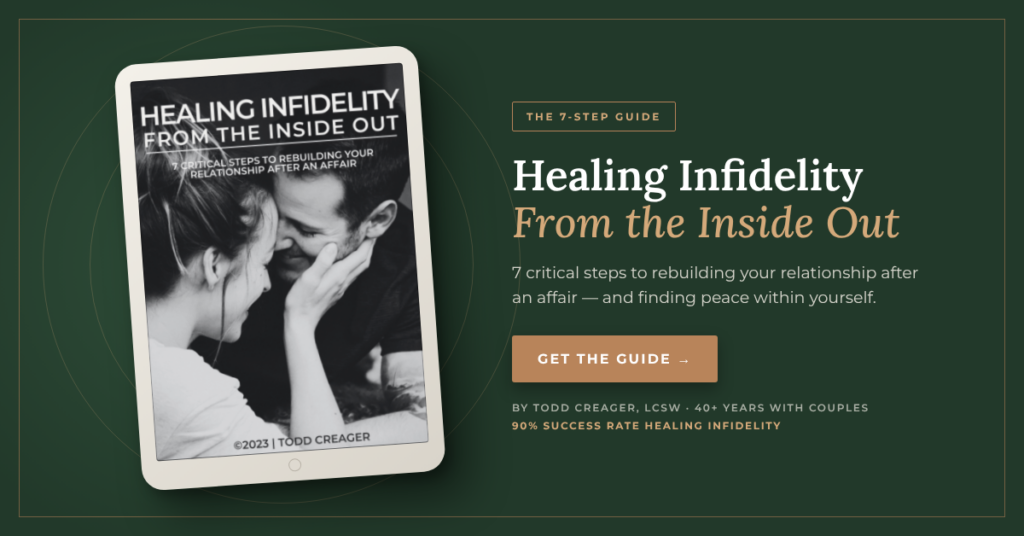
And don’t forget to download my free guide, “Healing Infidelity from the Inside Out,” which provides a roadmap for navigating this challenging process. 

Go From Hurting to Happy Today...

When you click the button below, you’ll gain access to my exclusive Healing Infidelity From The Inside Out Guide.

It’s a powerful resource that will support you every step of the way, providing practical guidance and actionable steps toward finding peace within yourself.

healing infidelity from the inside out mock up