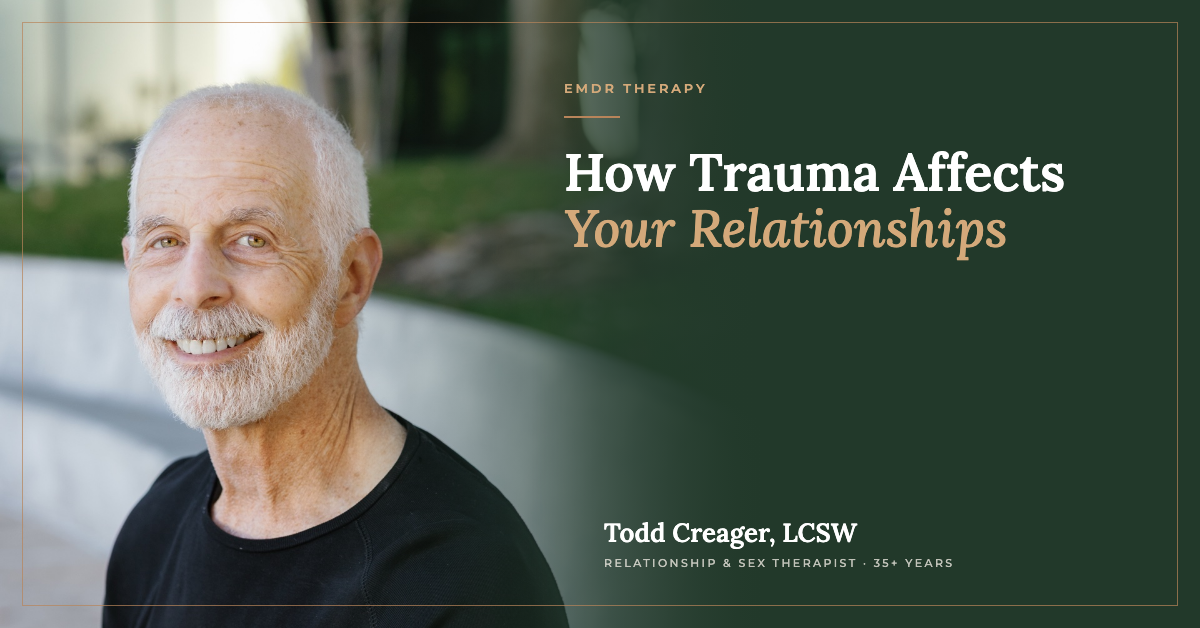

How Unresolved Trauma Affects Your Relationships

How Unresolved Trauma Affects Your Relationships

Picture of Todd Creager

Todd Creager

Todd Creager, LCSW, LMFT, is a marriage, relationship and sex therapist who helps couples heal from infidelity, betrayal and years of disconnection, so they can build a long, hot marriage instead of ending one.

35+ years in practice. Certified EMDR therapist. Adjunct lecturer, USC School of Social Work. Bestselling author of The Long, Hot Marriage and Love, Sex and Karaoke. Married, happily, for a long time.

Learn more about Todd: https://toddcreager.com/about/

Ready to talk? See how Todd works with couples and individuals or reach out for a 20-minute phone consult.

KEY TAKEAWAYS

Unresolved trauma affects relationships in specific, recognizable ways — it rarely stays in the past:

  • Unresolved trauma commonly shows up as hypervigilance, shutdown reactions, or difficulty trusting even a genuinely safe partner.
  • These patterns aren’t character flaws or relationship failures — they’re a nervous system still protecting itself from an old threat.
  • Partners of someone carrying unresolved trauma often personalize reactions that are actually about the old wound, not about them.
  • Addressing the underlying trauma directly tends to shift relationship patterns more effectively than communication skills alone.

“Why do I react like this when nothing’s actually wrong?” is one of the most common questions I hear in my office — usually asked by someone who’s already tried to reason their way out of a pattern that keeps happening anyway. I’m Todd Creager, and the answer is often unresolved trauma, showing up in a relationship it was never really about. Here’s how trauma affects relationships, and what actually helps.

The Relationship Patterns Unresolved Trauma Actually Creates

Hypervigilance is one of the most common — scanning a partner’s tone, expression, or timing for danger signs, even when nothing is actually wrong. It’s exhausting for the person experiencing it and confusing for a partner who feels like they’re constantly walking on eggshells for no clear reason.

Shutdown reactions show up as withdrawing or going numb during conflict or intimacy, not because the person doesn’t care, but because their nervous system is protecting them the way it learned to during the original trauma. And trust issues — struggling to believe a genuinely trustworthy partner, or needing constant reassurance that never quite lands — often trace back to an earlier betrayal or wound, not to anything the current partner is actually doing.

What most people don’t realize is how specific these patterns often are. Someone might function well in most of life and still have one particular relational trigger — a certain tone of voice, a certain kind of silence — that reliably activates an old trauma response.

Why This Isn’t a Character Flaw — or a Reflection on Your Partner

These patterns aren’t evidence of a bad relationship or a broken person. They’re a nervous system doing exactly what it learned to do to survive an earlier threat — the problem is that the response doesn’t know the threat has passed.

This matters for both partners. For the person carrying the trauma, understanding this can reduce the shame that often comes with reactions that feel disproportionate or embarrassing. For the partner on the receiving end, it helps to know the reaction is frequently about an old wound, not a verdict on them or the relationship.

I see this misunderstanding cause real damage in relationships — partners personalizing a trauma response as rejection or distrust, when it’s actually an old alarm system misfiring in a new, safer context.

How to Shift the Way Trauma Affects Your Relationship

Naming the pattern out loud, together, is often the first real shift — “this is my trauma response, not about you” changes how a partner receives it, and reduces the shame that keeps the cycle going for the person carrying it.

Communication skills help at the surface level, but in my experience, addressing the underlying trauma directly — often through EMDR — tends to shift these patterns more durably than learning new conversation techniques alone. You can’t out-communicate a nervous system that’s still bracing for an old threat.

This is exactly where individual trauma work and couples work meet. I often see the best results when a partner does individual trauma processing alongside the couple’s relational work — each piece supporting the other rather than trying to fix a nervous-system pattern with communication tools alone.

What to Do Next

If you recognize how trauma affects relationships in your own life, here’s where to start:

  • Notice which specific triggers — a tone, a silence, a type of moment — tend to activate the strongest reaction.
  • Name the pattern out loud with your partner: “this is an old response, not about you right now.”
  • Consider whether the underlying trauma, not just the relationship pattern, needs direct attention.
  • If communication skills alone haven’t shifted it, that’s a sign to look at the trauma underneath.

Your first step: book a free consultation to talk through whether individual trauma work could help your relationship patterns.

These patterns can shift — but usually by addressing what’s underneath them, not just the behavior on the surface. I offer both individual EMDR work and couples therapy, in my Huntington Beach office and virtually. For more on how EMDR resolves trauma, my complete guide to EMDR therapy for trauma walks through it.

Revitalize Your Life: Instant Access to Your Trauma Healing Blueprint

Access the Essential Steps You Need to Move Beyond Trauma and Reclaim Joy in Your Life
Frequently Asked Questions

Q: Why do I overreact to small things in my relationship?

A: This is often a trauma response — the nervous system reacting to a current moment as if it were an old threat. It’s not a character flaw, and it’s a pattern that can shift with the right support.

Q: How does childhood trauma affect relationships in adulthood?

A: Yes, very commonly. Childhood trauma often shows up as hypervigilance, shutdown reactions, or trust issues in adult relationships, even when the current partner has done nothing to cause them.

Q: How do I stop shutting down during conflict with my partner?

A: Shutdown reactions are typically a nervous-system protection response, not a choice. Addressing the underlying trauma directly, often through therapy like EMDR, tends to shift this more effectively than trying to will it away.

Q: Should my partner and I do individual therapy or couples therapy for this?

A: Often both, at the same time. Individual trauma work can resolve the nervous-system pattern, while couples work addresses how it’s been showing up between you — each supports the other.
How Unresolved Trauma Affects Your Relationships

How Unresolved Trauma Affects Your Relationships

KEY TAKEAWAYS

Unresolved trauma affects relationships in specific, recognizable ways — it rarely stays in the past:

  • Unresolved trauma commonly shows up as hypervigilance, shutdown reactions, or difficulty trusting even a genuinely safe partner.
  • These patterns aren’t character flaws or relationship failures — they’re a nervous system still protecting itself from an old threat.
  • Partners of someone carrying unresolved trauma often personalize reactions that are actually about the old wound, not about them.
  • Addressing the underlying trauma directly tends to shift relationship patterns more effectively than communication skills alone.

“Why do I react like this when nothing’s actually wrong?” is one of the most common questions I hear in my office — usually asked by someone who’s already tried to reason their way out of a pattern that keeps happening anyway. I’m Todd Creager, and the answer is often unresolved trauma, showing up in a relationship it was never really about. Here’s how trauma affects relationships, and what actually helps.

The Relationship Patterns Unresolved Trauma Actually Creates

Hypervigilance is one of the most common — scanning a partner’s tone, expression, or timing for danger signs, even when nothing is actually wrong. It’s exhausting for the person experiencing it and confusing for a partner who feels like they’re constantly walking on eggshells for no clear reason.

Shutdown reactions show up as withdrawing or going numb during conflict or intimacy, not because the person doesn’t care, but because their nervous system is protecting them the way it learned to during the original trauma. And trust issues — struggling to believe a genuinely trustworthy partner, or needing constant reassurance that never quite lands — often trace back to an earlier betrayal or wound, not to anything the current partner is actually doing.

What most people don’t realize is how specific these patterns often are. Someone might function well in most of life and still have one particular relational trigger — a certain tone of voice, a certain kind of silence — that reliably activates an old trauma response.

Why This Isn’t a Character Flaw — or a Reflection on Your Partner

These patterns aren’t evidence of a bad relationship or a broken person. They’re a nervous system doing exactly what it learned to do to survive an earlier threat — the problem is that the response doesn’t know the threat has passed.

This matters for both partners. For the person carrying the trauma, understanding this can reduce the shame that often comes with reactions that feel disproportionate or embarrassing. For the partner on the receiving end, it helps to know the reaction is frequently about an old wound, not a verdict on them or the relationship.

I see this misunderstanding cause real damage in relationships — partners personalizing a trauma response as rejection or distrust, when it’s actually an old alarm system misfiring in a new, safer context.

How to Shift the Way Trauma Affects Your Relationship

Naming the pattern out loud, together, is often the first real shift — “this is my trauma response, not about you” changes how a partner receives it, and reduces the shame that keeps the cycle going for the person carrying it.

Communication skills help at the surface level, but in my experience, addressing the underlying trauma directly — often through EMDR — tends to shift these patterns more durably than learning new conversation techniques alone. You can’t out-communicate a nervous system that’s still bracing for an old threat.

This is exactly where individual trauma work and couples work meet. I often see the best results when a partner does individual trauma processing alongside the couple’s relational work — each piece supporting the other rather than trying to fix a nervous-system pattern with communication tools alone.

What to Do Next

If you recognize how trauma affects relationships in your own life, here’s where to start:

  • Notice which specific triggers — a tone, a silence, a type of moment — tend to activate the strongest reaction.
  • Name the pattern out loud with your partner: “this is an old response, not about you right now.”
  • Consider whether the underlying trauma, not just the relationship pattern, needs direct attention.
  • If communication skills alone haven’t shifted it, that’s a sign to look at the trauma underneath.

Your first step: book a free consultation to talk through whether individual trauma work could help your relationship patterns.

These patterns can shift — but usually by addressing what’s underneath them, not just the behavior on the surface. I offer both individual EMDR work and couples therapy, in my Huntington Beach office and virtually. For more on how EMDR resolves trauma, my complete guide to EMDR therapy for trauma walks through it.

Revitalize Your Life: Instant Access to Your Trauma Healing Blueprint

Access the Essential Steps You Need to Move Beyond Trauma and Reclaim Joy in Your Life

Frequently Asked Questions

Q: Why do I overreact to small things in my relationship?

A: This is often a trauma response — the nervous system reacting to a current moment as if it were an old threat. It’s not a character flaw, and it’s a pattern that can shift with the right support.

Q: How does childhood trauma affect relationships in adulthood?

A: Yes, very commonly. Childhood trauma often shows up as hypervigilance, shutdown reactions, or trust issues in adult relationships, even when the current partner has done nothing to cause them.

Q: How do I stop shutting down during conflict with my partner?

A: Shutdown reactions are typically a nervous-system protection response, not a choice. Addressing the underlying trauma directly, often through therapy like EMDR, tends to shift this more effectively than trying to will it away.

Q: Should my partner and I do individual therapy or couples therapy for this?

A: Often both, at the same time. Individual trauma work can resolve the nervous-system pattern, while couples work addresses how it’s been showing up between you — each supports the other.
Reader Interactions

Leave a Reply

Your email address will not be published. Required fields are marked *