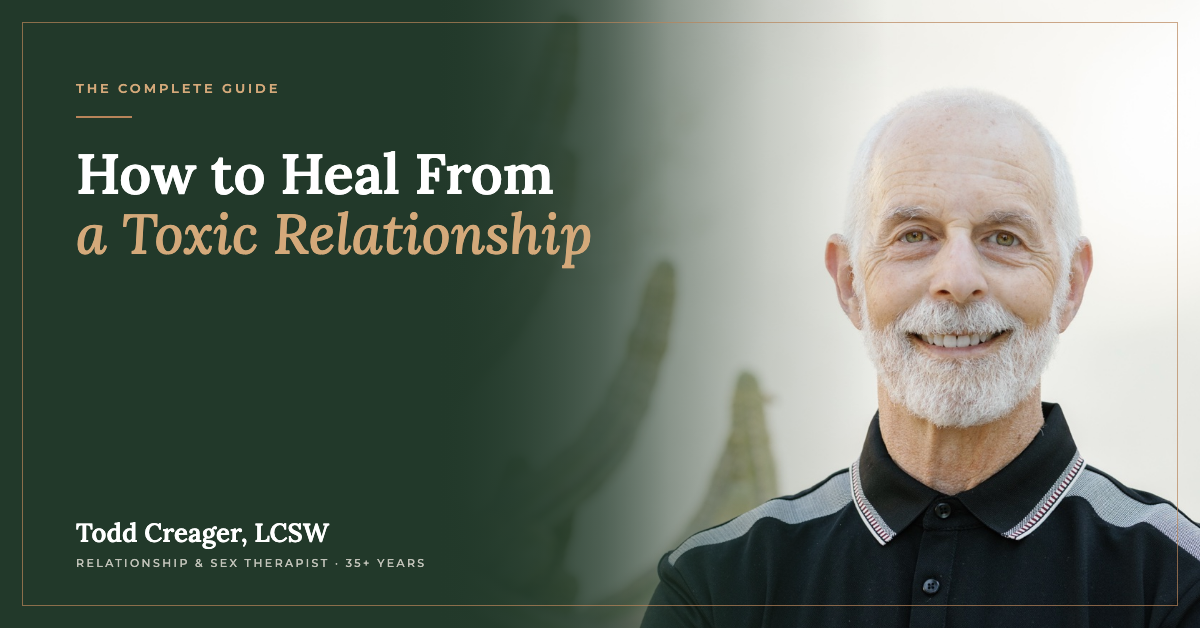

How to Heal From a Toxic Relationship

How to Heal From a Toxic Relationship

Picture of Todd Creager

Todd Creager

Todd Creager, LCSW, LMFT, is a marriage, relationship and sex therapist who helps couples heal from infidelity, betrayal and years of disconnection, so they can build a long, hot marriage instead of ending one.

35+ years in practice. Certified EMDR therapist. Adjunct lecturer, USC School of Social Work. Bestselling author of The Long, Hot Marriage and Love, Sex and Karaoke. Married, happily, for a long time.

Learn more about Todd: https://toddcreager.com/about/

Ready to talk? See how Todd works with couples and individuals or reach out for a 20-minute phone consult.

KEY TAKEAWAYS

If you suspect a relationship in your life is toxic, here’s what’s actually true about healing from a toxic relationship:

  • Toxic relationships often don’t announce themselves — they erode a person’s sense of reality gradually, which is exactly what makes them so hard to see from inside.
  • Gaslighting, narcissistic dynamics, and trauma bonding are distinct patterns, but they share a common thread: they make the person being harmed doubt their own perception.
  • Toxic patterns can come from a partner, a parent, or another close relationship — the dynamics and the healing process are strikingly similar across all three.
  • Healing is possible, but it usually requires outside support, because the same distorted perception that got someone into the relationship makes it hard to fully see clearly from inside.

Hi — I’m Todd Creager. “Is this actually toxic, or am I overreacting?” is one of the most common questions I hear from people trying to make sense of a painful relationship — with a partner, a parent, or sometimes both. The fact that you’re asking the question is often itself meaningful.

In more than 35 years of this work, I’ve helped people recognize and heal from toxic dynamics in every kind of close relationship. This page walks through the real signs, why these patterns are so disorienting, and how recovery actually happens.

Why Toxic Relationships Are So Hard to See From the Inside

Toxic dynamics rarely look dramatic from the start. They build gradually — a comment here, a boundary crossed there, small enough each time that leaving or even naming it feels like an overreaction. By the time the pattern is undeniable, someone’s sense of what’s normal has often already shifted.

This is what makes gaslighting in particular so effective and so damaging — it works specifically by making a person doubt their own perception and memory of events. Over time, the person on the receiving end starts to default to the other person’s version of reality rather than trusting their own.

What most people don’t expect: the confusion itself — that persistent “am I crazy or is this real” feeling — is often the clearest sign something toxic is happening. Healthy relationships, even difficult ones, don’t usually leave you doubting your own grip on reality this consistently.

The Patterns Worth Knowing — Gaslighting, Narcissism, and Trauma Bonds

Gaslighting is a pattern of denying, minimizing, or distorting someone’s experience until they stop trusting their own perception. It can be subtle — “that never happened” or “you’re too sensitive” — repeated often enough that it reshapes how someone sees reality.

Narcissistic relationship dynamics involve one person’s needs, feelings, and version of events consistently taking priority, with genuine empathy for the other person largely absent, especially when it’s inconvenient. This isn’t the same as someone being self-centered occasionally — it’s a consistent pattern.

Trauma bonding is the confusing, powerful attachment that forms in a relationship with intermittent kindness and harm — the cycle of hurt followed by warmth actually strengthens the bond rather than weakening it, which is part of why leaving toxic relationships is so much harder than outsiders assume.

These patterns show up not just in romantic relationships but in families — and the same recognition and healing process applies whether the source is a partner or a parent.

How Recovery Actually Works

Recovery usually starts with re-establishing trust in your own perception — learning to trust what you saw, felt, and remembered, even when it was consistently denied or minimized. This is often the single hardest and most important step.

Setting boundaries comes next, and it’s rarely a one-time conversation — it’s an ongoing practice, especially with a parent or family member you can’t simply walk away from the way you might a romantic partner. Boundaries in these cases are about protecting yourself while staying in relationship, which is genuinely harder than a clean break.

What most people don’t realize: healing from a toxic relationship almost always benefits from outside support, precisely because the distorted perception that developed inside the relationship makes it difficult to fully see clearly without help from someone outside it.

What to Do Next

If you’re trying to make sense of a relationship right now, here’s where to start:

  • Notice if you regularly doubt your own memory or perception after interactions with this person — that’s a meaningful signal, not an overreaction.
  • Start keeping a private record of specific incidents, in your own words, to counter the effect of having your reality repeatedly denied.
  • Consider whether this pattern shows up with a partner, a parent, or both — the recognition and healing process is similar either way.
  • Reach out for support sooner rather than later — outside perspective is often what makes clarity possible.

Your first step: grab my free guide to recognizing the signs, so you have language for what you’re experiencing.

You’re not overreacting, and you’re not imagining it. Healing from a toxic relationship, whatever form it takes, is possible — and you don’t have to sort through it alone. I offer therapy in my Huntington Beach office and virtually, anywhere. Book a free consultation.
Feeling like you might be the victim of verbal abuse and/or gaslighting?

Frequently Asked Questions

Q: How do I know if my relationship is toxic?

A: A key sign is regularly doubting your own memory or perception after interactions with this person. Toxic relationships often build gradually, so the persistent “am I overreacting” feeling is itself meaningful, not evidence you’re wrong.

Q: What are the signs of gaslighting?

A: Gaslighting involves someone consistently denying, minimizing, or distorting your experience — phrases like “that never happened” or “you’re too sensitive” repeated until you stop trusting your own perception of events.

Q: Can family relationships be toxic, not just romantic ones?

A: Yes. Toxic dynamics, including gaslighting and narcissistic patterns, show up in family relationships just as often as romantic ones, and the recognition and healing process is strikingly similar.

Q: Why is it so hard to leave a toxic relationship?

A: Trauma bonding is a major factor — the cycle of harm followed by intermittent kindness actually strengthens the emotional attachment rather than weakening it, which is why leaving is far harder than outsiders often assume.
How to Heal From a Toxic Relationship

How to Heal From a Toxic Relationship

KEY TAKEAWAYS

If you suspect a relationship in your life is toxic, here’s what’s actually true about healing from a toxic relationship:

  • Toxic relationships often don’t announce themselves — they erode a person’s sense of reality gradually, which is exactly what makes them so hard to see from inside.
  • Gaslighting, narcissistic dynamics, and trauma bonding are distinct patterns, but they share a common thread: they make the person being harmed doubt their own perception.
  • Toxic patterns can come from a partner, a parent, or another close relationship — the dynamics and the healing process are strikingly similar across all three.
  • Healing is possible, but it usually requires outside support, because the same distorted perception that got someone into the relationship makes it hard to fully see clearly from inside.

Hi — I’m Todd Creager. “Is this actually toxic, or am I overreacting?” is one of the most common questions I hear from people trying to make sense of a painful relationship — with a partner, a parent, or sometimes both. The fact that you’re asking the question is often itself meaningful.

In more than 35 years of this work, I’ve helped people recognize and heal from toxic dynamics in every kind of close relationship. This page walks through the real signs, why these patterns are so disorienting, and how recovery actually happens.

Why Toxic Relationships Are So Hard to See From the Inside

Toxic dynamics rarely look dramatic from the start. They build gradually — a comment here, a boundary crossed there, small enough each time that leaving or even naming it feels like an overreaction. By the time the pattern is undeniable, someone’s sense of what’s normal has often already shifted.

This is what makes gaslighting in particular so effective and so damaging — it works specifically by making a person doubt their own perception and memory of events. Over time, the person on the receiving end starts to default to the other person’s version of reality rather than trusting their own.

What most people don’t expect: the confusion itself — that persistent “am I crazy or is this real” feeling — is often the clearest sign something toxic is happening. Healthy relationships, even difficult ones, don’t usually leave you doubting your own grip on reality this consistently.

The Patterns Worth Knowing — Gaslighting, Narcissism, and Trauma Bonds

Gaslighting is a pattern of denying, minimizing, or distorting someone’s experience until they stop trusting their own perception. It can be subtle — “that never happened” or “you’re too sensitive” — repeated often enough that it reshapes how someone sees reality.

Narcissistic relationship dynamics involve one person’s needs, feelings, and version of events consistently taking priority, with genuine empathy for the other person largely absent, especially when it’s inconvenient. This isn’t the same as someone being self-centered occasionally — it’s a consistent pattern.

Trauma bonding is the confusing, powerful attachment that forms in a relationship with intermittent kindness and harm — the cycle of hurt followed by warmth actually strengthens the bond rather than weakening it, which is part of why leaving toxic relationships is so much harder than outsiders assume.

These patterns show up not just in romantic relationships but in families — and the same recognition and healing process applies whether the source is a partner or a parent.

How Recovery Actually Works

Recovery usually starts with re-establishing trust in your own perception — learning to trust what you saw, felt, and remembered, even when it was consistently denied or minimized. This is often the single hardest and most important step.

Setting boundaries comes next, and it’s rarely a one-time conversation — it’s an ongoing practice, especially with a parent or family member you can’t simply walk away from the way you might a romantic partner. Boundaries in these cases are about protecting yourself while staying in relationship, which is genuinely harder than a clean break.

What most people don’t realize: healing from a toxic relationship almost always benefits from outside support, precisely because the distorted perception that developed inside the relationship makes it difficult to fully see clearly without help from someone outside it.

What to Do Next

If you’re trying to make sense of a relationship right now, here’s where to start:

  • Notice if you regularly doubt your own memory or perception after interactions with this person — that’s a meaningful signal, not an overreaction.
  • Start keeping a private record of specific incidents, in your own words, to counter the effect of having your reality repeatedly denied.
  • Consider whether this pattern shows up with a partner, a parent, or both — the recognition and healing process is similar either way.
  • Reach out for support sooner rather than later — outside perspective is often what makes clarity possible.

Your first step: grab my free guide to recognizing the signs, so you have language for what you’re experiencing.

You’re not overreacting, and you’re not imagining it. Healing from a toxic relationship, whatever form it takes, is possible — and you don’t have to sort through it alone. I offer therapy in my Huntington Beach office and virtually, anywhere. Book a free consultation.

Feeling like you might be the victim of verbal abuse and/or gaslighting?

Frequently Asked Questions

Q: How do I know if my relationship is toxic?

A: A key sign is regularly doubting your own memory or perception after interactions with this person. Toxic relationships often build gradually, so the persistent “am I overreacting” feeling is itself meaningful, not evidence you’re wrong.

Q: What are the signs of gaslighting?

A: Gaslighting involves someone consistently denying, minimizing, or distorting your experience — phrases like “that never happened” or “you’re too sensitive” repeated until you stop trusting your own perception of events.

Q: Can family relationships be toxic, not just romantic ones?

A: Yes. Toxic dynamics, including gaslighting and narcissistic patterns, show up in family relationships just as often as romantic ones, and the recognition and healing process is strikingly similar.

Q: Why is it so hard to leave a toxic relationship?

A: Trauma bonding is a major factor — the cycle of harm followed by intermittent kindness actually strengthens the emotional attachment rather than weakening it, which is why leaving is far harder than outsiders often assume.
Reader Interactions

Leave a Reply

Your email address will not be published. Required fields are marked *