
Key Takeaways
Somatic triggers in relationships show up in your body before your thinking mind catches up.
- Parts of you speak through physical sensation first: a stomach that drops, a jaw that clenches, tightness across the chest.
- Most couple fights are protective parts reacting to protective parts, which is why an argument escalates in seconds with neither person choosing it.
- Pausing for thirty seconds before a hard conversation and naming where you feel something is the difference between a part running the conversation and you being present for it.
- Seeing a reaction as a younger part rather than a verdict on the relationship stops it from being evidence that something is wrong with you.
Your partner hasn’t finished a sentence yet, and your stomach has already dropped. Or your jaw has clenched. Or there’s a tightness across your chest that wasn’t there ten seconds ago.
That’s not stress. That’s a part of you communicating through your body before your thinking mind ever gets involved.
Somatic triggers in relationships are one of the most missed pieces of couples work I see. Most couples I sit with have no idea it’s happening. They’re reacting to each other’s reactions, and by the time anyone has words for it, the fight is three minutes old.
Here’s what your body is reporting, why couples escalate so fast, and the thirty-second practice that gives you back a choice.
What Somatic Triggers in Relationships Actually Are
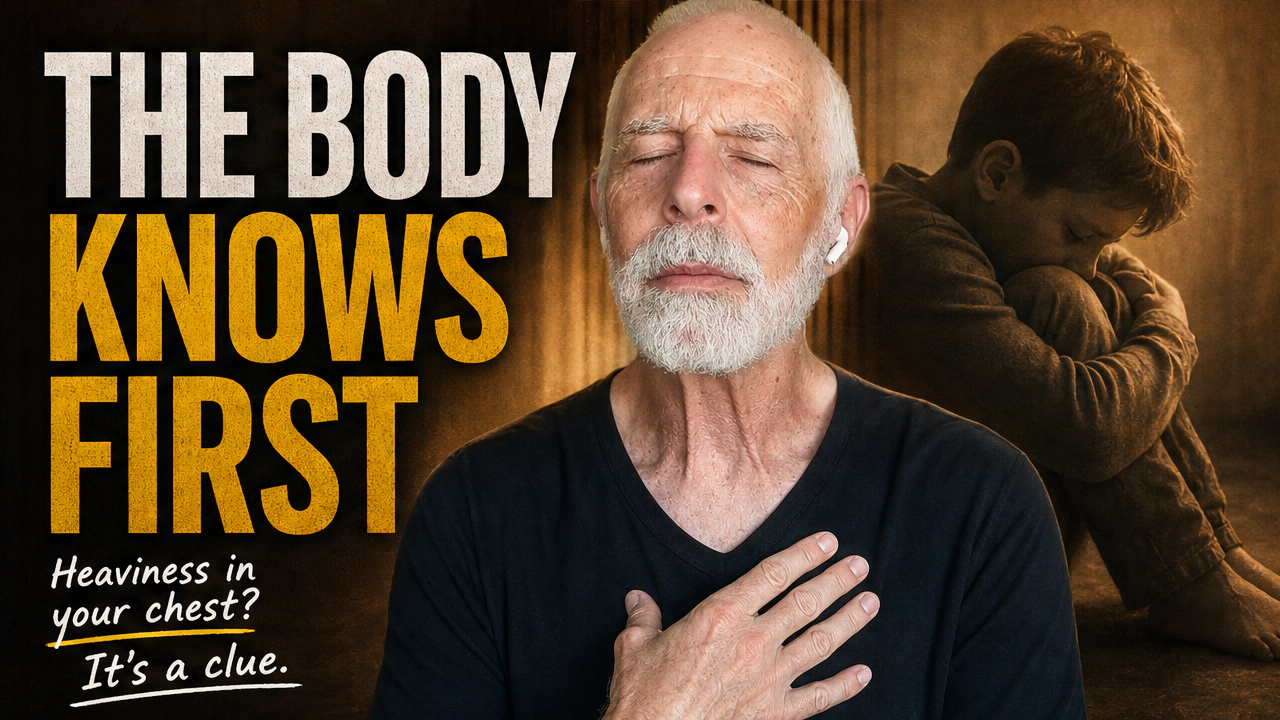
A somatic trigger in a relationship is a physical sensation — tightness, heat, heaviness, numbness — that signals a protective or wounded part of you has been activated by something your partner said or did, before your conscious mind has processed a word of it.
Parts don’t only show up as thoughts or emotions. They show up in the body, and they’re faster than you are.
A protector can tighten your shoulders and cross your arms before you’ve registered what your partner said. A firefighter — the part whose job is to put out the emotional fire right now, by any means available — can flood you with the urge to leave the room or grab your phone before you’ve decided anything. An exile, meaning a wounded younger part of you that got touched, can drop a heaviness into your chest that makes you feel small and helpless in a way that doesn’t match the moment.
That mismatch is the tell. When the size of the sensation doesn’t fit what just happened, you’re not responding to your partner. You’re responding to something older, and your partner happens to be standing in the room.
What most people do instead is argue about the content — who said what, what was meant, what was implied. I’ve watched couples spend a whole session litigating a sentence when the real information showed up in one of their chests before the sentence ended.
Why Couples Escalate in Seconds
Two nervous systems are reacting to each other faster than either person can think, and that’s the whole mechanism.
My protective parts, which are trying to protect my wounded parts, are interacting with your protective parts, which are trying to protect yours. Nobody is choosing any of it. It’s quick, and the whole thing escalates in seconds.
I say this to couples all the time when they come out of one of these fights and ask, “Why are we doing this? What’s wrong with us? Maybe we shouldn’t be together.” That’s not really it. Not every couple is destined to be together, but many break up because they never understood this piece — they have parts getting activated, and they’re reading the activation as evidence about the relationship.
This is also why better communication skills run out so fast. You can hand a couple better sentences, and they help right up until a part gets activated — then the part is driving and the technique is a passenger. If the same fight keeps arriving in the same shape no matter how carefully you word things, that’s a parts problem rather than a communication problem. If your fights are about differing wants, needs and logistics, better conversation skills will help. Two different situations, two different kinds of work.
Once a couple can notice it’s a part of me, not all of me — and can see where that part came from, and take care of it differently, and start to recognize their partner’s parts too — everything shifts.
The Thirty-Second Pause That Gives You Back a Choice
Before your most difficult conversation, pause for thirty seconds and notice where you feel something. Tightness, heat, heaviness, numbness. You don’t have to understand it. Just name it: something clenched in my chest.
That’s you observing a part rather than being it.
The gap between a part activating and you seeing it is small, and it’s the whole thing. When you can feel the part in your body before it takes over your mouth, you have a choice you didn’t have before — and so does your partner.
Naming doesn’t require accuracy, which is what trips people up. Clients want the label right before they’ll say anything, and that’s the thinking mind trying to take the job back. “There’s heat in my face” is enough. You’re not diagnosing. You’re creating half a second of distance from something that’s been running you.
What the practice will not do is stop the sensation from arriving. Parts don’t retire because you noticed them. They show up on schedule, and the change is in what happens next — whether the tightness becomes a raised voice or becomes information.
The couples who get the most from this do it before the hard conversation rather than during it. Once you’re activated, your protectors are much less interested in being observed.
When a Younger Part Hasn’t Updated
Sometimes the part reacting to your relationship is responding to a version of it that no longer exists.
A couple I saw yesterday was leaving on a trip out of the country. They’ve been together three or four years. She travels with a particular friend regularly and it’s never a problem, but this trip was with her partner and a few of his family members, and she was anxious.
We traced it to the year before. They’d gone through real conflict, and right before they could resolve it they got on a plane, and she had a panic attack in the air. She was afraid of it happening again.
What she said to him was, “I’m afraid. I don’t know why. I don’t want to ruin it for you.” He was kind about it. As I sat back and watched, I could see it in her face and her body. Anxiety. A lot of distrust.
What came out was that she’d been abandoned before by people she really counted on. The friend she travels with isn’t that important to her. Her boyfriend is as important as the people who didn’t come through, so a much younger part was getting activated. It hadn’t updated. Their relationship is better than a year ago and she’s safer in it, but the young part hadn’t gotten the news.
The trip made her vulnerable for a practical reason. At home, when she gets upset, she picks up her stuff and goes back to her apartment. On vacation she couldn’t, which made it claustrophobic. What if I have this reaction and I have no escape?
Here’s what shifted in the session. He could see it as a younger part and stop taking it personally, so it stopped meaning anything about whether she wanted to be with him. And she got some control back, because now when she’s about to grab her things and leave, she has somewhere else to take it: what is that part of me?
What To Do Next
Run the thirty-second scan before the conversation you’ve been dreading. Not during. Find where in your body something is happening.
Name it out loud, in plain words. “My chest is tight.” “My stomach dropped.” Skip the interpretation. The naming is the work.
Check the size. If the intensity doesn’t match what happened, ask how old the feeling is. A part that feels five years old got activated by something older than your partner.
Tell your partner what your body did, rather than what they did wrong. “Something clenched in my chest when you said that” gives you both somewhere to go. “You always do this” gives you a fight.
Start with the first one this week. One conversation, thirty seconds beforehand. If the same reactions keep arriving and neither of you can get underneath them, sit down with someone who works this way.
Somatic triggers in relationships aren’t a sign that you’re broken or that your relationship is wrong for you. Your body knows things quicker than your conscious mind does. That is for sure, and that’s human.
The couples who learn to read that signal stop reacting to each other’s reactions and start responding to what’s there. If that’s the work you want, reach out and we’ll talk about what it would look like for you two.
This is Todd Creager, making the world safe for love.
If you want help reading these signals in your own relationship, reach out to schedule a session and we’ll look at what your body has been telling you.

What if your next argument could bring you closer instead of driving you apart?
Learn how in Todd Creager’s Loving & Connecting Masterclass.
Lifetime access. Real results.
Frequently Asked Questions
Q: Why does my body react before I even know what my partner said? A: Protective parts operate faster than conscious thought. They pick up tone, facial expression and pacing and respond physically — tight shoulders, crossed arms, a dropped stomach — before your thinking mind has processed the content. The sensation isn’t an overreaction. It’s early information.
Q: What’s the difference between a somatic trigger and ordinary stress? A: Ordinary stress fits the situation in size and fades when it resolves. A somatic trigger tends to be out of proportion to what happened, and carries a younger quality with it — feeling small, helpless, a version of yourself that doesn’t match your age.
Q: Does noticing a part make the reaction stop? A: No, and expecting that sets you up to feel like it isn’t working. Parts keep showing up. What changes is the gap between the sensation arriving and you acting on it, which is where your choices live.
Q: Is a reactive fight a sign we shouldn’t be together? A: Usually not. Many couples separate because they never understood that their parts were getting activated and read the reactivity as a verdict on the relationship. Reactive fights signal that wounded parts are in the room, and that is workable.

Reader Interactions