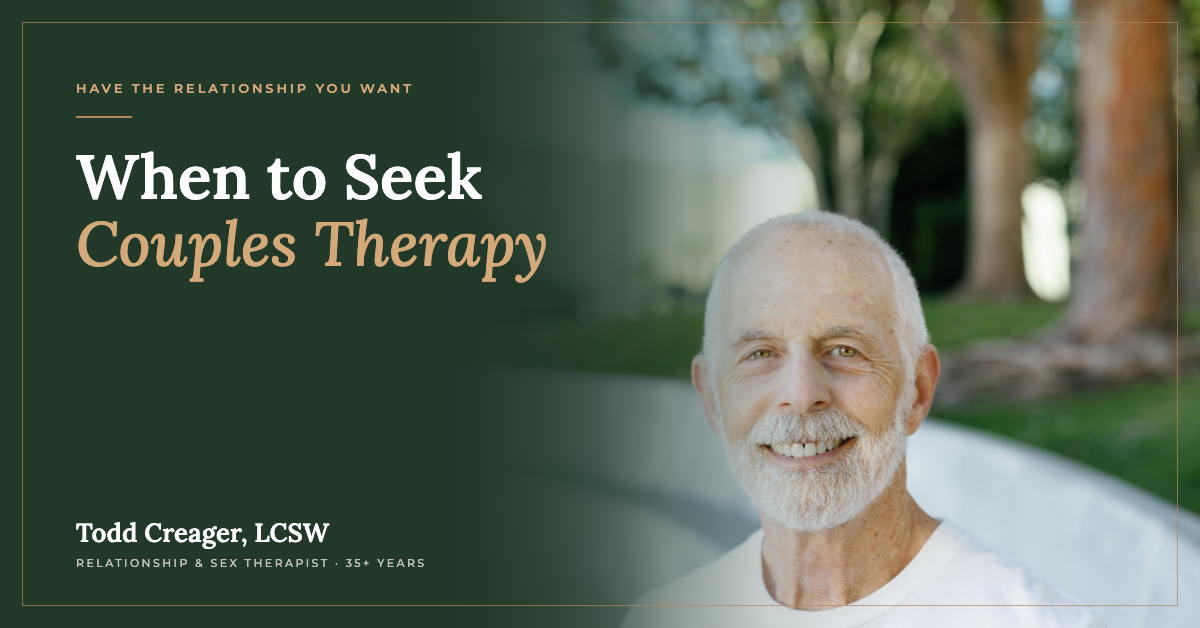

When to Seek Couples Therapy

When to Seek Couples Therapy

Picture of Todd Creager

Todd Creager

Todd Creager, LCSW, LMFT, is a marriage, relationship and sex therapist who helps couples heal from infidelity, betrayal and years of disconnection, so they can build a long, hot marriage instead of ending one.

35+ years in practice. Certified EMDR therapist. Adjunct lecturer, USC School of Social Work. Bestselling author of The Long, Hot Marriage and Love, Sex and Karaoke. Married, happily, for a long time.

Learn more about Todd: https://toddcreager.com/about/

Ready to talk? See how Todd works with couples and individuals or reach out for a 20-minute phone consult.

KEY TAKEAWAYS

Most couples wait far longer than they need to before getting help. Here’s what’s worth acting on:

  • The same argument resurfacing repeatedly without resolution is one of the clearest signs it’s time for outside support.
  • Couples typically wait an average of six years after problems begin before seeking therapy — far longer than necessary.
  • Waiting doesn’t just delay help, it makes the underlying patterns more entrenched and harder to unwind.
  • Couples therapy isn’t only for crises — it’s just as effective, often more so, for couples who want to strengthen an already decent relationship.

“Is it too small a problem for therapy?” I get some version of this question constantly, usually from couples who’ve already been struggling for a while. I’m Todd Creager, and after 35 years of this work, my honest answer is almost always the same: if you’re asking the question, it’s probably time.

The Signs Couples Wait Too Long to Notice

The clearest sign is a repeating argument — the same disagreement resurfacing again and again without ever actually resolving. If you can predict exactly how your next fight about this topic will go, that’s a pattern that needs outside help to break, not more attempts to solve it the same way.

Other signs: one or both partners have stopped bringing up concerns at all, which usually isn’t peace — it’s resignation. A gradual loss of physical or emotional intimacy that neither partner has directly addressed. Or simply a persistent sense of loneliness inside the relationship, even when nothing is dramatically wrong.

What most people don’t expect: an affair, a major betrayal, or a single dramatic event is often not what actually brings couples into therapy first. More often, it’s the accumulation of smaller, unaddressed patterns — the dramatic event is usually just what finally makes them act.

Why Couples Wait — and Why Waiting Makes It Harder

Research on this is fairly consistent: couples wait an average of around six years after problems begin before seeking help. Most tell me they hoped it would resolve on its own, or worried therapy meant admitting the relationship was failing.

In my experience, waiting doesn’t just delay help — it lets the patterns become more automatic and harder to interrupt. A communication habit that’s six months old is far easier to shift than one that’s been running for six years.

There’s also a common misconception that therapy is a last resort before divorce. In practice, some of the couples who benefit the most are the ones who come in while things are still fundamentally good, wanting to build something even stronger rather than repair something badly broken.

What Couples Therapy Actually Does

Good couples therapy isn’t a referee assigning blame. It’s a structured space to actually see the patterns you’re both caught in — patterns that are often invisible from inside the relationship, no matter how self-aware either partner is individually.

It gives both partners a chance to be heard in a way that’s hard to replicate at home, where old grooves in a conversation tend to pull things back to the same place. A skilled therapist interrupts those grooves and helps build new ones.

And it works regardless of how serious things are — I’ve helped couples in acute crisis and couples who simply wanted their good relationship to become a great one. The tools are largely the same; only the starting point differs.

What to Do Next

If any of this sounds familiar, here’s how to think about next steps:

  • Notice if you’re having the same argument on repeat — that’s a strong signal outside support would help.
  • Don’t wait for a dramatic event to justify getting help — the accumulation of smaller patterns is reason enough.
  • Talk to your partner about therapy as building something stronger, not admitting failure.
  • If you’re both curious but hesitant, a single consultation is a low-pressure way to see what it’s actually like.

Your first step: book a free consultation — no commitment required to simply talk through where things stand.

You don’t need a crisis to justify getting support, and waiting rarely makes things easier. I offer couples therapy in my Huntington Beach office and virtually, anywhere. For the bigger picture on building a lasting connection, my complete guide walks through the core skills.

Frequently Asked Questions

Q: How do I know if we need couples therapy?

A: A repeating argument that never resolves, a partner who’s stopped raising concerns, fading intimacy, or a general sense of loneliness in the relationship are all strong signs it’s worth exploring, even without a dramatic crisis.

Q: How long do most couples wait before seeking therapy?

A: Research suggests couples typically wait around six years after problems begin before seeking help — far longer than necessary, and long enough for patterns to become significantly more entrenched.

Q: Is couples therapy only for relationships in crisis?

A: No. Many couples who benefit most come in while the relationship is still fundamentally good, wanting to strengthen it further rather than repair something badly broken.

Q: What actually happens in couples therapy?

A: A skilled therapist helps both partners see patterns that are often invisible from inside the relationship, and interrupts old conversational grooves so new, healthier ones can form.

When to Seek Couples Therapy

When to Seek Couples Therapy

KEY TAKEAWAYS

Most couples wait far longer than they need to before getting help. Here’s what’s worth acting on:

  • The same argument resurfacing repeatedly without resolution is one of the clearest signs it’s time for outside support.
  • Couples typically wait an average of six years after problems begin before seeking therapy — far longer than necessary.
  • Waiting doesn’t just delay help, it makes the underlying patterns more entrenched and harder to unwind.
  • Couples therapy isn’t only for crises — it’s just as effective, often more so, for couples who want to strengthen an already decent relationship.

“Is it too small a problem for therapy?” I get some version of this question constantly, usually from couples who’ve already been struggling for a while. I’m Todd Creager, and after 35 years of this work, my honest answer is almost always the same: if you’re asking the question, it’s probably time.

The Signs Couples Wait Too Long to Notice

The clearest sign is a repeating argument — the same disagreement resurfacing again and again without ever actually resolving. If you can predict exactly how your next fight about this topic will go, that’s a pattern that needs outside help to break, not more attempts to solve it the same way.

Other signs: one or both partners have stopped bringing up concerns at all, which usually isn’t peace — it’s resignation. A gradual loss of physical or emotional intimacy that neither partner has directly addressed. Or simply a persistent sense of loneliness inside the relationship, even when nothing is dramatically wrong.

What most people don’t expect: an affair, a major betrayal, or a single dramatic event is often not what actually brings couples into therapy first. More often, it’s the accumulation of smaller, unaddressed patterns — the dramatic event is usually just what finally makes them act.

Why Couples Wait — and Why Waiting Makes It Harder

Research on this is fairly consistent: couples wait an average of around six years after problems begin before seeking help. Most tell me they hoped it would resolve on its own, or worried therapy meant admitting the relationship was failing.

In my experience, waiting doesn’t just delay help — it lets the patterns become more automatic and harder to interrupt. A communication habit that’s six months old is far easier to shift than one that’s been running for six years.

There’s also a common misconception that therapy is a last resort before divorce. In practice, some of the couples who benefit the most are the ones who come in while things are still fundamentally good, wanting to build something even stronger rather than repair something badly broken.

What Couples Therapy Actually Does

Good couples therapy isn’t a referee assigning blame. It’s a structured space to actually see the patterns you’re both caught in — patterns that are often invisible from inside the relationship, no matter how self-aware either partner is individually.

It gives both partners a chance to be heard in a way that’s hard to replicate at home, where old grooves in a conversation tend to pull things back to the same place. A skilled therapist interrupts those grooves and helps build new ones.

And it works regardless of how serious things are — I’ve helped couples in acute crisis and couples who simply wanted their good relationship to become a great one. The tools are largely the same; only the starting point differs.

What to Do Next

If any of this sounds familiar, here’s how to think about next steps:

  • Notice if you’re having the same argument on repeat — that’s a strong signal outside support would help.
  • Don’t wait for a dramatic event to justify getting help — the accumulation of smaller patterns is reason enough.
  • Talk to your partner about therapy as building something stronger, not admitting failure.
  • If you’re both curious but hesitant, a single consultation is a low-pressure way to see what it’s actually like.

Your first step: book a free consultation — no commitment required to simply talk through where things stand.

You don’t need a crisis to justify getting support, and waiting rarely makes things easier. I offer couples therapy in my Huntington Beach office and virtually, anywhere. For the bigger picture on building a lasting connection, my complete guide walks through the core skills.

Frequently Asked Questions

Q: How do I know if we need couples therapy?

A: A repeating argument that never resolves, a partner who’s stopped raising concerns, fading intimacy, or a general sense of loneliness in the relationship are all strong signs it’s worth exploring, even without a dramatic crisis.

Q: How long do most couples wait before seeking therapy?

A: Research suggests couples typically wait around six years after problems begin before seeking help — far longer than necessary, and long enough for patterns to become significantly more entrenched.

Q: Is couples therapy only for relationships in crisis?

A: No. Many couples who benefit most come in while the relationship is still fundamentally good, wanting to strengthen it further rather than repair something badly broken.

Q: What actually happens in couples therapy?

A: A skilled therapist helps both partners see patterns that are often invisible from inside the relationship, and interrupts old conversational grooves so new, healthier ones can form.

Reader Interactions

Leave a Reply

Your email address will not be published. Required fields are marked *