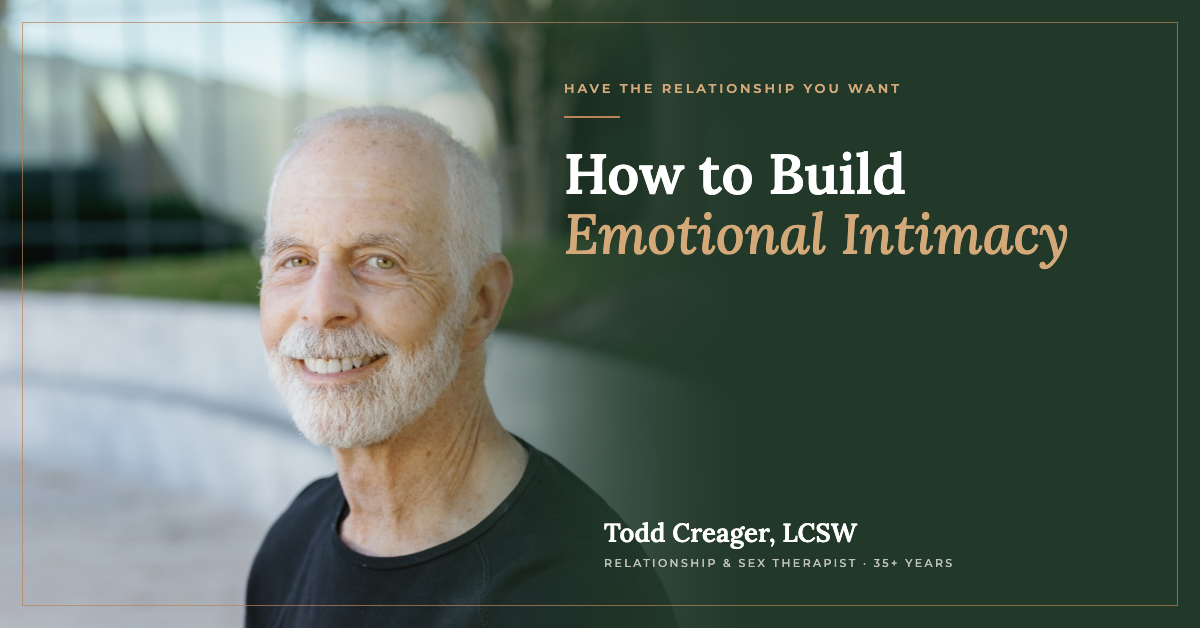

How to Build Emotional Intimacy

How to Build Emotional Intimacy

Picture of Todd Creager

Todd Creager

Todd Creager, LCSW, LMFT, is a marriage, relationship and sex therapist who helps couples heal from infidelity, betrayal and years of disconnection, so they can build a long, hot marriage instead of ending one.

35+ years in practice. Certified EMDR therapist. Adjunct lecturer, USC School of Social Work. Bestselling author of The Long, Hot Marriage and Love, Sex and Karaoke. Married, happily, for a long time.

Learn more about Todd: https://toddcreager.com/about/

Ready to talk? See how Todd works with couples and individuals or reach out for a 20-minute phone consult.

KEY TAKEAWAYS

Emotional intimacy isn’t a feeling that either exists or doesn’t — it’s a practice. Here’s what that actually means:

  • Emotional intimacy is knowing your partner’s inner world — their fears, hopes, and daily experience — not just living efficiently alongside them.
  • It fades gradually, through busyness and routine, almost never through one dramatic event.
  • Emotional intimacy is rebuilt through small, consistent moments of curiosity, not one big romantic gesture.
  • It’s never too late to rebuild it, even after years of drift — the process looks the same at any stage.

“We’re not fighting. We’re just not close anymore.” I hear some version of this constantly, and it’s often harder to address than an actual conflict, because there’s no clear moment to point to. I’m Todd Creager, and I want to walk through what emotional intimacy actually is, why it fades so quietly, and how to rebuild it — even if it’s been years.

What Emotional Intimacy Actually Is — and Isn’t

Emotional intimacy is genuinely knowing your partner’s inner world — what they’re afraid of right now, what they’re proud of, what’s actually on their mind, not just the logistics of a shared life. It’s different from simply being efficient partners who run a household well together.

Couples often mistake proximity for intimacy. You can be in the same room every night, handling the same responsibilities, and still not actually know what’s happening inside your partner. That gap is invisible day to day and enormous over years.

What surprises people most: emotional intimacy and sexual intimacy are deeply linked, but they’re not the same thing, and one doesn’t automatically restore the other. Many couples try to fix distance through physical connection alone, without addressing the emotional gap underneath — and wonder why it doesn’t stick.

Why Emotional Intimacy Fades in Long Relationships

It rarely fades because of one dramatic event. It fades because life gets full — kids, work, logistics — and the ordinary, unscheduled conversations that used to happen naturally simply stop happening. Nobody decides to stop being close. It just stops being prioritized.

Routine plays a role too. Long-term partners can predict each other so well that they stop actually asking, because they assume they already know the answer. That assumption, more than any conflict, is often what creates the real distance.

What most couples don’t realize is that emotional intimacy requires ongoing curiosity, even after decades together — your partner is not a fixed, fully-known person. They’re changing, the same as you are, and intimacy depends on continuing to actually find that out.

How to Rebuild It, Even If It’s Been Years

Rebuilding emotional intimacy doesn’t require a dramatic reset — it requires small, consistent moments of genuine curiosity. Ask a question you don’t already know the answer to. Share something you haven’t mentioned yet, even something small.

A structure that works well: set aside 10 minutes, phones away, and ask one real question — not “how was your day” but “what’s been on your mind lately that we haven’t talked about?” The specificity matters; vague questions get vague answers.

It’s genuinely never too late to start this, whether it’s been months or decades. I’ve watched couples in their 60s and 70s rebuild a closeness they’d assumed was permanently gone — the process looks the same at any stage, it just takes consistency more than any single big gesture.

What to Do Next

This week, try building one moment of real emotional intimacy:

  • Set aside 10 minutes, phones away, and ask a question you genuinely don’t know the answer to.
  • Share something on your mind that you haven’t mentioned yet, even something small.
  • Notice one assumption you’re making about your partner — and ask instead of assuming.
  • Do this consistently rather than as a one-time gesture — emotional intimacy is built through repetition.

Your first step: pick one night this week for a 10-minute, phones-away conversation with one real question.

Emotional intimacy isn’t something you either have or don’t — it’s something you keep building, at every stage of a relationship. For the fuller framework, my complete guide walks through what else strengthens a lasting connection.

For the habits that rebuild lasting connection, not just occasional closeness, grab my free guide, the 7 Keys to a Satisfying, Sexy Life.

Frequently Asked Questions

Q: What is emotional intimacy in a relationship?

A: Emotional intimacy is genuinely knowing your partner’s inner world — their fears, hopes, and daily experience — rather than just efficiently sharing logistics and routines together.

Q: Why do couples grow apart emotionally over time?

A: Usually through gradual busyness rather than one dramatic event — unscheduled, ordinary conversations stop happening as life gets full, and partners start assuming they already know each other instead of continuing to ask.

Q: Can emotional intimacy be rebuilt after years of distance?

A: Yes, at any stage. It’s rebuilt through small, consistent moments of genuine curiosity rather than one big gesture, and the process works the same whether it’s been months or decades.

Q: Is emotional intimacy the same as sexual intimacy?

A: No, though they’re closely linked. Many couples try to close emotional distance through physical connection alone, without success, because the emotional gap underneath needs its own attention.

How to Build Emotional Intimacy

How to Build Emotional Intimacy

KEY TAKEAWAYS

Emotional intimacy isn’t a feeling that either exists or doesn’t — it’s a practice. Here’s what that actually means:

  • Emotional intimacy is knowing your partner’s inner world — their fears, hopes, and daily experience — not just living efficiently alongside them.
  • It fades gradually, through busyness and routine, almost never through one dramatic event.
  • Emotional intimacy is rebuilt through small, consistent moments of curiosity, not one big romantic gesture.
  • It’s never too late to rebuild it, even after years of drift — the process looks the same at any stage.

“We’re not fighting. We’re just not close anymore.” I hear some version of this constantly, and it’s often harder to address than an actual conflict, because there’s no clear moment to point to. I’m Todd Creager, and I want to walk through what emotional intimacy actually is, why it fades so quietly, and how to rebuild it — even if it’s been years.

What Emotional Intimacy Actually Is — and Isn’t

Emotional intimacy is genuinely knowing your partner’s inner world — what they’re afraid of right now, what they’re proud of, what’s actually on their mind, not just the logistics of a shared life. It’s different from simply being efficient partners who run a household well together.

Couples often mistake proximity for intimacy. You can be in the same room every night, handling the same responsibilities, and still not actually know what’s happening inside your partner. That gap is invisible day to day and enormous over years.

What surprises people most: emotional intimacy and sexual intimacy are deeply linked, but they’re not the same thing, and one doesn’t automatically restore the other. Many couples try to fix distance through physical connection alone, without addressing the emotional gap underneath — and wonder why it doesn’t stick.

Why Emotional Intimacy Fades in Long Relationships

It rarely fades because of one dramatic event. It fades because life gets full — kids, work, logistics — and the ordinary, unscheduled conversations that used to happen naturally simply stop happening. Nobody decides to stop being close. It just stops being prioritized.

Routine plays a role too. Long-term partners can predict each other so well that they stop actually asking, because they assume they already know the answer. That assumption, more than any conflict, is often what creates the real distance.

What most couples don’t realize is that emotional intimacy requires ongoing curiosity, even after decades together — your partner is not a fixed, fully-known person. They’re changing, the same as you are, and intimacy depends on continuing to actually find that out.

How to Rebuild It, Even If It’s Been Years

Rebuilding emotional intimacy doesn’t require a dramatic reset — it requires small, consistent moments of genuine curiosity. Ask a question you don’t already know the answer to. Share something you haven’t mentioned yet, even something small.

A structure that works well: set aside 10 minutes, phones away, and ask one real question — not “how was your day” but “what’s been on your mind lately that we haven’t talked about?” The specificity matters; vague questions get vague answers.

It’s genuinely never too late to start this, whether it’s been months or decades. I’ve watched couples in their 60s and 70s rebuild a closeness they’d assumed was permanently gone — the process looks the same at any stage, it just takes consistency more than any single big gesture.

What to Do Next

This week, try building one moment of real emotional intimacy:

  • Set aside 10 minutes, phones away, and ask a question you genuinely don’t know the answer to.
  • Share something on your mind that you haven’t mentioned yet, even something small.
  • Notice one assumption you’re making about your partner — and ask instead of assuming.
  • Do this consistently rather than as a one-time gesture — emotional intimacy is built through repetition.

Your first step: pick one night this week for a 10-minute, phones-away conversation with one real question.

Emotional intimacy isn’t something you either have or don’t — it’s something you keep building, at every stage of a relationship. For the fuller framework, my complete guide walks through what else strengthens a lasting connection.

For the habits that rebuild lasting connection, not just occasional closeness, grab my free guide, the 7 Keys to a Satisfying, Sexy Life.

Frequently Asked Questions

Q: What is emotional intimacy in a relationship?

A: Emotional intimacy is genuinely knowing your partner’s inner world — their fears, hopes, and daily experience — rather than just efficiently sharing logistics and routines together.

Q: Why do couples grow apart emotionally over time?

A: Usually through gradual busyness rather than one dramatic event — unscheduled, ordinary conversations stop happening as life gets full, and partners start assuming they already know each other instead of continuing to ask.

Q: Can emotional intimacy be rebuilt after years of distance?

A: Yes, at any stage. It’s rebuilt through small, consistent moments of genuine curiosity rather than one big gesture, and the process works the same whether it’s been months or decades.

Q: Is emotional intimacy the same as sexual intimacy?

A: No, though they’re closely linked. Many couples try to close emotional distance through physical connection alone, without success, because the emotional gap underneath needs its own attention.

Reader Interactions

Leave a Reply

Your email address will not be published. Required fields are marked *