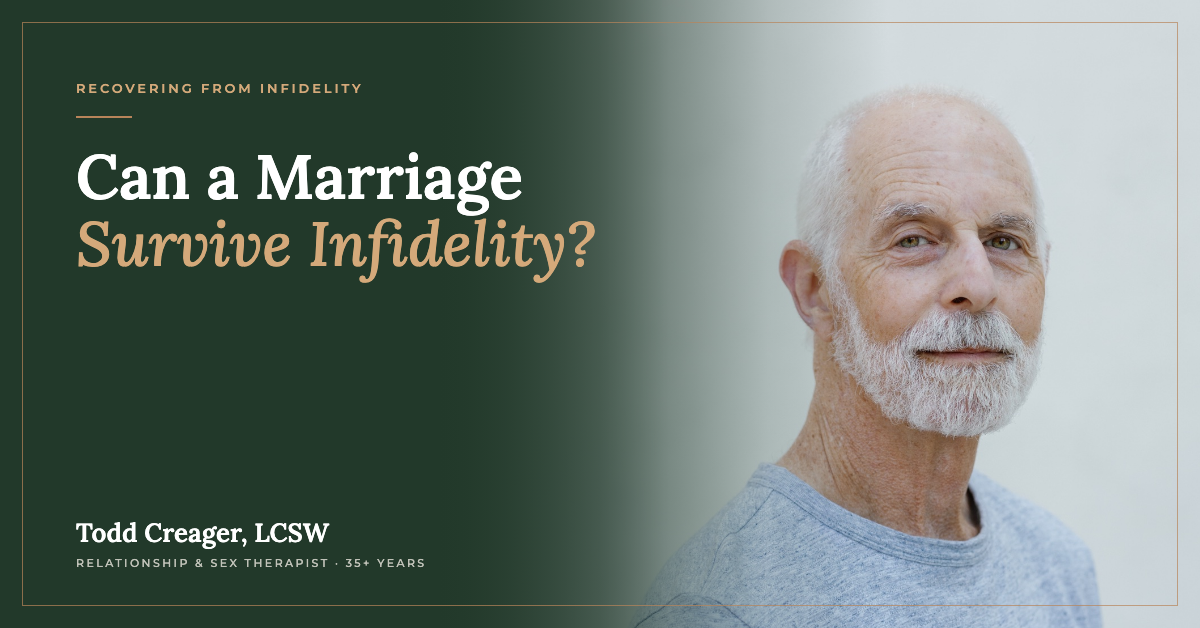

Can a Marriage Survive Infidelity? What 35 Years Shows

Can a Marriage Survive Infidelity? What 35 Years Shows

Picture of Todd Creager

Todd Creager

Todd Creager, LCSW, LMFT, is a marriage, relationship and sex therapist who helps couples heal from infidelity, betrayal and years of disconnection, so they can build a long, hot marriage instead of ending one.

35+ years in practice. Certified EMDR therapist. Adjunct lecturer, USC School of Social Work. Bestselling author of The Long, Hot Marriage and Love, Sex and Karaoke. Married, happily, for a long time.

Learn more about Todd: https://toddcreager.com/about/

Ready to talk? See how Todd works with couples and individuals or reach out for a 20-minute phone consult.

KEY TAKEAWAYS

If you’re asking whether your marriage can survive infidelity, here’s the honest, practitioner-level answer:

  • Most marriages CAN survive infidelity — in Todd Creager’s practice, about 90% of couples who commit to the recovery process stay together.
  • Survival isn’t about how bad the affair was. It’s about specific, learnable behaviors both partners take on afterward.
  • The affair is usually a symptom of something broken — in the relationship, in the partner who betrayed, or both — not a random event.
  • Couples who skip dealing with the pain in favor of quickly “moving on” tend to stall or relapse months later.

If you’re searching this at 1 a.m. with your stomach in a knot, I want to answer you directly before anything else: yes, marriages survive infidelity — often. I’m Todd Creager, and in more than 35 years of practice, roughly 90% of the couples who commit to the recovery process not only stay together, they build a relationship more honest than the one they had before the affair.

That number isn’t a guarantee for you specifically. But it isn’t a fluke either — there are real, observable reasons some couples make it and some don’t, and I want to walk you through exactly what separates them.

What the Couples Who Heal Actually Have in Common

The couples who survive infidelity aren’t the ones with the mildest affairs — they’re the ones who do specific things afterward, regardless of how serious the betrayal was.

After decades of watching this up close, the pattern is consistent. The partner who betrayed ends the affair completely and stays ended — no ambiguity, no “closure” contact. Both partners get curious about what the affair means for the relationship, rather than staying stuck in only defending or only attacking. The betrayed partner is allowed a long, nonlinear grief process without being rushed to “get over it.”

What most people miss is that healing isn’t about forgetting — it’s about both partners eventually stopping treating the affair as the only story of the marriage. It becomes a chapter, a hard one, not the whole book. Couples who reach that point describe it less like relief and more like finally exhaling.

The Affair Is a Symptom — Which Changes How You Read It

An affair is almost never really about the affair partner. It’s a symptom — of disconnection, of avoidance, of an escape from pain neither partner had language for yet. That doesn’t excuse it. But it changes what recovery actually needs to address.

I tell clients this often: understanding why doesn’t mean approving of what happened. It means you’re treating the affair as information as much as an injury — information that, read honestly, tells you what needs to change in the relationship or in the partner who betrayed. Couples who can eventually read that information without weaponizing it are the ones who turn crisis into change.

A few years ago, a couple came to me barely speaking, six weeks after discovery. She wanted him gone. He was terrified and defensive. By month four, they weren’t “over it” — nobody ever fully is — but they were having their first real conversations in a decade about what she needed from him at home, and what he’d been avoiding in himself for years. Eighteen months later, they told me it was the first time in their marriage either of them felt fully known. That’s what I mean when I say the affair can become the turning point rather than the ending.

Your First Three Steps If You’re Deciding Right Now

If you’re in the panic right now trying to figure out whether your marriage can survive this, here’s where to actually start.

One: don’t decide the future of the marriage this week — stabilize first. Two: get honest, together or separately, about what the affair might be revealing about the relationship. Three: get support — a therapist, a program, even a structured guide — rather than trying to navigate this blind.

The couples who regret their decisions later are almost always the ones who decided everything in week one, from a nervous system in crisis. The ones who end up okay — whichever way it goes — gave themselves real time first.

What to Do Next

Here’s exactly what to do in the next 24 hours if you’re trying to figure out whether to stay:

  • Write down one decision you will NOT make this week — filing, moving out for good, or announcing reconciliation.
  • Choose one or two safe people to talk to. Not the group chat.
  • Notice whether the affair partner is truly gone — no contact, no ambiguity.
  • Get a free structured resource in your hands today instead of guessing alone

Your first step: download the same 10-step checklist I give my private clients in crisis.

Your marriage surviving this isn’t promised. But it’s more possible than the panic in your chest is telling you right now — and knowing what actually predicts healing is the first step toward it.

For the full roadmap through every stage of recovery, my complete guide walks you through what comes next.
Frequently Asked Questions

Q: Can a marriage survive infidelity?

A: Yes, in most cases where both partners commit fully to the recovery process. Roughly 90% of couples who do this work in Todd Creager’s practice stay together and describe a stronger relationship than before.

Q: Does it matter how bad the affair was?

A: Less than people expect. Survival is determined more by what both partners do after discovery — ending contact fully, staying curious, doing the emotional work — than by the specifics of the betrayal itself.

Q: What percentage of couples stay together after an affair?

A: Estimates vary across studies, but in Todd Creager’s own 35+ years of practice, about 90% of couples who commit to structured recovery remain together.

Q: How do I know if my marriage can be saved?

A: Early signs include the affair being fully and verifiably over, genuine remorse rather than fear of consequences, and both partners willing to look honestly at what happened — not just move past it in silence.
Can a Marriage Survive Infidelity? What 35 Years Shows

Can a Marriage Survive Infidelity? What 35 Years Shows

KEY TAKEAWAYS

If you’re asking whether your marriage can survive infidelity, here’s the honest, practitioner-level answer:

  • Most marriages CAN survive infidelity — in Todd Creager’s practice, about 90% of couples who commit to the recovery process stay together.
  • Survival isn’t about how bad the affair was. It’s about specific, learnable behaviors both partners take on afterward.
  • The affair is usually a symptom of something broken — in the relationship, in the partner who betrayed, or both — not a random event.
  • Couples who skip dealing with the pain in favor of quickly “moving on” tend to stall or relapse months later.

If you’re searching this at 1 a.m. with your stomach in a knot, I want to answer you directly before anything else: yes, marriages survive infidelity — often. I’m Todd Creager, and in more than 35 years of practice, roughly 90% of the couples who commit to the recovery process not only stay together, they build a relationship more honest than the one they had before the affair.

That number isn’t a guarantee for you specifically. But it isn’t a fluke either — there are real, observable reasons some couples make it and some don’t, and I want to walk you through exactly what separates them.

What the Couples Who Heal Actually Have in Common

The couples who survive infidelity aren’t the ones with the mildest affairs — they’re the ones who do specific things afterward, regardless of how serious the betrayal was.

After decades of watching this up close, the pattern is consistent. The partner who betrayed ends the affair completely and stays ended — no ambiguity, no “closure” contact. Both partners get curious about what the affair means for the relationship, rather than staying stuck in only defending or only attacking. The betrayed partner is allowed a long, nonlinear grief process without being rushed to “get over it.”

What most people miss is that healing isn’t about forgetting — it’s about both partners eventually stopping treating the affair as the only story of the marriage. It becomes a chapter, a hard one, not the whole book. Couples who reach that point describe it less like relief and more like finally exhaling.

The Affair Is a Symptom — Which Changes How You Read It

An affair is almost never really about the affair partner. It’s a symptom — of disconnection, of avoidance, of an escape from pain neither partner had language for yet. That doesn’t excuse it. But it changes what recovery actually needs to address.

I tell clients this often: understanding why doesn’t mean approving of what happened. It means you’re treating the affair as information as much as an injury — information that, read honestly, tells you what needs to change in the relationship or in the partner who betrayed. Couples who can eventually read that information without weaponizing it are the ones who turn crisis into change.

A few years ago, a couple came to me barely speaking, six weeks after discovery. She wanted him gone. He was terrified and defensive. By month four, they weren’t “over it” — nobody ever fully is — but they were having their first real conversations in a decade about what she needed from him at home, and what he’d been avoiding in himself for years. Eighteen months later, they told me it was the first time in their marriage either of them felt fully known. That’s what I mean when I say the affair can become the turning point rather than the ending.

Your First Three Steps If You’re Deciding Right Now

If you’re in the panic right now trying to figure out whether your marriage can survive this, here’s where to actually start.

One: don’t decide the future of the marriage this week — stabilize first. Two: get honest, together or separately, about what the affair might be revealing about the relationship. Three: get support — a therapist, a program, even a structured guide — rather than trying to navigate this blind.

The couples who regret their decisions later are almost always the ones who decided everything in week one, from a nervous system in crisis. The ones who end up okay — whichever way it goes — gave themselves real time first.

What to Do Next

Here’s exactly what to do in the next 24 hours if you’re trying to figure out whether to stay:

  • Write down one decision you will NOT make this week — filing, moving out for good, or announcing reconciliation.
  • Choose one or two safe people to talk to. Not the group chat.
  • Notice whether the affair partner is truly gone — no contact, no ambiguity.
  • Get a free structured resource in your hands today instead of guessing alone

Your first step: download the same 10-step checklist I give my private clients in crisis.

Your marriage surviving this isn’t promised. But it’s more possible than the panic in your chest is telling you right now — and knowing what actually predicts healing is the first step toward it.

For the full roadmap through every stage of recovery, my complete guide walks you through what comes next.

Frequently Asked Questions

Q: Can a marriage survive infidelity?

A: Yes, in most cases where both partners commit fully to the recovery process. Roughly 90% of couples who do this work in Todd Creager’s practice stay together and describe a stronger relationship than before.

Q: Does it matter how bad the affair was?

A: Less than people expect. Survival is determined more by what both partners do after discovery — ending contact fully, staying curious, doing the emotional work — than by the specifics of the betrayal itself.

Q: What percentage of couples stay together after an affair?

A: Estimates vary across studies, but in Todd Creager’s own 35+ years of practice, about 90% of couples who commit to structured recovery remain together.

Q: How do I know if my marriage can be saved?

A: Early signs include the affair being fully and verifiably over, genuine remorse rather than fear of consequences, and both partners willing to look honestly at what happened — not just move past it in silence.
Reader Interactions

Leave a Reply

Your email address will not be published. Required fields are marked *