• Skip to main content
  • Skip to primary sidebar

Todd Creager

Orange County Marriage Therapy

Need a Little Advice?

Todd Creager

Trust Your Gut Recognizing Gaslighting in Your Relationship

January 2, 2026 by Todd Creager Leave a Comment

When Your Gut Knows the Truth But Your Partner Says You’re Wrong

Understanding Gaslighting, Reclaiming Your Intuition, and Finding Your Way Back to Yourself

You know something is wrong. Your body tells you. That tight feeling in your chest, the knot in your stomach, that voice in the back of your head saying this isn’t right.

But every time you try to bring it up, your partner turns it around. Suddenly you’re the problem. You’re “too sensitive” or “overreacting” or “imagining things.”

And here’s the thing that breaks my heart: after enough of this, you start to believe them.

The Quick Version

Gaslighting is when your partner consistently makes you doubt your own perceptions, memories, and gut instincts. It’s a form of emotional abuse—sometimes conscious and strategic, sometimes unconscious and self-protective. Either way, the damage is the same: you lose trust in yourself, which is the foundation of self-esteem and healthy relationships.

What Most People Don’t Realize

First, people who want relationships to work are more vulnerable to gaslighting. If you deeply value family, commitment, and connection, you’re more likely to question yourself rather than question your partner. That’s not weakness—it’s a strength being exploited.

Second, the person gaslighting often doesn’t see what they’re doing. In many cases, it’s an automatic defense mechanism rooted in their own unprocessed pain, shame, or trauma. They genuinely believe their version of events because facing the truth would be too painful.

Third, and this is the part that matters most: recovery means learning to trust your gut again. Not just leaving a bad situation, but actually rebuilding that relationship with your own intuition that got damaged along the way.

How Gaslighting Actually Works

Let me be clear about what gaslighting looks like in real life, because sometimes people think it has to be dramatic or obvious. It usually isn’t.

Your partner comes home late. You feel something’s off. When you ask about it, they don’t just explain—they attack. “Why are you always so suspicious? You’re so controlling. No wonder I don’t want to come home.” Now you’re apologizing for asking a simple question.

Or maybe you’re upset about something they said. Instead of hearing you out, they rewrite history: “I never said that. You’re making things up again.” And you start wondering if maybe you did misremember, even though you know you didn’t.

Over time, you learn to walk on eggshells. You describe it to me like walking through a minefield—one wrong step and everything blows up. You become invisible, making yourself smaller and smaller, just trying to avoid the next explosion.

Projective Identification: The Psychology Behind the Pattern

There’s a concept in psychology called projective identification, and understanding it can be really helpful. Here’s how it works: when someone can’t tolerate certain feelings in themselves—shame, inadequacy, fear—they project those feelings onto you. But it goes further than that. You actually start feeling what they can’t feel. You take on their emotional baggage.

So if your partner feels deep down that they’re not good enough, but they can’t face that, they might make you feel not good enough. Their shame becomes your shame. Their inadequacy becomes your inadequacy. It’s like an emotional transfer they don’t even know they’re doing.

This is why victims of gaslighting so often say, “I don’t even know what’s mine and what’s theirs anymore.” That confusion is the projective identification at work.

A Story from My Practice

Let me tell you about a couple I worked with many years ago—names changed, of course, but the dynamics were so clear.

The husband comes in for our first session and immediately goes on the attack. I was probably 20 years younger than I am now—he was probably my age at the time. He looks at me and says something along the lines of, “What does some young punk therapist know about marriage? Go to hell.” That was my greeting. First session.

Now, I’m human. I felt intimidated. But something about that intimidation felt off to me—not quite mine. So I said to his wife, “Wow, I feel really intimidated right now. Do you feel this way around him?”

She looked at me and said, “All the time. So do a lot of other people.”

I saw the smirk on his face. He was proud of this. So I turned to him and explained projective identification—that when someone makes everyone around them feel intimidated, often they’re unconsciously passing along a feeling they can’t tolerate in themselves.

He gave me grief about “fancy words” but I pressed on: “Who the hell intimidated you?”

And then, underneath all that aggression, something shifted. “Oh, so this is where I’m supposed to tell you about my father and how he abused me pretty much from the day I was born.”

There it was.

What Happened Next

This man was gaslighting his wife constantly. He made everyone around him feel stupid, inadequate, like they were walking through a minefield. But it wasn’t really about them—it was his own feelings of unworthiness, his own damaged self-esteem from a critical, abusive father. He acted out on other people what he couldn’t face in himself.

I don’t believe, deep down, he was a malicious man. Some people who gaslight are, but he wasn’t. He just had no other way to cope with his pain.

We worked together, and he was willing—with the right help—to see what he was doing. To recognize it as a defense mechanism. To understand how he was impacting the people he loved.

About eight or ten years later, I ran into his wife by chance. She told me, “Todd, what you did was so helpful. He would never admit it or give you credit—you know that—but he’s like a teddy bear now.”

His friendships got better. His marriage got dramatically better. Everything changed when he finally faced what he’d been running from.

Signs You May Be Experiencing Gaslighting

I want to be thoughtful here because every situation is different. But if you’re experiencing several of these patterns, it’s worth paying attention.

You often think “What’s wrong with me?” after conversations with your partner. You regularly wonder if you’re overreacting or being too sensitive. You find yourself apologizing even when you didn’t do anything wrong.

You’ve started covering up for your partner—lying to friends, family, even your children—because you want them to see your partner in a good light. You feel like you’re walking on eggshells, always bracing for the next explosion.

You feel like you need to be invisible to stay safe. When something goes wrong, it somehow always becomes your fault. You’ve become isolated from people who used to be close to you.

And maybe the biggest sign: you’ve stopped trusting your own gut. That inner voice that used to guide you has gotten quieter and quieter.

The Real Cost of Staying in a Gaslighting Relationship

The price you pay for keeping a relationship stabilized in that kind of toxic stability is enormous. I’m talking about your emotional wellbeing, your physical health, and—if you have children—their wellbeing too.

Because here’s what I’ve learned after 35 years of doing this work: the most important thing you can do for yourself and your children is to be a person with self-esteem. And the most essential part of self-esteem is listening to yourself—listening to your own heart and your own gut.

When you’re in a gaslighting relationship, you lose that. You become disconnected from your own intuition. And without that connection, you’re not really you anymore.

I’ve worked with countless people—men, women, all genders—who were victims of gaslighting. When they finally get out, either by leaving or by the relationship healing, they always say the same thing: “My God, it never was me. It never was me.”

They describe what it’s like to finally feel safe. To just express themselves without feeling like they’re in a minefield. To say something without bracing for it to blow up in their face.

The Path Forward: Whether You Stay or Go

Let me be honest with you: some gaslighting relationships can heal, and some can’t. The difference usually comes down to whether the person doing the gaslighting is willing to look at themselves honestly and take responsibility for their behavior.

When Healing Is Possible

In the relationships I’ve seen heal, two things had to happen. First, the victim of the gaslighting had to recognize what was happening and stop trying to make everything nice when it wasn’t nice. They had to disengage from the habit of smoothing things over and keeping the peace at any cost.

Second, the person doing the gaslighting had to face whatever they were running from. Their shame, their childhood wounds, their own feelings of inadequacy—whatever it was driving the behavior. That’s painful work. Not everyone is willing to do it.

But when both partners are willing, real change is possible. The man from my story is proof of that.

When You Need to Leave

Some relationships can’t be healed from the inside. When the gaslighting person refuses to take any responsibility, when they’re not willing to look at themselves, when every attempt to address the problem becomes another attack on you—sometimes leaving is the only way to heal.

And that’s okay. Leaving isn’t failure. Sometimes leaving is the bravest, healthiest thing you can do.

The First Step, No Matter What

Whether you end up staying or leaving, the first step is the same: find someone you can talk to. Even if—especially if—your partner has isolated you, which many people who gaslight do.

It might be a friend, a family member, or a professional therapist like myself. Someone who can help you get perspective and reconnect with your intuition and your gut.

You may have been brainwashed to think you need to keep everything private. That’s not necessarily true. It isn’t true when you’re dealing with someone who’s hurting you.

Reconnecting with Your Gut: The Real Work of Recovery

Recovery from gaslighting isn’t just about changing your circumstances. It’s about rebuilding trust with yourself. That inner compass that got damaged—it can heal.

Start by noticing when you dismiss your own feelings. When you feel something is off but immediately tell yourself you’re probably wrong, pause. Ask yourself: Is this my genuine intuition speaking, or is this the voice of someone who taught me not to trust myself?

Practice giving weight to your own perceptions. If you remember something a certain way, honor that memory. You’re not crazy. You’re not making things up. Your gut knows things before your mind catches up.

And be patient with yourself. This kind of healing takes time. You didn’t lose trust in yourself overnight, and you won’t rebuild it overnight either.

Trust Your Gut

Here’s what I want you to take away from all of this: your gut is not wrong. If something feels wrong, something probably is wrong.

Gaslighting is common. It’s painful. It’s confusing. But you can get free from it—whether that means your relationship heals or you find the strength to leave.

If this resonates with you, or if you know someone going through this, reach out. Talk to someone. Get the support you deserve.

You are not the problem. You never were.

Thanks for reading. This is Todd Creager, making the world safe for love.


Frequently Asked Questions About Gaslighting

What’s the difference between normal disagreements and gaslighting?

In healthy disagreements, both people can acknowledge each other’s perspective even when they don’t agree. With gaslighting, your reality itself gets denied. It’s not “I see it differently”—it’s “That never happened” or “You’re crazy for thinking that.” The pattern over time erodes your confidence in your own perceptions.

Can someone gaslight without meaning to?

Yes, absolutely. Sometimes gaslighting is conscious and strategic—the person knows exactly what they’re doing. But often it’s unconscious and self-protective. The person genuinely can’t face certain truths about themselves, so they rewrite reality in a way that protects their self-image. The impact on you is the same either way, but understanding this can be helpful in deciding whether the relationship can heal.

How long does it take to recover from a gaslighting relationship?

There’s no standard timeline. I’ve seen people make significant progress in months; others take years to fully rebuild trust with themselves. Factors include how long the gaslighting went on, whether you have support, and whether you’re still in the relationship. The key is being patient with yourself and getting professional help if you need it.

What if I’m worried I might be the one gaslighting?

The fact that you’re asking this question is actually a good sign. People who gaslight consistently rarely wonder if they’re the problem—that self-reflection is what they’re avoiding. That said, all of us can have moments of defensiveness where we deny or minimize things. If you’re concerned about this pattern in yourself, working with a therapist can help you develop more self-awareness and healthier ways of handling conflict.


About the Author

Todd Creager, LCSW, LMFT has spent over 35 years helping couples and individuals heal from the pain of betrayal, addiction, trauma, and relationship dysfunction. He specializes in infidelity recovery and helping partners rebuild trust and intimacy. His approach combines clinical expertise with genuine compassion, creating a safe space where people can face difficult truths and do the hard work of healing.

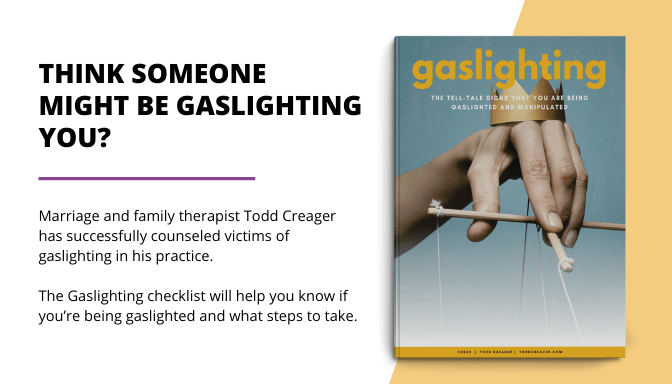
Feeling like you might be the victim of verbal abuse and/or gaslighting?

GET YOUR CHECKLIST HERE!

Filed Under: Blog, Gaslighting, Toxic Relationship Tips & Advice

Why Cheating Partners Use Gaslighting to Hide The Truth

December 18, 2025 by Todd Creager Leave a Comment

When Infidelity Meets Gaslighting: Why Your Gut Keeps Telling You Something’s Wrong (And Why They Keep Saying It’s Not)

Here’s what throws most people: they think the pain of discovering infidelity is the worst part. After 30+ years working with couples, I can tell you that’s rarely true.

The worst part?

It’s usually the months—sometimes years—before discovery, when you knew something was off but kept getting told you were imagining it.

TL;DR: Unfaithful partners often use gaslighting tactics to avoid facing consequences and their own shame. Common strategies include denying obvious behavioral changes, minimizing or rewriting events (the “drip method”), reversing blame onto you, and using anger as a distraction.

If you constantly find yourself asking “Am I overreacting?” or “What’s wrong with me?” around your partner, you may be experiencing gaslighting alongside infidelity.

But here’s what most people miss:

→ Gaslighting during affairs causes its own trauma symptoms before you even discover the betrayal

→ Most unfaithful partners aren’t consciously evil—they’re in self-protective mode (which doesn’t make it less harmful)

→ The manipulation isn’t just about hiding the affair; it’s about avoiding the shame of being caught “like a little kid”

Let me be clear about scope here:

I’m focusing on the more common scenario where gaslighting emerges from self-protection rather than malicious intent.

Yes, sometimes gaslighting is intentional and calculating. But in my practice, I see far more people who are unconsciously employing these tactics because facing reality feels unbearable. That distinction matters for recovery, though both cause real harm to you.

The Mechanics of Denial: When Obvious Changes Become “Your Problem”

Your partner’s behavior has shifted. They’re staying later at work. They’ve suddenly changed their phone password after 15 years together. They’re less interested in sex with you, or weirdly, they’re suddenly more interested. The emotional temperature in your home has changed—you can feel it.

You bring it up. And then you hear: “You’re making this up. You’re overreacting. Why are you always so suspicious? My God, we’ve been married 20 years—don’t you trust me?”

This is denying the obvious, and it’s one of the first tactics unfaithful partners use. Here’s the reality check most therapists won’t tell you: the person doing this has extremely high motivation to keep things exactly as they are. They don’t want their life to blow up. They don’t want to lose their family, their reputation, their comfortable setup. And they definitely don’t want to face the shame that comes with being exposed.

So they deny. Even when the evidence is stacking up. Even when your gut is screaming at you.

What this actually does to you: You start questioning your own perception. You think “Maybe I am being paranoid.” You wonder if you need to work on your trust issues. You might even start researching whether you have an anxiety disorder. Meanwhile, the gaslighting is creating its own trauma symptoms—disorientation, self-doubt, a constant feeling of “what’s wrong with me?”

If you’re asking yourself that question repeatedly around your partner, pay attention. That’s your first warning sign.

In practice: I’ve worked with betrayed partners who sought individual therapy before discovering the affair, convinced they had a mental health problem. Their therapists sometimes reinforced this because the therapist didn’t have the full picture. The betrayed partner did have anxiety and instability—but it was a rational response to being manipulated, not a preexisting condition.

The Drip Method: How Truth Gets Parceled Out to Minimize Damage

Let’s say they’ve been caught, or partially caught. Now comes the minimizing and rewriting of events.

“Look, I didn’t have sex with them, so what’s the big deal? I was just flirting.”

Or maybe they admit to one encounter: “I had a weak night. I drank too much. It happened once. I’m so sorry.”

Then you find the texts. Months of texts. Warming each other up for three months before that “one weak night.” Maybe they only had physical contact once, but there was significant emotional connection and planning. Or maybe—and this is extremely common—there were multiple physical encounters they’re not mentioning.

This is what we call the drip method in couples therapy. They give you just enough truth to seem like they’re being honest, while withholding the parts that make them look worse. Sometimes they’ll reframe their role entirely: “She really came on strong with me. I’m a rescuer—I just couldn’t say no.”

Then you discover texts where they were doing plenty of their own pursuing. They weren’t a passive victim of someone’s aggressive pursuit. They were an active, willing participant.

Why this matters: Each time you discover another piece they withheld, you experience the trauma of discovery again. It’s not one betrayal—it becomes multiple betrayals. The lying about the lying creates its own damage, separate from the affair itself.

The resource reality: If you’re in couples therapy and your partner is drip-feeding information, I tell clients to set a deadline. “You have one week to tell me everything. After that, each new revelation I discover on my own significantly reduces the chance we can recover from this.” Most people need consequences to break through the self-protection.

Reversing Blame: When Your Legitimate Concerns Become Your “Issues”

This one does real psychological damage. Your intuition kicks in—you know something’s wrong. You raise concerns. And suddenly, you’re the problem.

“You’re crazy. You’re insecure. You’re imagining things.”

Or they go deeper into your history: “You grew up with a mother who cheated on your father. Now you think everyone cheats. You grew up in a family where nobody trusted each other, so you can’t trust me.”

I’ve had clients where the unfaithful partner suggested the betrayed partner “get some therapy” for their trust issues. While actively cheating. The audacity is stunning, but remember—this is self-protection at work. They can’t face what they’re doing, so they make it about your supposed deficiencies.

Another version: “You kept pushing me away. You rejected me sexually over and over. What was I supposed to do?”

What they leave out: maybe you were pulling away because they stopped being emotionally present. They stopped listening. They stopped showing up for you in ways that make you feel safe enough to be sexually open. So they created the distance, then used that distance to justify betraying you, then blamed you for the distance.

When this crosses into danger territory: If you find yourself changing your behavior to avoid your partner’s accusations—if you’re walking on eggshells or suppressing valid concerns because you don’t want to seem “paranoid”—that’s a sign the gaslighting is working. Your emotional safety is being compromised.

What recovery requires: The unfaithful partner has to stop making you responsible for their choices. Full stop. They can acknowledge that problems existed in the relationship. They can own that they felt rejected or disconnected. But they have to own that cheating was their choice, made by them, for their own reasons. Until they can do that, recovery isn’t possible.

Anger as Distraction: The Strategic Explosion

Some unfaithful partners have figured out that anger shuts down conversation really effectively—especially if you’re someone who responds to anger with fear or withdrawal.

You bring up your concerns. They explode. “I can’t believe you’re accusing me of this! After everything I do for this family! I work my ass off and this is how you treat me?”

Suddenly you’re backing down, apologizing for bringing it up, just trying to avoid their wrath. The topic gets dropped. Your intuitive accusations get silenced. And they’ve successfully distracted from the real issue.

This isn’t always calculated. Sometimes it’s an automatic defensive response. But calculated or not, it’s still a manipulation that keeps you from getting answers you deserve.

The pattern to watch for: If every time you raise certain topics your partner becomes explosively angry, and you find yourself dropping those topics to keep the peace, that’s a red flag. Healthy relationships can handle difficult conversations without one partner using emotional volatility to control the dialogue.

What You Need to Know About Recovery (The Part Most Articles Skip)

Here’s what I see after working with hundreds of couples dealing with infidelity and gaslighting:

Recovery is possible, but only if the gaslighting stops. And I mean completely stops. The person who betrayed has to move from self-protection mode into full accountability. That’s a painful transition—it means facing their shame, their choices, their role in hurting you. Many people can’t make that shift without professional help.

Your symptoms are real, but they’re rational responses to an irrational situation. You’re not crazy. You’re not overreacting. Your nervous system is responding appropriately to a threat. When someone you love is lying to you and making you doubt your reality, anxiety and instability make perfect sense.

The gaslighting often reveals deeper issues that led to the affair. People who can’t face their shame about cheating usually can’t face other uncomfortable truths about themselves. The inability to be accountable in one area tends to show up in other areas too. That’s what needs addressing in therapy.

You’ll know they’re serious about change when they stop defending and start being curious. When they stop explaining why you’re wrong to be upset and start asking what you need to feel safe again. When they stop minimizing and start being transparent, even when the truth makes them look bad.

If You’re Reading This and Recognizing Your Situation

Step out of the self-blame. If you’ve been asking yourself “What’s wrong with me?” or “Am I overreacting?” repeatedly, the problem isn’t you. Your instincts are working fine—they’re being deliberately or unconsciously undermined.

You’re not paranoid for noticing changes. You’re not insecure for wanting honesty. You’re not demanding for expecting your partner to face reality with you instead of making you question yours.

The path forward requires both people developing what I call emotional muscles—the capacity to stay present with pain, to face uncomfortable truths, to be curious about each other’s experience without immediately defending. The unfaithful partner needs to build the muscle to tolerate their shame without deflecting it onto you. You need support to rebuild trust in your own perceptions.

Professional help matters here. These patterns run deep, and untangling gaslighting from infidelity from legitimate relationship issues requires skilled guidance. You can’t do this alone, and you shouldn’t have to.

This is Todd Creager, making the world safe for love.


About the Author: Todd Creager has worked with couples navigating infidelity recovery for over 30 years. His approach emphasizes creating safety for both partners while maintaining accountability, with particular expertise in helping betrayed partners rebuild trust in their own perceptions after gaslighting. These insights come from direct clinical experience with couples at various stages of recovery, from immediate crisis through long-term rebuilding.

Methodology Note: The examples throughout this article come from composite cases—patterns observed repeatedly across multiple clients with identifying details altered to protect confidentiality. The tactics described represent the most common gaslighting strategies observed in practice when infidelity is present, documented across hundreds of couple sessions.

https://youtu.be/ujiqlJMi9Ys

Filed Under: Betrayal, Blog, Cheating, Gaslighting, Infidelity Tips & Advice

Why You Shut Down During Arguments (And It’s Not Because You Don’t Care)

December 11, 2025 by Todd Creager Leave a Comment

This post is about something I see almost every week in my therapy office.

A couple sits on my couch, and one person goes quiet. Not the angry quiet—the disappearing kind. Their chest sinks, their voice gets small, and their partner thinks they’ve checked out. But here’s what’s really happening: their nervous system just hit the shame button, and they’re not avoiding the conversation—they’re drowning in it.

TL;DR: When you shut down during conflict, it’s usually not apathy or stonewalling—it’s a shame response. Your body is trying to protect you from feeling like a bad, wrong person. This article shows you how to recognize when shame takes over and how to stay present for yourself and your partner without collapsing.

But here’s what most people miss:

→ Shame shutdown looks like “not caring” to your partner, but it’s actually a sign you care so much that your nervous system can’t handle the perceived threat of being “bad”

→ Over-apologizing is often a shame response, not real accountability—and it doesn’t actually help repair

→ You can’t talk your way out of a shame spiral; you have to work with your body first

I’ve spent over 30 years working with couples, and I can tell you that shame-driven shutdown is one of the most misunderstood reasons we disconnect.

It gets mistaken for indifference, avoidance, or not trying. But I’m going to show you what’s really going on and how to work with it.

What Shame Actually Does to Your Nervous System

When shame hits, you’re not making a choice to shut down. Your body is doing what it learned to do, probably when you were young. Maybe you had a parent who shamed you, or you got the message that your feelings were too much, or you learned that being visible when you messed up was dangerous.

In my practice, I use EMDR (Eye Movement Desensitization and Reprocessing) to help people heal from the original shame wounds. But before we get there, you need to understand what’s happening in the moment.

Your nervous system has three basic responses to threat: fight, flight, or freeze. Shame triggers that freeze response—what we call the shutdown reaction. Your chest literally collapses. Blood flow to your prefrontal cortex (the thinking part of your brain) decreases. You feel small, young, and wrong.

I worked with a woman named Cheryl—names changed for privacy—who would go completely silent whenever her husband Jerry expressed disappointment. Not regular quiet. Gone. Jerry would feel abandoned, which made him push harder, which made Cheryl shut down more. Classic cycle.

Here’s what was happening: Cheryl’s mother had shamed her growing up. Any mistake meant you were a bad person. So when Jerry was upset, Cheryl’s 6-year-old self took over. That part of her believed she was fundamentally wrong, and the only option was to disappear.

The difference between guilt and shame matters here. Guilt says “I did something bad.” Shame says “I am bad.” Guilt can actually be useful—it helps you recognize when you need to repair something. But shame? Shame makes you unavailable because you’re not arguing about what happened; you’re trying to survive the feeling that you’re inherently wrong.

How to Know When Shame Has Taken Over

Pay attention to your body. Shame has a specific signature, and once you recognize it, you can start working with it instead of being hijacked by it.

In sessions, I ask people to notice:

→ Where does your chest go? (Usually it collapses inward)

→ What happens to your voice? (Gets quiet or disappears)

→ How big do you feel? (Small, young, like a child)

→ What’s the thought? (Usually something all-or-nothing: “I mess everything up” or “It’s all my fault”)

One client told me, “Every time we argue, I feel like I’m 6 years old and I just want to hide in my room.” That’s exactly it. You’re not actually 6, but that’s the age that shows up when shame takes over.

The language of shame is black and white. You’ll hear yourself think:

→ “I always do this”

→ “I’m the reason we’re not okay”

→ “I mess everything up”

→ “I can’t do anything right”

That “all or nothing” thinking is a red flag. Your adult self knows that relationships are nuanced. But shame doesn’t do nuance. It deals in absolutes.

Why Your Partner Thinks You Don’t Care (And What’s Really Happening)

This is where it gets tricky. From the outside, shame shutdown looks like:

→ Not caring

→ Giving up

→ Avoiding responsibility

→ Not being present

So your partner feels abandoned. They think you’re not trying, or you’re checked out, or you don’t value the relationship enough to engage.

But from the inside, you’re not checked out—you’re overwhelmed. You care so much that your system can’t handle the possibility of being seen as wrong or bad. The shame is so big that your nervous system shuts you down to protect you.

I’ve seen couples where the betrayed partner thinks the person who cheated is “stonewalling” when they go quiet. But often, what I’m seeing is shame collapse. The person who betrayed is flooded with “I’m a terrible person” and their body literally can’t stay present with that feeling and their partner’s pain at the same time.

This doesn’t excuse the behavior. But understanding it changes how we work with it.

The Moment That Changed Everything for Cheryl

We worked on helping Cheryl recognize the exact moment shame kicked in. Not after—right when it started. She learned to notice that chest collapse, that voice disappearing, that young feeling.

One time, Jerry came home frustrated about something minor—I think dishes or plans that got mixed up. Cheryl felt the familiar pull to collapse. But this time, instead of spiraling, she paused.

She placed her hand on her heart—something we’d practiced in session—and whispered to herself, “You’re safe now.” Just that. She felt her feet on the ground. She took three breaths. And she imagined her adult self stepping forward to sit next to that 6-year-old part.

The young part was still there, still scared. But Cheryl wasn’t fused with it anymore. She could be present for that part while also being present for Jerry.

She walked over and sat beside him. Didn’t explain. Didn’t apologize. Just sat close and breathed.

Jerry told me later, “That was the first time I felt like she stayed. Like she didn’t disappear into shame.”

What Actually Repairs Connection (Hint: It’s Not What You Think)

Most people think they need to apologize their way back to connection. But over-apologizing from a shame state doesn’t work. It actually keeps you small.

“I’m sorry, I’m sorry, I’m so sorry” from a collapsed chest isn’t repair. It’s appeasement. Your partner can feel the difference.

Real repair comes from presence. Not explanation. Not making yourself smaller. Just staying.

Your partner doesn’t want the shame-ridden version of you. They want you whole, grounded, and available. They want to know you can stay with them and stay with yourself at the same time.

Here’s what I tell clients: You don’t have to have the perfect words. You don’t have to explain everything. You just have to stay in the room—emotionally and physically.

The Practice That Changes Shame Shutdown

When you notice shame coming up, try this four-step process. I’ve used this with hundreds of people, and it works when you actually practice it (not just when you’re already in the middle of a meltdown):

1. Name it Say to yourself, “This is shame. This isn’t the truth about who I am.”

Just naming it creates a little space. You’re not the shame; you’re noticing the shame. That’s your adult self coming online.

2. Notice it in your body Where do you feel it? Chest? Throat? Stomach? Don’t try to change it. Just notice. “My chest feels tight and small.” “My throat feels closed.” “I want to curl up.”

3. Regulate This is where you work with your nervous system directly:

→ Put your hand on your heart or your belly

→ Feel your feet on the ground

→ Take three breaths where your exhale is longer than your inhale (this activates your parasympathetic nervous system)

→ Look around the room and name what you see (this brings you into the present)

4. Reconnect Once you’re a little more regulated, you can reconnect. Sometimes that’s sitting close to your partner. Sometimes it’s making eye contact. Sometimes it’s just saying, “I need a minute, but I’m here.”

The version of you that can do this—that can notice shame, work with it, and stay present—that’s the version your relationship needs.

What to Do When Your Partner Is the One Shutting Down

If you’re the partner watching someone collapse into shame, this is painful. You feel alone. You might get angry or push harder to get them to respond. That’s normal.

But here’s what helps: Recognize that their shutdown isn’t about not caring. It’s about caring so much that their system gets overwhelmed.

You can say something like, “I can see this is hard for you. I’m not going anywhere. Take the time you need.” Give them space to regulate without abandoning them or making them wrong for the response.

Some people need a few minutes. Some need an hour. You can ask, “What do you need right now?” But don’t interrogate. Don’t make them explain why they’re shutting down while they’re in it. That just piles shame on top of shame.

When they come back, acknowledge that they came back. “Thank you for staying with this” or “I’m glad you’re here” goes a long way.

The Long-Term Work: Healing the Original Shame

What I’ve described above is about managing shame in the moment. But the deeper work is about healing the original wounds that created the shame response in the first place.

This is where EMDR comes in. In my practice, I help people process the early experiences that taught them they were bad, wrong, or too much. When you heal those wounds, the shame response doesn’t get triggered as easily.

I’ve seen people who couldn’t stay in a room during conflict learn to stay present, even when things are hard. Not because they’re forcing themselves, but because their nervous system isn’t interpreting disappointment or frustration as a threat to their fundamental worth.

This takes time. It takes professional support. But it’s possible, and I’ve watched thousands of people do it.

Your Relationship Needs You Whole, Not Small

I want you to remember this: connection doesn’t come from erasing yourself. It comes from showing up as fully as you can, even when it’s hard.

When shame tells you to disappear, your relationship suffers. Not because your partner needs you to be perfect, but because they need you to be present.

You don’t have to have it all figured out. You don’t have to never feel shame. But you can learn to recognize when it’s taking over and bring yourself back.

That’s the work that changes relationships. Not perfect communication. Not never messing up. Just the ability to stay—with yourself and with your partner—even when it’s uncomfortable.

If you’re reading this and recognizing yourself, know that you’re not alone. Shame-driven shutdown is one of the most common patterns I see. And it’s workable. You can learn to stay present. Your relationship can heal.


About the Author

I’m Todd Creager, a licensed clinical social worker and marriage and family therapist. I’ve been working with couples for over 30 years, helping them heal from infidelity, rebuild connection, and break free from patterns that keep them stuck. I specialize in using EMDR to help people heal from shame and trauma, and I’ve worked with thousands of individuals and couples who thought their relationships were beyond repair. Most of them were wrong about that.

The insights in this article come from decades of sitting with people in their hardest moments and watching what actually works to help them reconnect. If you’re struggling with shame in your relationship, there’s help available. You don’t have to figure this out alone.

Watch the video and get personal insights from Todd on why you’re shutting down during conflict

Filed Under: Arguing and Bickering, Blog, Communication Tips & Advice, Divorce Proof Your Marriage

When Silence Becomes Punishment: Why Withdrawal Hurts More Than Words

December 3, 2025 by Todd Creager Leave a Comment

When Silence Becomes Punishment: Why Withdrawal Hurts More Than Words

Sometimes the most painful thing in a relationship isn’t what gets said. It’s what doesn’t get said. The cold silence. The turned back. The partner who’s physically there but emotionally gone.

You know what I’m talking about.

You’ve been hurt, so you pull back. You get cool. You don’t respond right away. Maybe you tell yourself it’s not intentional, that you just need space. But here’s what most people don’t realize: that quiet withdrawal?

It’s often a cry for closeness. A way of saying “I’m hurting” without knowing how to say it directly.

What you need to know right now: Silent withdrawal is usually self-protection, not revenge. But to your partner, it feels like punishment.

The good news? You can repair connection without saying a word—and sometimes that’s more powerful than any conversation.

But here’s what most people miss:

→ Staying physically present (even when you’re still upset) sends a completely different message than leaving the room

→ Your partner can’t fight for you if you’ve disappeared—emotionally or physically

→ The body repairs faster than words sometimes, and that’s okay

I’m Todd Creager. For over 40 years, I’ve worked with couples who are stuck in these silent standoffs. What I’ve learned is that most partners don’t want to punish—they want to feel safe again.

And there are ways to signal “I’m still here” without having to explain, defend, or solve anything in that moment.

What’s Really Happening When You Withdraw

Here’s the pattern I see constantly in my practice. One partner says or does something that hurts. Maybe they were dismissive. Maybe they got defensive when you tried to share something vulnerable. Maybe they humiliated you in front of others.

Your first instinct? Protect yourself. So you withdraw. You become unavailable. You give off the vibe: “You don’t get access to me until I feel better.”

I had a client tell me once: “I didn’t slam doors or scream. I just made him feel the way I felt—small and invisible.”

What she wanted, desperately, was for him to fight for her. To notice. To come after her and make it right. But all he did was pull further away until she tried something completely different.

The thing is, she wasn’t trying to be mean. Neither are you when you do this. You’re trying to survive the pain. But withdrawal creates a terrible cycle: You pull away to protect yourself. Your partner feels punished and pulls away too. Now you’re both alone, and nobody knows how to get back.

The Real Story: Ken and Terry

Let me tell you about Ken and Terry because their story shows up in some version in almost every couple I work with.

Whenever Terry brought up something emotional, Ken would do what a lot of partners do. He’d shoot holes in what she was saying. Try to give his reasons why she wasn’t correct. He’d get defensive, basically.

Terry eventually got so tired of being minimized that she just stopped. She stopped trying to connect. She stopped bringing things up. She became what I call “politely distant.”

When they came to see me, Terry said, “I just don’t try anymore.” And Ken said, “I feel all alone in this relationship.”

Ken didn’t quite understand what was happening. There were a lot of things he did well in the relationship—like a lot of partners, he wasn’t all bad. He just wasn’t aware of the pain his defensiveness created. And Terry wasn’t so tuned into the pain Ken felt when she pushed him away.

See, her pushing away was self-protection. His defensiveness was self-protection too. Two people trying to protect themselves, both ending up hurt.

The Moment Everything Changed

After we worked together for a bit, something happened. They had another fight. Terry caught herself at the exact moment she wanted to punish Ken by withdrawing.

Instead of icing him out completely, she did something brave. She sat on the couch near him. Back turned—because she was still struggling, still hurt—but closer. She didn’t say a word. She just didn’t leave.

Later she told me it was the hardest thing she’d ever done. Just sitting there, still upset, still not ready to talk, but present.

That night, Ken reached out. They had their first honest, soft moment in weeks, maybe months.

Why Physical Presence Matters More Than You Think

We’ve been taught that conflict needs to be solved through talking. That if you’re not communicating verbally, you’re not fixing anything.

But sometimes connection starts in the body first.

The silent cold shoulder feels like control. Silent presence feels like repair.

I’m going to say that again because it’s important: The silent cold shoulder feels like control, but silent presence feels like repair.

When you can stay in the room—not to punish, but to witness—you tell your partner something crucial: “I’m still here. I’m still open.” That’s where healing begins.

Your nervous system speaks to your partner’s nervous system. When you leave the room or turn away completely, their nervous system reads: “Threat. Abandonment. Danger.” When you stay present, even silently, their nervous system gets a different message: “Still safe. Still connected. We’ll get through this.”

What This Looks Like in Real Life

You don’t have to be perfect at this. You don’t have to fake being okay when you’re not. Here’s what I mean by “silent presence”:

Scenario 1: After a fight in the kitchen

→ Old pattern: Storm off to the bedroom, close the door, don’t come out for hours

→ New pattern: Move to the living room, sit where your partner can see you, let yourself calm down there

Scenario 2: When your partner says something dismissive

→ Old pattern: Give them the cold shoulder for days, minimal responses, make them feel your displeasure

→ New pattern: Take space if you need it, but stay in proximity. Sit in the same room reading. Be near them during dinner even if you’re quiet.

Scenario 3: When you’re hurt but can’t find words

→ Old pattern: Shut down completely, refuse touch or eye contact, leave them guessing

→ New pattern: Let your body stay soft even when your words aren’t ready. A hand on their shoulder. Sitting close on the couch. Small signals that say “I’m upset, but I’m not gone.”

Why This Works When Talking Fails

I’ve seen couples talk themselves in circles for hours. They explain, defend, counter-argue, explain again. Both people leave exhausted and more disconnected than before.

Here’s what I’ve learned from 40+ years of working with couples: Your body can say “I’m committed to us” faster than your mouth can sometimes.

When you’re hurt, your thinking brain isn’t working right anyway. You’re flooded. Your partner is flooded. More words usually means more misunderstanding.

But if you can stay near each other? If you can let your body communicate “I’m not abandoning you even though I’m upset”? You’re doing repair work without needing perfect words.

The Common Mistakes People Make

Mistake 1: Confusing presence with pretending you’re okay

Staying present doesn’t mean acting like nothing happened. Terry stayed on the couch with her back turned. She was clearly still upset. But she was there.

Mistake 2: Using physical presence as a manipulation

Some people stay in the room but make sure their partner feels their anger. Heavy sighs. Eye rolls. That’s not presence—that’s proximity punishment. Your partner can tell the difference.

Mistake 3: Expecting instant results

Terry told me sitting on that couch was the hardest thing she’d ever done. It won’t feel natural at first. Your instinct is to leave, to protect, to punish a little. That’s normal. You’re rewiring decades of patterns.

Mistake 4: Thinking this replaces all verbal communication

This isn’t about never talking. You’ll still need conversations. But those conversations go better when you’ve stayed connected through the worst moments.

What Your Partner Experiences When You Stay

I ask betrayed partners and hurt partners all the time: “What does it feel like when your partner withdraws?”

They say things like:

→ “Like I don’t matter”

→ “Like I’m being erased”

→ “Like they’ve already left the relationship mentally”

→ “Terrifying—I don’t know if they’re coming back”

Then I ask: “What does it feel like when they stay present, even when upset?”

Completely different answers:

→ “Like we’re going to be okay”

→ “Like they’re still fighting for us”

→ “Like there’s hope”

→ “Safe—even though we’re struggling”

Your partner isn’t reading your mind. They’re reading your body, your proximity, your availability. When you stay, even silently, you’re saying something important.

How to Start Practicing Silent Presence

Next time you want to pull away, ask yourself: “What do I really want right now?”

If the honest answer is “I want to punish them” or “I want them to feel what I feel,” that’s information. That’s hurt talking. You can acknowledge that feeling without acting on it.

If the honest answer is “I want to feel safe” or “I need space to calm down,” then try this:

Step 1: Take the space you need, but keep your partner in sight. Move to another part of the room instead of another floor.

Step 2: Let your body relax as much as you can. Uncross your arms. Soften your shoulders. You’re still upset—that’s okay—but your body can signal “I’m not dangerous to you right now.”

Step 3: When you’re ready (even if it’s just 1%), do something small. Sit near them like Terry did with Ken. Make eye contact for a second. Touch their hand as you walk by.

You’re not saying “everything’s fine.” You’re saying “I’m still here.”

What About When Your Partner Is the One Withdrawing?

This is painful. You’re on the receiving end of the silent treatment, and it feels terrible.

Here’s what not to do: Chase them down demanding they talk. Force proximity. Get angry about their anger.

Here’s what can help: Give them space, but stay nearby. Say something like “I can see you’re upset. I’m going to be in the living room when you’re ready.” Then actually be there.

Don’t disappear into your phone. Don’t leave the house. Be genuinely available.

Sometimes the person who’s withdrawing needs to see that you’re not going anywhere. That their silence isn’t driving you away. That’s what Ken did for Terry that night—he was there when she was ready.

The Pattern That Changes Everything

I’ve watched this pattern transform relationships:

Old cycle: Fight → Withdraw → Partner withdraws → Both feel abandoned → Resentment builds → Next fight is worse

New cycle: Fight → Feel the urge to withdraw → Choose presence instead → Partner feels safe → Small repair moment → Next fight is easier

You don’t fix everything in one night. But you stop making things worse. And you start building a different habit—a habit of staying instead of leaving.

When Silent Presence Isn’t Enough

Look, I teach verbal repair tools too. Sometimes you need words. Sometimes you need to apologize clearly, or hear your partner’s pain, or work through something complex.

But what I see couples overlook constantly is that the nonverbal repair tools can be more important. They create the safety that makes verbal repair possible.

If you’ve been in a pattern of withdrawal and punishment for months or years, sitting on that couch with your back turned might be 90% of the work in that moment. The conversation can come later, when you’re both regulated.

Why This Feels So Hard

Staying present when you’re hurt goes against your survival instinct. Your body wants to flee or fight. Silent presence is neither—it’s something more difficult. It’s staying vulnerable when every cell in your body is screaming to protect yourself.

That’s why Terry said it was the hardest thing she’d ever done.

But here’s what I’ve learned: The hard thing is also the thing that works. The easy thing—withdrawing, shutting down, giving the cold shoulder—feels like self-care in the moment. But it destroys connection over time.

The hard thing—staying present, staying soft, staying available—feels scary and vulnerable. But it builds the relationship you actually want.

What Happens Next

You’re not going to get this perfect. You’ll have fights where you still withdraw. Where you still give the cold shoulder. That’s part of being human.

But if you can catch yourself even once a month and choose presence instead? You’re changing the pattern. You’re teaching your nervous system and your partner’s nervous system that conflict doesn’t mean abandonment.

That one moment on the couch changed everything for Ken and Terry. Not because it solved their communication issues overnight. But because it showed both of them that connection was still possible, even in pain.

The Real Question

So the next time you feel that urge to pull away, to get cool, to make your partner feel your hurt through your absence, ask yourself:

“What do I really want right now?”

If the answer is “I want us to be okay,” then try something different. Try staying. Try letting your body say “I’m still here” when your words can’t.

Sit near them. Let your presence speak. Don’t leave the room. Don’t leave the relationship, even for a moment.

Because sometimes the most powerful thing you can say is nothing at all—as long as you’re still there to not say it.


About Todd Creager: For over 40 years, I’ve helped couples identify the subtle disconnect patterns that keep love at arm’s length.

I guide them back to intimacy using both verbal and nonverbal repair tools—because sometimes the body knows how to heal before the words come.

If you’re struggling with withdrawal patterns in your relationship, you’re not alone, and there are ways back to connection that don’t require perfect communication. They just require presence.

What if your next argument could bring you closer instead of driving you apart?


Learn how in Todd Creager’s Loving & Connecting Masterclass.
Lifetime access. Real results.

Say Yes to a Better Relationship

Filed Under: Blog, Uncategorized

Why You Freeze During Conflict (And How to Stop)

November 27, 2025 by Todd Creager Leave a Comment

When Your Body Shuts Down During Conflict: Why You Freeze and How to Stay Present Without Saying a Word

You’re in the middle of a difficult conversation with your partner. Their voice rises slightly, maybe there’s frustration or disappointment in their tone. And then something happens inside you—your mind goes blank, your body feels heavy, and you can’t access words even if you wanted to. You’re still sitting there, but you’ve gone somewhere else entirely.

If this sounds familiar, you’re not broken. You’re experiencing what I call the freeze response, and I’ve watched it play out in my office for over 40 years of working with couples. What looks like indifference or rejection to your partner is actually your nervous system trying to keep you safe from emotional overwhelm.

Here’s what you need to know right now: Freezing isn’t a character flaw or a relationship death sentence. It’s a survival mechanism. But here’s what most people miss—you don’t need to force yourself to talk your way out of it, and your partner doesn’t need to get louder to pull you back. There’s a completely different way through this that has nothing to do with finding the right words.

The bigger issue? Most couples don’t understand what’s really happening when one person goes blank during conflict. They think it’s about not caring enough to engage, when it’s actually about caring so much that the intensity becomes unbearable. That misunderstanding creates a painful cycle where one partner pursues harder and the other retreats deeper.

In this article, I’m going to walk you through what freezing actually is (it’s not what you think), why it happens to some people and not others, and most importantly, how to stay present in your body even when your words disappear. I’m also going to show partners of people who freeze how to respond in ways that help rather than make things worse.

This isn’t about fixing yourself or your partner. It’s about understanding how your nervous systems work and learning to work with them instead of against them.

What’s Actually Happening When You Freeze

Let me tell you about a client I’ll call Martine. She described freezing as “like my soul leaves the room. I’m here, but I’m not.” I’ve heard some version of this from many clients over the years. That absence—that’s what their partners feel most acutely.

Her husband Larry would get expressive when he was frustrated or disappointed. Not yelling, not aggressive, just more animated. And every single time, Martine would shut down. Her eyes would go distant, her body would still, her voice would simply stop. And the more she retreated, the more desperate Larry became to reach her. He’d talk more, ask more questions, try harder to connect. Which only pushed her further away.

This is the pattern I see again and again. The person who freezes isn’t choosing withdrawal. Their nervous system has made the choice for them.

When you freeze, your body is responding to perceived threat the same way it would if you were facing physical danger. Except the danger isn’t physical—it’s emotional intensity that feels too big to handle. Your system essentially says “I can’t fight this, I can’t run from it, so I’m going to shut down and wait for it to pass.”

Here’s what’s happening physiologically: Your heart rate might actually slow down (different from the fight-or-flight response where it speeds up). Blood flow redirects away from your extremities. Your thinking brain goes offline. You might feel numb or disconnected from your body. Time might feel strange—either moving very slowly or in a blur.

None of this is conscious. You’re not deciding to check out. Your body is trying to protect you from what it perceives as overwhelming emotional flooding.

Why Some People Freeze and Others Don’t

The freeze response usually has roots in your history. Maybe you grew up in a home where conflict was scary—loud voices, unpredictability, or worse. Maybe you learned early that speaking up made things worse, not better. Maybe you were punished for expressing emotions, so you learned to make yourself very small and very quiet.

When you’re young and truly powerless in a situation, freezing can be adaptive. It helps you survive. The problem is that your nervous system doesn’t always update its threat assessment as you grow. So even in adult relationships where you’re safe and have choices, that old wiring can kick in.

I’ve worked with clients who had no obvious trauma but still freeze. Sometimes it’s about temperament—some people are naturally more sensitive to emotional intensity. Their threshold for overwhelm is simply lower, and that’s not a failing. It’s just how their system is calibrated.

What matters more than why you freeze is recognizing that it’s happening and learning to work with it.

The Real Cost of Freezing (And It’s Not What You Think)

People often think the problem with freezing is that you can’t resolve the conflict in that moment. That’s true, but it’s not the real damage.

The real cost is that your partner experiences your freeze as absence. As rejection. As proof that you don’t care enough to stay engaged. They can’t see your nervous system shutting down to protect you. They can only see you disappearing right in front of them.

And here’s the painful irony—you’re often freezing precisely because you care so much. Because the relationship matters so deeply that the possibility of rupture feels unbearable. Because you don’t want to say the wrong thing or make it worse. So you say nothing at all.

I tell couples this all the time: the opposite of connection isn’t conflict. It’s absence. You can have conflict and still feel connected if both people stay emotionally present. But when one person goes absent, even if they’re physically in the room, that’s when the real disconnection happens.

What Doesn’t Work (Stop Doing These Things)

If you’re the person who freezes, here’s what won’t help:

Forcing yourself to keep talking when you’ve gone blank. That usually comes out wrong or feels fake, and your partner can sense it.

Beating yourself up for freezing. That just adds shame on top of overwhelm, which makes you more likely to freeze next time.

Promising you’ll do better next time without changing anything about how you respond to your nervous system.

If you’re the partner of someone who freezes, here’s what makes it worse:

Getting louder or more insistent. I know you’re trying to reach them, but intensity is exactly what triggered the shutdown. More intensity won’t bring them back.

Interpreting their freeze as not caring. I understand that’s how it feels, but that interpretation keeps you both stuck.

Demanding they explain themselves in the moment. Their thinking brain is offline. They literally can’t access explanations when they’re frozen.

How to Stay Present When Words Won’t Come

Now here’s what actually works. I’m going to tell you what I taught Martin, and what changed everything for her and Larry.

I asked Martin to try something different the next time she felt herself starting to freeze. Instead of disappearing completely, she was to do these specific things:

Press her feet firmly into the floor. This is grounding. When you freeze, you often go numb and lose connection with your body. Feeling the solid floor under your feet brings you back into physical sensation.

Hold something warm—a cup of tea, a mug of coffee, even just warm water. The temperature gives your nervous system something to focus on besides the emotional intensity. You’re giving it a different kind of input.

Place one hand on your heart. This is both grounding and self-soothing. You’re literally giving yourself the comfort your system is seeking.

Look at your partner. Even if you can’t speak, maintain eye contact. Let them see that you’re trying to stay present.

Martine did exactly this. She felt herself starting to shut down during a conversation with Larry. She pressed her feet into the floor, grabbed her tea, put her hand on her heart, and kept her eyes on him. She didn’t say a single word.

And Larry noticed. He told me later, “That was the first time I felt like you stayed even when you couldn’t talk.”

That’s the breakthrough. You don’t have to perform connection through words. You just have to allow connection through presence.

The Three-Minute Practice That Rewires Your Freeze Response

Here’s what I teach people who freeze: you’re not going to talk your way out of this pattern. You’re going to feel your way out.

Between conversations with your partner, practice this on your own:

Sit quietly and think about a moment when you typically freeze. Don’t try to solve anything. Just notice what happens in your body. Where do you feel it? Does your chest get tight? Does your throat close? Do your hands go cold?

Then do the grounding practices I described above. Feet on floor. Something warm to hold. Hand on heart. Breathe slowly—in for four counts, out for six counts. That longer exhale tells your nervous system it’s safe to relax.

Do this for just three minutes. You’re teaching your body that you can feel activation without completely shutting down. You’re building what I call your emotional muscle—your capacity to stay present with intensity.

The goal isn’t to never freeze again. That’s unrealistic. The goal is to catch yourself earlier in the process and have tools to stay grounded instead of going completely offline.

What Your Partner Can Do (This Part Is For Them)

If your partner freezes during conflict, your instinct is probably to reach harder for them. I get it. Their absence is painful, and you want them back.

But here’s what actually helps: Create more safety, not more intensity.

Lower your voice. Soften your body language. Slow down your speech. You’re signaling to their nervous system that there’s no threat here.

Say something like: “I can see you’re having a hard time right now. I’m not going anywhere. Take the time you need.”

Give them physical space if they need it, but stay emotionally available. You’re showing them they won’t be abandoned if they need to regulate their nervous system.

Notice and acknowledge when they’re trying to stay present, even if they can’t speak. “I can see you’re working hard to stay here with me. Thank you.” That kind of recognition matters more than you might think.

Don’t take their freeze personally. I know that’s hard. But their shutdown isn’t about you or how much they care. It’s about their nervous system being overwhelmed.

Beyond the Freeze: Building Long-Term Capacity

Over time, the goal is to increase your window of tolerance—the amount of emotional intensity you can handle before your nervous system hits the eject button.

This happens through repeated experiences of staying present with uncomfortable feelings and discovering you’re okay. That you have choices. That you’re not trapped.

Sometimes this work needs professional support. If you have a history of trauma, if freezing is deeply ingrained, if you and your partner can’t break the pattern on your own—that’s when couples therapy or individual work can be crucial. There’s no shame in that. Some nervous system patterns need more specialized help to shift.

What I’ve seen in 40 years of this work is that people absolutely can learn to stay present during difficult conversations. The freeze response doesn’t have to define your relationship. But it takes practice, patience, and a willingness to work with your body instead of against it.

Your Nervous System Isn’t Your Enemy

I want you to hear this: You’re not broken if you freeze. You’re not weak. You’re not failing at relationships.

Your freeze response is your nervous system trying to take care of you. It’s just using an old strategy that doesn’t serve you anymore. You developed this response for good reasons—it helped you survive something. The question now is whether it’s still helping or whether it’s time to develop new options.

The beautiful thing about nervous systems is they can learn. They can adapt. You can teach your body that it’s safe to stay present, even when things get intense. You can rewire those old patterns.

But you can’t think your way out of a freeze response. You have to feel your way out. You have to work with your body, not just your mind.

That’s why the practices I’ve shared here—grounding, staying physically present even when words won’t come, building capacity gradually—these aren’t just techniques. They’re ways of partnering with your nervous system instead of fighting it.

When You Know You’re Not Broken, Just Frozen

If you take nothing else from this article, take this: The next time you feel yourself starting to freeze during a difficult conversation, remember you have more options than you think.

You can press your feet into the floor and feel the ground supporting you. You can hold something warm and let that sensation anchor you. You can put your hand on your heart and remind yourself that you’re okay. You can look at your partner and let your eyes say what your mouth can’t.

You don’t have to force words. You don’t have to fake being okay. You just have to stay in your body and let your presence speak.

Because connection doesn’t require perfect communication. It just requires showing up, even in the messy, frozen, wordless moments. That’s when real intimacy happens—when you can be fully present with someone without having to perform being fine.

Your partner doesn’t need you to have all the right words. They just need to feel that you’re still there with them, even when things get hard.

And that? That’s completely possible, starting today.


About the Author: Todd Creager has spent over 40 years helping couples repair relationships through emotional safety and deep reconnection. His approach focuses on working with nervous system responses and building capacity for presence during conflict, rather than forcing communication before partners are ready. He works with individuals dealing with trauma, couples recovering from infidelity, and partners learning to connect more authentically.

Methodology Note: The approaches described in this article are based on over four decades of clinical experience working with couples who struggle with shutdown responses during conflict. The techniques integrate somatic (body-based) practices with attachment theory and nervous system regulation principles. Individual results vary based on trauma history, relationship dynamics, and consistency of practice.

Watch The Video Where Todd Explains How to Stop Shutting Down During Arguments

What if your next argument could bring you closer instead of driving you apart?


Learn how in Todd Creager’s Loving & Connecting Masterclass.
Lifetime access. Real results.

Say Yes to a Better Relationship

Filed Under: Blog, Communication Tips & Advice, Conflict Resolution, Relationship Advice

Why Defending Yourself Is Killing Your Relationship (And What to Do Instead)

November 20, 2025 by Todd Creager Leave a Comment

If you’ve ever walked away from an argument with your partner feeling exhausted and unheard—even though you were just trying to explain your side—you’re not alone.

I’ve worked with hundreds of couples over the years, and I can tell you this: defensiveness is one of the biggest connection killers I see in my practice. But here’s what catches most people off guard: when you’re defending yourself, you’re not being difficult. You’re actually showing how much you care about being understood.

TL;DR: Defensiveness isn’t resistance—it’s protection.

When you explain yourself during conflict, you think you’re clarifying, but your partner hears rejection. The solution isn’t more talking. It’s presence. Three non-verbal reconnection techniques can stop the defend-disconnect cycle and create the safety needed for real communication.

What Most People Miss:

→ Your defense feels like rejection to your partner, no matter how valid your point is

→ The more you explain, the more distant your partner gets (not closer)

→ Creating safety happens through presence, not through being understood first

→ Both partners are usually trying to help the situation—they’re just making it worse

I’m going to walk you through why this happens, what’s really going on beneath the surface, and give you a specific example from my practice that changed how one couple communicates entirely.

The Hidden Truth About Defensiveness

When you defend yourself in a relationship conflict, you’re making being understood your goal. And that sounds reasonable, right? You want your partner to see things accurately, to know your intentions, to understand that what they’re saying isn’t quite fair or isn’t quite right.

The problem is this: while you’re defending, you’re not connecting.

I see this play out the same way with couple after couple in my office. One partner expresses something—maybe it’s a complaint, maybe it’s hurt, maybe it’s frustration. The other partner immediately feels misunderstood and jumps in to explain. “No, that’s not what happened” or “You’re not seeing it from my perspective” or “If you just understood that I was trying to…”

And in that moment, connection dies.

Your partner doesn’t hear your explanation as clarification. They hear it as dismissal of their experience. They feel diminished. Their reality is being challenged when all they wanted was to be heard. So what do they do? They double down. They get more intense. They repeat themselves with more emotion because now they feel rejected on top of whatever they were already upset about.

And then what do you do? You defend more because clearly they’re still not getting it. You’re trying to be helpful. You’re trying to make things better. If they could just see it your way, they wouldn’t be so upset with you.

See the cycle?

In my experience working with couples for over three decades, I’ve found that defensiveness isn’t an attack—it’s protection. And when both partners understand that, something starts to shift. But even though we can understand it intellectually, protection still creates disconnection, not connection.

What Really Happened with Rob and Jody

Let me tell you about Rob and Jody. I’ve been helping them move from constant miscommunication into deep understanding—not just spoken understanding, but the kind of unspoken understanding where you feel safe with each other.

They came to me doing exactly what I just described. Jody would bring something up. Rob would feel it was unfair or inaccurate, so he’d immediately explain himself.

He felt misunderstood, and he thought if he could just clarify, she’d see that she was perceiving things wrong.

But Jody didn’t stop and say, “Oh, okay, I see your point.” Why? Because she had a point too. She was trying to get her point heard. So now you’ve got two people bickering. I call it like each person has their own tennis balls and they’re both throwing balls in the air, but nobody’s really catching anything.

What couples really need to learn is how to play catch—where one person throws and the other person catches. In other words, one person is present for the other person.

Rob and Jody weren’t trying to fight. They were really trying to clarify. But Jody didn’t hear clarification. She heard rejection. So she’d get more intense, maybe angrier, because she didn’t feel heard. And Rob would get even more frustrated that she couldn’t see how unfair her perception was.

No one felt heard.

Here’s the moment that changed everything for them: Rob told me, “Every time I defend myself, I thought I was helping. But she told me she felt like I didn’t care about her experience at all.” That surprised him because he surely did care. But it comes off the opposite way when you’re defending.

That hit him hard.

He was trying to make things better. People who defend are often trying to make things better—they never do, but they’re trying. Rob thought if Jody could just see it his way, she wouldn’t be so upset with him.

The Pause That Changed Their Marriage

So we tried something new. The next time conflict came up (and we worked on this with both of them, not just Rob), Jody brought something up that definitely triggered him. Rob felt that urge to explain himself.

But this time, he took a pause. He took a breath. Actually, several breaths. And then he reached his hand out to her.

Notice: no talking. No defense. Just presence.

Jody looked a little shocked. And then something happened that doesn’t happen when people are defending themselves—she softened. She actually opened up more than she had ever told him before about that particular subject.

That moment changed everything.

We think the way to fix disconnection is to talk more. But when you drop the need to be right or to be understood or to defend yourself, you create space for something deeper. Safety. Softness. Repair.

When you slow down and reach out in some nonverbal way, when you’ve dropped your urge or your impulse to defend, something happens to the other person. It registers with them.

Because really, your partner doesn’t need your defense. Your partner needs your presence.

Jody learned to do this for Rob too. Every time she felt the urge to defend herself, she’d take a breath or two or whatever she needed, and then she’d reach out and touch him in some way—touch his leg, hold his hand. They practiced this in sessions. They did it between sessions.

And Rob, who typically wasn’t someone who shared a lot emotionally, started sharing more. Why? Because they were creating a place of safety.

Why This Works (The Science Behind Presence)

When you defend yourself during conflict, you’re activating your partner’s threat response. Their nervous system is registering: “My experience doesn’t matter here. I’m not safe to be vulnerable.”

Based on my work with couples dealing with infidelity, trauma, and complex relational patterns, I’ve seen how the body holds these responses. When one partner goes into explanation mode, the other partner’s body tenses. Their breathing becomes shallow. They’re preparing for battle, not connection.

But when you pause and reach out physically, you’re sending a completely different signal. You’re saying with your body: “I’m here. You matter. I’m not going anywhere.” That drops the other person’s defenses because they’re not being rejected anymore.

What research on attachment and nervous system regulation tells us: Physical touch and presence activate the parasympathetic nervous system—the part that helps us calm down and feel safe. Words activate the thinking brain, which during conflict is already spinning and trying to prove a point.

This isn’t about who’s right or wrong. It’s about creating the conditions where you can actually hear each other.

Three Ways to Break the Defensiveness Cycle

1. The Pause and Breathe

When you feel that urge to explain yourself, that’s your cue. That urgency you feel? That’s your signal to stop, not to speak. Take at least three slow breaths. I tell couples to breathe in for four counts, hold for four, breathe out for six. That’s enough to start regulating your nervous system.

During those breaths, you’re not planning what to say. You’re not building your case. You’re just breathing.

Common pitfall I see: People take one quick breath and then jump back into explanation mode. That doesn’t work. Your body needs time to shift out of protection mode.

2. Reach Out Nonverbally

After you’ve taken those breaths, reach out to your partner in some physical way. This might be:

→ Reaching for their hand

→ Placing your hand on their leg

→ Moving closer to them

→ Making soft eye contact

The key is that you’re making a bid for connection, not defense. You’re saying, “I want to be close to you” without saying anything at all.

What happens next: Your partner might be shocked at first, like Jody was. They’re expecting defense, so presence catches them off guard. Give them a moment to register what’s happening.

3. Stay Present While They Share

This is the hardest part. Once your partner softens and starts sharing more (which they usually will), you might hear things that trigger your defensiveness again. You might hear perceptions that feel inaccurate or unfair.

Stay present anyway. Keep breathing. Keep your hand on theirs. You can address misunderstandings later, but right now, you’re creating safety. And safety is what allows real communication to happen.

Reality check from 30+ years of practice: This doesn’t mean you never get to share your perspective. It means you prioritize connection first. When your partner feels heard and safe, they become capable of hearing you too. When they’re in defense mode because you’ve been defending, they can’t hear anything except rejection.

When Defensiveness Makes Sense (And Still Doesn’t Help)

I want to acknowledge something important: sometimes what your partner is saying genuinely isn’t accurate. Sometimes their perception is skewed by their own past trauma or their own pain. Sometimes they’re making assumptions that aren’t fair.

And in those moments, of course you want to clarify. Of course you want to be understood. Your desire to defend is completely understandable.

But here’s what I’ve learned in working with couples dealing with infidelity recovery, trauma, and deep relational pain: being understood in that moment is less important than creating safety. Once safety exists, understanding can happen. But if you sacrifice safety to be understood, you get neither.

I work with partners in pain all the time—people dealing with betrayal, people recovering from infidelity, people with complex trauma histories. In those situations, emotions are heightened and perceptions can be distorted by pain. The betrayed partner might perceive things through a lens of hurt that makes everything feel like rejection.

And the person who betrayed might feel constantly misunderstood, like nothing they do is seen accurately.

In both cases, defensiveness feels justified. But it still doesn’t work.

What to Do When Your Partner Gets Defensive

Everything I’ve said applies to you too when your partner is the one defending. If you bring something up and your partner immediately starts explaining themselves, you probably feel dismissed. You might get more intense, more emotional, more insistent that they hear you.

Instead, try this: “I can see you want me to understand your perspective. I do want to hear that. But right now, I need you to hear me first. Can you just listen for a moment?”

If they keep defending, you can say: “When you explain yourself right now, I feel like my experience doesn’t matter. I’m not saying you’re wrong. I just need you to hear me first.”

And if they still can’t stop defending, that might be a sign that professional help would be useful. Some couples need a therapist to help them break these patterns because they’re too entrenched to change on their own.

What Safety Actually Looks Like

When couples tell me they want to feel “safe” in their relationship, they often mean they want to be able to share vulnerable things without being shut down. They want to be able to bring up difficult topics without starting World War III.

Safety isn’t the absence of conflict. Safety is the presence of connection even during conflict.

In safe relationships:

→ You can say something your partner doesn’t like without them attacking or defending

→ You can be upset without your partner trying to fix it or explain it away

→ You can have different perceptions without one person being “right” and one being “wrong”

→ You can pause when things get heated and come back without resentment

When Rob stopped defending and reached out to Jody, he created safety. Not because he agreed with her perception, but because he prioritized connection over being understood.

That’s what safety looks like.

The Long-Term Shift

Rob and Jody didn’t become perfect at this overnight. They still slip into defensiveness sometimes. But now they catch themselves faster. Now they have a tool that actually works.

What I’ve noticed in my practice is that couples who learn to prioritize presence over defense end up communicating better overall. Why? Because they’re building emotional muscles—the ability to stay present for each other even when it’s uncomfortable.

That’s what creates the deeper, more authentic connection that couples come to therapy seeking.

Based on my work with hundreds of couples: The ones who make it through infidelity, trauma, and major life crises are the ones who learn to be curious about each other instead of defensive. They develop the capacity to sit with pain—their own and their partner’s—without trying to escape it or explain it away.

That’s not easy. It requires practice. But it’s possible.

When to Get Professional Help

Some situations are too complex to handle on your own:

→ If there’s been infidelity and the defensiveness is tied to lies or ongoing betrayal

→ If one or both partners have trauma histories that make vulnerability terrifying

→ If defensiveness has escalated into contempt, criticism, or emotional withdrawal

→ If you’ve tried these techniques and can’t seem to make them stick

Working with a therapist who understands couples dynamics, infidelity recovery, and trauma can help you navigate these deeper waters. Sometimes you need someone to help you see your blind spots and hold space for both of you.

Your Next Step

The next time you feel the need to defend yourself in a conversation with your partner, try this:

Pause. Soften your body. Reach out in some nonverbal way.

In that moment, when you shift from trying to be understood to trying to connect, the entire dynamic can change.

Your partner doesn’t need your defense. Your partner needs your presence.

And when you give them that, you create the space where real understanding becomes possible.


About This Approach

The reconnection techniques described here are based on attachment theory, nervous system regulation, and trauma-informed couples therapy.

They’re particularly effective for:

→ Couples stuck in pursue-withdraw patterns

→ Partners recovering from infidelity

→ Individuals with trauma histories affecting their relationships

→ Anyone struggling with emotional reactivity during conflict

These methods work because they address the nervous system first, before trying to address the content of the disagreement.

When both partners feel safe, they become capable of hearing each other and working through differences constructively.

Methodology note: The case example of Rob and Jody represents a composite of multiple couples I’ve worked with over three decades of practice.

Names and identifying details have been changed to protect client confidentiality while illustrating the patterns I consistently observe in my clinical work.

What if your next argument could bring you closer instead of driving you apart?


Learn how in Todd Creager’s Loving & Connecting Masterclass.
Lifetime access. Real results.

Say Yes to a Better Relationship

Filed Under: Arguing and Bickering, Blog, Communication Tips & Advice, Conflict Resolution

Do You Want to Be Right or Do You Want to Be Connected?

November 13, 2025 by Todd Creager Leave a Comment

You know what I see week after week in my therapy practice? Couples sitting across from each other, both absolutely convinced they’re right. And they are—sort of. They’re right from their perspective. But here’s what they’re missing: being right is costing them their relationship.

TL;DR: Most communication problems aren’t about who’s correct—they’re about the anxiety of not being validated. When couples race to prove they’re right, they stop listening. The solution isn’t better arguments; it’s developing the emotional muscle to prioritize understanding over validation.

But here’s what most people miss:

→ The need to be right functions like an addiction—it gives you a temporary hit of validation but damages long-term connection

→ Different personality types aren’t obstacles to overcome; they represent complementary values that both matter

→ Your partner feeling heard by you is more valuable than them agreeing with you

I’ve spent over four decades working with couples navigating everything from infidelity recovery to passion renewal.

And I can tell you this: the smartest, most accomplished people often struggle the most with this issue. Why? Because being right has served them well in other areas of life. But in relationships, it’s poison.

Why Couples Get Stuck in the Need to Be Right

Years ago, I took a training that introduced me to something called BLM—not Black Lives Matter, but “Be Like Me.” The instructor kept pointing out how we all walk around with this unconscious expectation: You’re supposed to be like me. You’re supposed to see things the way I see them.

But that’s not how humans work.

Take Sam and Barbara, a couple I’ve been working with. Sam’s successful in his career, very structured, follows a code of ethics and discipline. Barbara has her master’s degree, stayed home with their two kids, and approaches life with more flexibility—what I call “loosey goosey” energy.

They came to me saying they had communication problems. What they actually had was a Cold War. Years of it. Barbara felt Sam didn’t value her opinions. Sam insisted he just didn’t agree with her.

See the problem? Neither one felt understood. And when you don’t feel understood, you dig in harder. You explain more. You present your case more forcefully. You need to win.

The Addiction to Being Right in Relationships

When someone agrees with us, we feel validated. Maybe it means we’ll get what we want. There’s a neurological payoff—it feels good to be right.

But here’s the reality: in most conflicts, both people have valid perspectives based on their personality, their experiences, their values. Sam’s structure and discipline matter. Barbara’s flexibility and spontaneity matter. These aren’t competing values that need a winner—they’re complementary approaches that could strengthen their relationship.

The problem wasn’t their differences. The problem was their anxiety about not being validated, which led them to act in ways that made the other person feel unheard.

How to Stop Fighting About Who’s Right in Your Relationship

A colleague of mine wrote a book called “Do You Wanna Be Right or Do You Wanna Be Married?” That title says it all.

Sam and Barbara are learning to shift their goal. Instead of racing to convince each other who’s right, they’re racing toward something else: who can help the other person feel understood first.

That’s the opposite of what most couples do.

This shift requires developing emotional muscle. Just like you need physical strength to lift heavy furniture without getting hurt, you need emotional strength to handle life’s challenges with grace.

You can’t just decide one day, “Okay, I’m going to be a better listener.” You have to practice. You have to build that muscle through repetition, even when—especially when—you strongly disagree with what you’re hearing.

Practical Steps to Choose Connection Over Being Right

Here’s what I work on with couples:

1. Recognize the addiction pattern. Notice when you feel that urgent need to correct, explain, or convince. That’s the craving for validation kicking in.

2. Shift your intent. Your new goal isn’t agreement—it’s understanding. Can you get where they’re coming from, even if you think they’re completely wrong?

3. Build the muscle gradually. Start with less emotionally charged topics. Practice letting your partner feel heard without immediately countering with your perspective.

4. Value complementary differences. When you see different approaches—structure versus flexibility, caution versus spontaneity—ask yourself: “What’s valuable about their perspective that I’m missing?”

Sam and Barbara are doing this work now. It’s not easy. They still have moments where the old pattern kicks in—that need to prove themselves right. But they’re catching it faster. They’re choosing connection over correctness more often.

What Better Communication Actually Looks Like

Let’s say Sam thinks they should have a strict bedtime routine for the kids—same time every night, no exceptions. Barbara thinks some flexibility is fine—if the kids are having fun on a weekend, why not let them stay up?

Old pattern: Sam explains why structure is crucial for child development. Barbara counters with why rigid rules create anxiety. They both marshal more evidence. Nobody listens. Everyone feels dismissed.

New pattern: Sam shares why consistency feels important to him—maybe it comes from his own chaotic childhood. Barbara shares why she values spontaneity—maybe her parents were too controlling. They’re not debating parenting philosophy anymore. They’re understanding each other’s emotional reality.

From there, they can actually problem-solve. Maybe weeknights have structure, weekends have flexibility. But more importantly, they both feel heard. They both feel valued.

Building Emotional Muscle for Relationship Communication

Think about what happens when you try to lift something heavy without proper strength. You hurt yourself. You might drop what you’re carrying.

Same with emotional challenges. If you haven’t built the muscle to tolerate hearing perspectives that contradict yours, if you can’t sit with the discomfort of not being validated immediately, you’ll keep dropping the emotional weight of your relationship conflicts.

Building this muscle means:

→ Staying present when you disagree instead of rehearsing your rebuttal

→ Asking questions to understand rather than to poke holes in their logic

→ Reflecting back what you heard before offering your perspective

→ Noticing when your anxiety about being wrong is driving your behavior

It’s repetition, just like at the gym. The first few times feel awkward and uncomfortable. But over time, it becomes your new default.

Why Feeling Understood Matters More Than Being Right

Here’s something I’ve seen in my four decades of practice: couples who learn to give up the need to be right don’t just communicate better. They reconnect at a deeper level.

Because when you feel truly understood by your partner—not agreed with, but understood—something profound happens. You feel safe. You feel valued. The emotional armor comes down.

And from that place, you can handle disagreements without them threatening the foundation of your relationship. You can appreciate your differences instead of battling over them.

Sam and Barbara are starting to experience this. They’re becoming what they always wanted: a couple that communicates well together. Not because they agree more—they still disagree plenty—but because they’ve stopped making agreement the goal.

They’re choosing connection over correctness. And their relationship is stronger for it.

Moving From Conflict to Connection in Your Relationship

What I’ve shared with you about Sam and Barbara comes from real sessions, real struggles, real breakthroughs. The patterns I see in their relationship show up in countless couples—different personalities, same fundamental challenge of prioritizing validation over understanding.

This approach to couples work draws on personality type frameworks, attachment theory, and decades of observing what actually helps couples move from conflict to connection. It’s not about applying a formula—every couple is unique. But the principle of developing emotional muscle to prioritize understanding? That’s universal.

If you’re recognizing these patterns in your own relationship, know that change is possible. It takes practice. It takes building new habits. But couples do this work successfully all the time.

The question isn’t whether you’re right or your partner is right. The question is: do you want to be right, or do you want to be connected?


Todd Creager has been helping couples and individuals heal from trauma and rekindle passion for over four decades. His approach combines deep empathy with practical strategies for building stronger emotional connections.

Watch The Video where Todd Explains Why Being Right is Ruining Your Relationship

What if your next argument could bring you closer instead of driving you apart?


Learn how in Todd Creager’s Loving & Connecting Masterclass.
Lifetime access. Real results.

Say Yes to a Better Relationship

Filed Under: Blog, Communication Tips & Advice, Divorce Proof Your Marriage, Relationship Advice

Why Bickering Becomes Your Default (And How to Break the Cycle)

November 7, 2025 by Todd Creager Leave a Comment

When Bickering Becomes Your Relationship’s Default Setting: What Nobody Tells You About Breaking the Cycle

You know that moment when you realize you’ve had the same argument for the third time this week? Not even about anything important—just that familiar dance where one person brings something up, the other gets defensive, and within minutes you’re both exhausted and further apart than when you started.

Here’s what I’ve seen after working with hundreds of couples: most relationship advice tells you to “communicate better” or “really listen to each other.” But that’s like telling someone who’s drowning to “just swim harder.” When you’re already in reactive mode, those tools are about as useful as a chocolate teapot.

TL;DR: Constant bickering isn’t a communication problem—it’s a nervous system problem. Most couples are trying to solve the wrong issue. They think they need better words when they actually need to slow down their reactivity first. The pattern isn’t: bad communication → disconnection. It’s: dysregulation → reactive communication → more dysregulation → deeper disconnection.

What Most People Miss:

→ Your brain can’t process your partner’s perspective when you’re in defensive mode—it’s literally a neurological impossibility, not a character flaw

→ The content of your arguments matters far less than the speed at which you’re having them

→ Trying to “fix” the relationship through more talking when you’re both activated is like throwing gasoline on a fire and expecting it to help

Why “Just Communicate Better” Is Terrible Advice

I worked with Rick and Diane for about six months. Twenty-five years married, three kids, successful careers. They came in doing what I call the “bicker-escalate-disconnect” loop. Diane would bring up feeling disconnected. Rick would immediately defend himself—”Look what I provide! I’m doing my best!” Diane would feel unheard. Rick would feel unappreciated. Both would shut down.

Sound familiar?

Here’s the thing that took them weeks to understand: they weren’t having a communication problem. They were having a regulation problem.

When Diane approached Rick with a complaint, his nervous system heard: “You’re failing. You’re not enough.” Within seconds—and I mean seconds—his body was flooded with cortisol and adrenaline. His brain literally couldn’t access the parts responsible for empathy, perspective-taking, or curiosity. He was in survival mode.

Same thing happened to Diane when Rick got defensive. Her nervous system interpreted his defensiveness as: “Your feelings don’t matter. You’re too much.” And off to the races they’d go.

Most couples therapy focuses on teaching you communication techniques while you’re dysregulated. That’s backwards. You can’t use sophisticated tools when your brain is in fight-or-flight mode. It’s like trying to perform surgery while riding a rollercoaster.

The Speed Problem Nobody Talks About

After analyzing patterns with couples for over two decades, I’ve noticed something: the couples who bicker constantly aren’t arguing about different things than couples who don’t—they’re arguing at different speeds.

Think about it. When Diane said “I don’t feel close to you,” Rick had maybe half a second before his defensive response kicked in. That’s not enough time for his nervous system to settle, for him to get curious, for him to access the part of his brain that could hear her pain instead of just hearing criticism.

The arguments weren’t happening because they disagreed. The arguments were happening because neither of them could slow down enough to notice what was actually happening inside themselves before they reacted to each other.

This is where most relationship advice goes wrong. It tells you what to say differently. But it doesn’t address the state you’re in when you’re saying it.

I’ll give you a real example from Rick and Diane’s process. About two months in, Diane started to feel that familiar frustration building. But instead of immediately going to Rick with her complaint, she paused. She got curious about what was happening in her body. Tight chest. Throat constricting. That old story playing: “He’ll never prioritize me.”

That pause—maybe thirty seconds—changed everything. Because when she did approach Rick, she wasn’t coming from that activated, desperate place. She was coming from a more grounded space. And Rick could feel the difference. His nervous system didn’t immediately interpret her as a threat.

What’s Really Happening When You Bicker

Most couples think they’re arguing about dishes, money, sex, parenting, or time. And sure, those are the topics. But here’s what’s actually happening underneath:

You’re each trying to protect yourself from feeling something that feels unbearable. For Rick, it was feeling like a failure. For Diane, it was feeling invisible and unimportant. Every bickering match was both of them trying to avoid those core feelings while simultaneously triggering exactly those feelings in each other.

This is the part that most people find hard to accept: when you’re judging your partner, you’re revealing more about your own pain than about their behavior.

When Diane judged Rick as “caring more about work than me,” she was really saying: “I’m terrified I don’t matter.” When Rick judged Diane as “never satisfied,” he was really saying: “I’m terrified I’m not enough.”

But you can’t hear that nuance when you’re moving at argument speed. You’re just defending, attacking, or shutting down.

Why Disconnection Feels Easier (And Why That’s the Trap)

Rick and Diane had developed what a lot of couples develop: conflict fatigue. They’d had so many unrewarding conversations that just talking about emotional stuff felt pointless. So they’d disconnect. Live parallel lives. Be polite roommates who occasionally had sex out of obligation.

And honestly? For a while, that feels better than the constant fighting. It’s quieter. Less chaotic. You can convince yourself you’re being “mature” by not bringing things up.

But here’s the problem: disconnection doesn’t heal anything. It just postpones the pain. And while you’re disconnected, resentment builds. Distance grows. And the gap between you becomes harder and harder to bridge.

I see couples who’ve been disconnected for so long that they’ve forgotten they ever felt connected. They look at each other across my office like strangers, both thinking: “Is it even worth trying?”

The answer is usually yes. But not by doing more of what hasn’t worked.

The Real Answer Isn’t What You Think

Rick and Diane didn’t save their relationship by learning better communication techniques. They saved it by learning to slow down their nervous systems first.

We worked on what I call the Stop Technique—though that’s somewhat of a misnomer because it’s not really about stopping. It’s about creating space between stimulus and response. It’s about noticing what’s happening in your body before you react to your partner.

Sounds simple, right? It’s not. Or rather, it’s simple but not easy.

Because slowing down feels counterintuitive when you’re upset. Your body wants to react NOW. Your brain is screaming: “Defend yourself! Make them understand! Fix this immediately!”

But that urgency is exactly what keeps you stuck.

Rick and Diane practiced—and I mean actually practiced, like homework—slowing down their reactivity. At first for just a few minutes a day. Not when they were in the middle of an argument (that’s too hard). But in calm moments, practicing noticing their internal state. Practicing getting curious about their own reactions before trying to manage their partner’s behavior.

Here’s what started to shift: when Diane felt that familiar frustration building, she could recognize it earlier. She could feel her body tensing up, notice that old story starting to play. And instead of immediately bringing it to Rick from that activated place, she could take a few breaths. Get grounded. Figure out what she actually needed instead of just what she was mad about.

Same with Rick. When Diane brought something up, he could notice his defensiveness rising before it took over completely. He could feel his chest tightening, hear that voice saying “You’re not enough.” And instead of immediately defending himself, he could pause. Just for a moment. Long enough to remember: “Her pain isn’t proof of my failure.”

What Changed (And What Didn’t)

Here’s what didn’t change: Rick still worked a lot. Diane still wanted more connection. Their circumstances stayed pretty much the same.

Here’s what did change: how they were with each other in those circumstances.

Rick didn’t suddenly start working 20 fewer hours a week. But when he was with Diane, he was actually with her. Not halfway out the door mentally. Not defending his choices. Just present.

Diane didn’t lower her standards or decide she was asking for too much. But she stopped approaching Rick from that desperate, activated place that made him immediately defensive. She learned to ask for what she needed from a grounded place, which made it about a thousand times easier for Rick to actually hear her.

And the bickering? Pretty much stopped. Not because they never disagreed, but because when they did, they could slow down enough to actually work through it instead of just reacting to each other.

Why This Works When Everything Else Hasn’t

After working with couples for decades, I can tell you: the ones who make it aren’t the ones who never fight or disagree. They’re the ones who learn to regulate themselves first before trying to regulate each other.

Most relationship advice puts the cart before the horse. It tells you to validate your partner’s feelings, use “I” statements, really listen, show empathy. All good things. But impossible to do when your nervous system is flooded.

You have to slow down first. Get your own nervous system settled. Only then can you access the parts of your brain that can be curious, empathetic, and flexible.

This isn’t about becoming some enlightened being who never gets triggered. Rick and Diane still get activated sometimes. I still get activated with my own partner. We’re human. But the difference is in what you do with that activation. Do you let it drive the bus? Or do you notice it, acknowledge it, and choose to respond from a more grounded place?

That’s the skill. And it’s a skill anyone can learn, even if you’ve been stuck in the bicker-escalate-disconnect pattern for years.

What Actually Reconnects You (Without More Talking)

Here’s something that surprises people: the best reconnection often happens without words.

When Rick and Diane were both activated, talking made things worse. Every word was just more ammunition. But when they’d slow down together—maybe just sit quietly for a few minutes, or take a walk without trying to solve anything, or even just breathe in the same room—their nervous systems would start to sync up again.

You can reconnect through presence before you can reconnect through words. Your body knows this even if your mind doesn’t trust it yet.

Some of the most powerful sessions with Rick and Diane involved very little talking. They’d practice just being in the same space, noticing their own reactions, breathing, settling. Not trying to fix anything. Not explaining or defending. Just… being.

That probably sounds too simple to work. But simple doesn’t mean ineffective.

Moving Forward (Without the Usual Bullshit About “Communication”)

If you’re stuck in the bicker-escalate-disconnect pattern, you probably don’t need another article telling you to “really listen” or “use active listening techniques.” You need permission to stop trying to communicate your way out of a dysregulated nervous system.

You need to learn to slow down first. To notice what’s happening in your body before you react to your partner. To get curious about your own pain instead of just managing your partner’s behavior.

This isn’t about becoming perfect at self-regulation. It’s about getting just good enough at it that you can interrupt the old patterns before they completely take over.

Rick and Diane aren’t perfect at this. They still slip into old patterns sometimes. But now they can catch themselves earlier. They can notice when they’re speeding up and choose to slow down instead. And that makes all the difference.

Your relationship can feel good again. But probably not by doing more of what hasn’t worked. Not by talking more, solving more, or explaining more. By slowing down first, then connecting from that more grounded place.

That’s where the real work is. And it takes less time than you think—but maybe more awareness than you’re used to bringing to your daily interactions.


Todd Creager has worked with couples navigating infidelity, trauma, and disconnection for over two decades. He specializes in somatic and body-centered approaches that address the nervous system patterns underlying relationship struggles. His work focuses on helping couples move beyond reactive communication patterns to create genuine connection and safety.

What if your next argument could bring you closer instead of driving you apart?


Learn how in Todd Creager’s Loving & Connecting Masterclass.
Lifetime access. Real results.

Say Yes to a Better Relationship

Filed Under: Arguing and Bickering, Blog, Communication Tips & Advice, Conflict Resolution Tagged With: Bickering and Arguing

Why Your Communication Problem Isn’t Actually About Communication

October 30, 2025 by Todd Creager Leave a Comment

about something I see almost daily in my practice, and it’s probably not what you think.

Couples come to me saying they have a “communication problem.” And technically, they’re right—they aren’t talking, or when they do talk, it goes sideways fast. But here’s what most people miss: the communication breakdown is almost never the real problem. It’s a symptom of something deeper that’s happening beneath the surface.

Let me explain why:

→ Most relationship communication issues stem from nervous system dysregulation, not lack of talking skills

→ Partners often have opposing regulation strategies (shutdown vs. fight) rooted in childhood coping mechanisms

→ Real solutions focus on learning new ways to regulate your nervous system while staying connected

→ You don’t necessarily need to talk more—you need to regulate better

But Here’s What Most People Miss:

→ Telling someone to “communicate better” is like telling someone having a panic attack to “just calm down”—their nervous system is already hijacked

→ Your partner’s “annoying” response pattern (shutting down, getting loud) was once a survival strategy that worked

→ Self-criticism about your patterns actually makes the dysregulation worse, not better

What We’re Covering: This piece walks through the real mechanics of why couples get stuck in communication loops, what’s actually happening in your body during these moments, and—most importantly—what you can do about it that doesn’t involve just “talking more.”

I’m drawing from decades of work with couples in pain, and I’ll show you why the conventional advice often misses the mark.

The Couple That Couldn’t Talk (But It Wasn’t About Talking)

Let me tell you about Helen and Nance. When they first came to see me, they looked exhausted. Helen had this tight-lipped frustration—the kind that comes from years of hitting a brick wall. Nance sat slumped, already bracing for what was coming.

Their presenting problem? “We can’t communicate.”

They weren’t wrong. Nance would shut down whenever Helen tried to discuss anything difficult. Sometimes he’d freeze completely. Other times he’d quietly leave the room. Helen’s response? She’d get louder, follow him, voice rising: “Why can’t you talk to me? Why can’t you talk to me?”

Nance would eventually muster: “Because you’re so aggressive. I feel attacked.”

Helen: “I don’t want to be that way!”

Round and round they’d go.

By the time they reached my office, they’d both given up. The house was quiet—but it was the hollow quiet of disconnection, not peace.

Now, most traditional therapy would focus on communication skills. Active listening techniques. “I” statements. Maybe some scripts for difficult conversations.

All of that can be useful. But with Helen and Nance, it would’ve been like handing a manual on advanced driving techniques to someone whose car won’t start. We needed to look under the hood first.

What’s Really Happening: Your Nervous System Is Running the Show

Here’s the piece that changes everything once you understand it: Both Helen and Nance were regulating their central nervous systems the only way they knew how.

That’s it. That’s the hidden issue.

Nance grew up in a house where his dad yelled at his mom. A lot. It scared him as a kid. His mom, meanwhile, was critical—always finding what was wrong, never satisfied. What was Nance supposed to do as a child? He couldn’t fix it. He couldn’t stop it. So he learned to go to his room, read books, play video games, and shut out the chaos. He learned to ignore the criticism from his mom and the coldness from his dad.

And here’s the thing—it worked. That strategy helped him survive. It helped him cope with pain he couldn’t do anything about. I’d bet money that at some point early on, maybe he tried expressing himself. Maybe he reached out. And it didn’t go well. So his nervous system learned: shutdown equals safety.

Helen’s story was different but equally powerful. Her dad worked constantly. Her mom ran everything and seemed to accept this distant marriage as just “the way things are.” Helen had a close relationship with her mom but almost none with her dad. She watched her mother’s loneliness and made herself a promise: I will never have the kind of marriage my mother had. I will never be that lonely in my relationship.

Fast forward to Helen and Nance’s marriage. What happens when disconnection threatens?

Nance’s nervous system, shaped by years of childhood conditioning, says: “Danger. Shut down. Go internal. That’s how we stay safe.” Immobilization defense.

Helen’s nervous system, equally conditioned by her childhood, says: “Danger. Do NOT let this turn into my parents’ marriage. Fight for connection. Get louder.” Mobilization defense.

You see the problem? Nance shuts down, which triggers Helen’s deepest fear of ending up like her mom. Helen gets louder, which triggers Nance’s childhood experience of his dad yelling and his mom criticizing. Nance shuts down harder. Helen pushes harder. Both are dysregulating each other while desperately trying to regulate themselves.

Neither one is choosing this consciously. Neither one is being “difficult.” They’re both running deeply ingrained nervous system programs designed to keep them safe.

The Sympathetic and Immobilization Defense Patterns

Let me get a bit more technical here because understanding this changes how you approach the whole thing.

When we perceive threat—and for many couples, conflict or disconnection is perceived as threat—our autonomic nervous system takes over. You’ve probably heard of fight-or-flight. That’s your sympathetic nervous system kicking into gear. But there’s also freeze, which is more of an immobilization response.

Helen’s Pattern – Mobilization Defense: Her sympathetic nervous system activates. Heart rate goes up. Voice gets louder. She’s in fight mode (not so much flight). From her perspective, she’s fighting for the relationship. She’s trying to get her husband to engage in a way she never got with her dad. In her body, silence equals abandonment equals mom’s loneliness. So her system mobilizes to prevent that outcome.

Nance’s Pattern – Immobilization Defense: His system goes into shutdown mode. Heart rate might actually slow. He freezes. Words become impossible. From his perspective, he’s trying to avoid the criticism and yelling he experienced as a kid. In his body, engaging during conflict equals pain. So his system immobilizes to prevent that outcome.

Both are trying to regulate. Both are trying to protect themselves. And both strategies, ironically, dysregulate their partner.

What Most Therapists Miss: Conventional communication advice assumes both people are in a regulated state where they can access their prefrontal cortex—the part of the brain that does rational thinking, empathy, and communication. But when you’re in fight-or-flight or freeze, you literally don’t have full access to those capabilities. Your nervous system has hijacked the show.

Telling Nance to “just talk” when he’s in shutdown is like telling someone who’s frozen in a trauma response to “just move.” Telling Helen to “calm down and lower your voice” when her system is mobilized to fight for connection is equally futile.

Why Beating Yourself Up Makes It Worse

Here’s something I tell every couple I work with, and it’s something Helen and Nance needed to hear:

When we’re dealing with each other in ways that don’t work, it’s usually because we don’t know any other way.

Read that again.

The self-criticism many people heap on themselves—”Why do I keep doing this? What’s wrong with me? I should be better than this”—comes from a false belief that you should have known better.

No. What you’re doing made perfect sense at some point in your life. It was adaptive. It worked. Your nervous system learned it well because it kept you safe.

The problem isn’t that you’re broken or stupid or bad at relationships.

The problem is that your childhood coping strategy is still running the show in your adult relationship, and it’s not working anymore in this new context.

Beating yourself up actually makes the dysregulation worse. Shame and self-criticism activate stress responses in the body. So now you’re not just dealing with the original trigger—you’re also dealing with the shame spiral on top of it. Your nervous system has even more to cope with.

Learning New Ways to Regulate (While Staying Connected)

So here’s the good news, and this is what I’m most passionate about: We can learn new ways to regulate our nervous systems.

You are not doomed to repeat these patterns forever. Your nervous system is adaptable. We can learn new tricks.

The goal isn’t to eliminate your stress responses—you’re a human being, and some level of activation is normal and healthy. The goal is to expand your window of tolerance so you can stay present with your partner even when things get difficult.

For someone like Nance (the shutdown pattern): The work is learning that he doesn’t have to shut down completely to stay regulated. There are other ways to manage his discomfort without disconnecting entirely. This might look like:

→ Learning to notice the early signs that shutdown is coming (body awareness)

→ Practicing staying present for just 30 seconds longer than feels comfortable

→ Developing language to name what’s happening: “I’m noticing I want to leave right now, but I’m going to try to stay”

→ Understanding that his shutdown, while protective for him, dysregulates Helen

For someone like Helen (the fight pattern): The work is learning that she can stay regulated without escalating. There are ways to pursue connection that don’t involve raising her voice or pushing harder. This might look like:

→ Recognizing when her system is starting to mobilize (racing heart, rising voice)

→ Pausing to take a few breaths before continuing

→ Naming her fear directly: “I’m scared we’re disconnecting” instead of “Why won’t you talk to me?”

→ Understanding that her pursuit, while coming from good intentions, dysregulates Nance

The Gold Medal: Co-Regulation Here’s what becomes possible once both partners learn new regulation strategies: you can actually start to help regulate each other’s nervous system.

When Helen can stay calm, her calm nervous system sends a signal to Nance’s nervous system: “It’s safe here. You don’t have to shut down.” When Nance can stay present without shutting down, his presence sends a signal to Helen’s nervous system: “I’m not leaving. You don’t have to fight for connection.”

This is called co-regulation, and it’s one of the most beautiful things that happens in healthy relationships. Your nervous systems start working together instead of against each other.

And then—voila—there’s communication. Real communication. Not forced scripts or techniques, but actual connection happening because both nervous systems are regulated enough to allow it.

Three Common Mistakes Couples Make

Mistake #1: Thinking More Talking Will Fix It

I can’t tell you how many couples come in saying they need to “communicate more” or “talk things through better.” Sometimes, yes, you need better communication skills. But often what you actually need is better regulation skills. Talking when you’re dysregulated just means you’re having a dysregulated conversation—which usually makes things worse, not better.

Mistake #2: Trying to Logic Your Way Out

When your nervous system is activated, your prefrontal cortex (the logical, rational part of your brain) is offline. Trying to reason with yourself or your partner in that moment is like trying to run a computer program when the power’s out. First, you need to get the power back on—which means regulation.

Mistake #3: Blaming Your Partner’s Pattern

It’s so easy to see your partner’s pattern as “the problem.” If only Nance would talk more. If only Helen would stop yelling. But both patterns are symptoms of the same underlying issue: nervous system dysregulation rooted in childhood adaptation. Neither person is the villain. You’re both stuck in a dance where each person’s dysregulation triggers the other’s.

What Actually Helps: Practical Steps

Based on working with hundreds of couples over decades, here’s what actually makes a difference:

Step 1: Develop Awareness of Your Own Pattern You can’t change what you’re not aware of. Start noticing:

→ What does it feel like in your body when you start to go into your pattern?

→ What triggers tend to activate it?

→ What are the early warning signs before you’re fully dysregulated?

Keep a simple log for a week. Just notice. No judgment. “I noticed I started to shut down when…” or “I noticed my voice got louder when…”

Step 2: Learn to Self-Regulate This is the skill that most people never learned growing up. Simple practices include:

→ Box breathing (4 counts in, 4 hold, 4 out, 4 hold)

→ Placing your hand on your heart or stomach

→ Going for a short walk

→ Splashing cold water on your face

→ Progressive muscle relaxation

Find what works for your nervous system. Some people need to move (walk, stretch). Some people need to ground (breathing, body awareness). Experiment.

Step 3: Practice Staying Present Just a Little Longer

Don’t try to completely override your pattern overnight. That’s too big a leap. Instead, if you normally shut down after 30 seconds of conflict, try staying for 45 seconds. If you normally escalate within 2 minutes, try staying regulated for 2 minutes and 15 seconds.

Small increments. You’re building new neural pathways. That takes repetition and time.

Step 4: Communicate About Your Pattern (When You’re Regulated)

Have a conversation with your partner when you’re both calm. Not during conflict. Talk about your patterns.

“When I feel criticized, my instinct is to shut down. I learned this as a kid. I’m working on it, but I need you to know it’s not about you—it’s my nervous system trying to protect me.”

“When I feel disconnection starting, my instinct is to pursue harder and get louder. I learned this from watching my parents. I’m working on it, but I need you to know I’m actually scared, not angry.”

This kind of vulnerability, shared from a regulated state, builds understanding and compassion.

Step 5: Create Repair Rituals

You will dysregulate. You will fall back into old patterns sometimes. That’s normal. That’s being human. What matters is repair.

Develop a simple ritual for after things go sideways:

→ “Can we try that again?”

→ A specific hand gesture that means “I need a break but I’m coming back”

→ A brief hug or physical connection before talking

→ A shared phrase like “We got stuck in the pattern, didn’t we?”

Repair is more important than perfection.

When Professional Help Makes Sense

Look, I’m a therapist, so you might think I’m biased here. But there are specific situations where professional help isn’t just useful—it’s crucial:

When to Consider Therapy:

→ You’ve been stuck in the same pattern for months or years with no improvement

→ One or both partners experienced significant childhood trauma

→ There’s been infidelity, addiction, or other major betrayals

→ Either partner has mental health issues (depression, anxiety, PTSD) that complicate the dynamic

→ You’ve tried self-help approaches and they’re not creating change

→ The relationship is affecting your physical health, work, or parenting

A skilled couples therapist who understands nervous system regulation can:

→ Help you identify your specific patterns more clearly than you might on your own

→ Provide real-time coaching during difficult conversations

→ Offer tailored regulation strategies based on your unique nervous systems

→ Address underlying trauma that’s fueling the patterns

→ Hold hope for you when you can’t hold it for yourselves

What to Look For in a Therapist:

→ Specialization in couples therapy (not just individual therapy)

→ Training in attachment theory, nervous system regulation, or trauma-informed care

→ Understanding that both partners are in pain, not that one is “the problem”

→ Focus on the relationship dynamic, not just individual communication skills

→ Ability to create a safe space for both partners

The Evolution Helen and Nance Experienced

Let me tell you how things turned out for Helen and Nance, because their story illustrates what’s possible.

They developed what I call “emotional muscle”—the ability to stay present with discomfort without immediately reaching for their old coping strategies. Nance learned he could feel anxious and stay in the conversation. Helen learned she could feel scared of disconnection and not escalate in response.

They practiced. A lot. It wasn’t linear. Some weeks were better than others. But gradually, something shifted.

Nance started saying things like, “I notice I want to leave right now, but I’m going to sit with this for another minute.” Helen started saying things like, “I’m feeling that panic again—the one where I think you’re checking out—but I’m going to take a breath instead of raising my voice.”

They learned to name what was happening in their bodies. They learned to understand each other’s patterns with compassion instead of blame. They learned, gradually, to co-regulate—to help soothe each other’s nervous systems instead of triggering them.

Most importantly: They learned they didn’t have to be victims of their families of origin. Nance could evolve beyond his childhood shutdown strategy. Helen could evolve beyond her childhood pursuit pattern.

They found that beating themselves up was not only unhelpful—it was inaccurate. They weren’t failing at something they should have known. They were learning something new. Big difference.

Why “Just Talk More” Isn’t the Answer

This might sound counterintuitive coming from a therapist, but talking isn’t everything. In fact, sometimes talking is exactly the wrong prescription.

If you’re dysregulated, talking will likely be dysregulated talking—which means more misunderstanding, more hurt, more disconnection. You need regulation first, connection second, communication third.

Here’s what I tell couples: You need to be able to be present with each other in ways that don’t involve words. You need to rebuild safety in your nervous systems around each other. Sometimes that happens through:

→ Being in the same room doing separate things peacefully

  • Physical touch without talking (hand-holding, hugging)
  • Parallel activities (cooking together, walking together)
  • Eye contact and presence
  • Small gestures that signal “I’m here” and “You matter”

These non-verbal forms of connection can actually be more regulating than conversation, especially when you’re learning new patterns.

Once your nervous systems feel safe together again, communication becomes easier. Natural, even. You don’t have to force it or script it. It flows because the underlying foundation—regulation and co-regulation—is there.

Moving Forward

If you’re reading this and recognizing your own pattern—or your partner’s—take a breath. Seriously. Right now. Take a breath.

What you’re experiencing isn’t a character flaw. It’s not evidence that your relationship is doomed. It’s not proof that you or your partner are broken.

It’s evidence that you’re human beings with nervous systems shaped by your experiences, doing your best to stay safe in relationships.

The patterns you developed made sense. They served you once. They protected you.

And now, with awareness and practice and probably some patience and maybe some professional support, you can learn new patterns. You can expand your window of tolerance. You can develop the emotional muscle to stay present with each other even when it’s uncomfortable.

Helen and Nance did it. Hundreds of other couples I’ve worked with have done it. You can do it too.

This is what I’m passionate about—helping couples understand that communication problems are usually regulation problems in disguise, and that there’s a path forward that doesn’t require you to somehow become a different person or erase your past.

You just need to learn some new tricks. Your nervous system is ready. The question is: are you?


About the Author: Todd Creager has spent decades working with couples navigating infidelity, disconnection, and communication breakdowns. His approach focuses on understanding the deeper nervous system dynamics that drive relationship patterns, helping partners move from dysregulation and pain toward co-regulation and authentic connection. He specializes in helping couples who feel stuck in patterns that seem impossible to change.

Methodology Note: The insights in this article are drawn from direct clinical experience with hundreds of couples over multiple decades, integrated with current research on nervous system regulation, attachment theory, and trauma-informed care. The case examples are composites designed to illustrate common patterns while protecting client confidentiality. The emphasis on nervous system regulation as foundational to communication is based on both practical observation in therapy sessions and emerging neuroscience research on how autonomic nervous system states affect relational capacity.


Making the world safe for love.

What if your next argument could bring you closer instead of driving you apart?


Learn how in Todd Creager’s Loving & Connecting Masterclass.
Lifetime access. Real results.

Say Yes to a Better Relationship

Filed Under: Blog, Communication Tips & Advice, Conflict Resolution

Why Feeling Like a “Bad Person” After Betrayal Keeps You Stuck (And What Actually Helps)

October 22, 2025 by Todd Creager Leave a Comment

Here’s something I see all the time in my practice: the person who betrayed their partner comes in drowning in shame, convinced they’re fundamentally broken.

They’re so busy hating themselves that they can’t do the actual work of healing. That’s the paradox—the worse you feel about yourself, the less capable you become of making real changes.

Quick Overview: Guilt says “I did something bad.” Shame says “I am bad.” You need guilt as a signal that change is required, but shame? Shame keeps you paralyzed.

This article walks you through how to work with these feelings instead of getting consumed by them, based on what I’ve seen help hundreds of couples recover from infidelity.

But here’s what most people miss:

→ Calling yourself a “bad person” actually lets you off the hook from understanding why the betrayal happened

→ Your partner needs you functional and healing, not destroyed by self-condemnation

→ The betrayal came from a part of you trying to solve a problem badly—you need to understand that part, not just punish yourself for it

Who this is for: If you betrayed your partner and you’re struggling with crushing guilt and shame, this is for you. This is also valuable for betrayed partners trying to understand what’s happening with the person who hurt them.

Understanding the Difference Between Guilt and Shame (And Why It Matters for Your Recovery)

Let me be clear about something first. I’ve been accused of being too nice to people who cheat. That’s not true at all.

What you did was an interpersonal crime.

You stole from your partner—you stole their ability to make decisions based on true information.

Think about it this way: you drive up to an intersection and you need accurate information to decide what to do.

Can I turn left safely? Should I wait? You get this information through your senses, and then you make good decisions.

When you betrayed your partner, you deprived them of making decisions based on what was actually true.

That’s theft. That’s serious.

But—and this is where people get confused—just because you did something that lacks moral fiber doesn’t mean you are a bad person through and through.

Shame tells you you’re rotten at the core. In my 30+ years working with couples, I’ve found that shame is one of the biggest obstacles to actual healing.

Why? Because when you believe you’re fundamentally bad, you stop being curious.

You stop asking the important questions.

Guilt, on the other hand, is like the indicator light in your car. Your gas tank is low—pay attention, get off the road, fill up. That’s useful. Guilt says “I need to look at this. I need to make changes.” Once you’ve gotten the message and you’re doing the work, holding onto guilt becomes counterproductive.

The tricky part is this: many people who betrayed want their partner to just get over it quickly because they can’t tolerate the guilt.

They minimize what happened because their own discomfort is overwhelming them.

That’s not fair to your partner. Your partner has their own healing process, and it’s not on your schedule.

The Parts Work Approach: Why You’re Not Simply a “Cheater”

One of the most helpful frameworks I use comes from understanding that we all have different parts. There’s probably a part of you that would never, ever think about betraying your partner.

That part values loyalty, honesty, connection. But there was this other part that did betray.

And here’s what’s interesting—that part betrayed not only your partner, but it also betrayed the loyal part of you.

So what is that part about?

In almost every case I’ve worked with, the part that led to betrayal was trying to solve a problem. It just solved it in a terrible way.

Maybe you grew up in a family where your feelings were ignored, where nobody helped you tune into what you needed.

You learned early on to deal with pain by yourself. Fast forward to your adult relationship, and when you’re struggling, you don’t have the conscious option of going to your partner and saying “This is what I feel. This is what I need.”

That’s not really available to you as a choice—not because you’re bad, but because you never developed that emotional muscle.

So instead, this part of you found another way to cope. A way that involved secrecy and betrayal.

I’m not excusing it. What I am saying is that becoming a student of yourself—understanding what made you vulnerable to making this choice—is way more useful than just calling yourself a bad person and stopping there.

How to Forgive Yourself Without Minimizing What You Did

This is where people get stuck. They think forgiving themselves means they’re saying “it wasn’t that bad.” That’s not what it means.

Here’s the distinction: don’t forgive yourself if you’re not doing the work.

If you’re just sitting around waiting for time to pass, if you haven’t gotten curious about that part of you that betrayed, if you’re not actively building new emotional skills—then no, there’s nothing to forgive yet.

But if you are doing the work? If you’re in therapy, if you’re learning to understand yourself, if you’re developing the capacity to turn toward your partner with your struggles instead of away—then holding onto self-condemnation becomes pointless. It’s not helping you or your partner.

Forgiving yourself means letting go of the holding on. It means you stop making yourself small and broken. Your partner needs you to be strong enough to help them heal. They need you functional, not destroyed.

And here’s something people don’t talk about enough: when you stay stuck in shame, you’re actually making your partner the custodian of your feelings. You’re asking them to regulate your emotions for you by reassuring you that you’re not terrible. That’s not their job right now. They’ve got their own healing to do.

Living With What You’ve Done: The Scar Metaphor

One question I hear a lot: “Is it possible to live with what I’ve done?”

Yes. Absolutely yes.

Life isn’t simple and it’s not always tidy. It’s complex and it can be messy. What you did was hard for your partner and hard for you. A lot of people who cheat tell me it was a terrible time even while they were doing it. They hated having the secret, but they did it anyway.

I have a small scar on my hand. I have another one on my neck from skin cancer. You know what? I’m still beautiful. Scars don’t make me less beautiful.

You have a scar now. Your relationship has a scar. But it doesn’t take away from the beauty. We need to wrap our arms around that reality. Yes, there’s complexity in life. Yes, things aren’t always clean. But learning and repairing—that’s more important than having some perfect, unscarred relationship.

Almost all couples have scars. Maybe not the scar of infidelity, but something that happened through conflict or through immaturity that caused hurt. What matters is learning how to repair.

Can You Feel Like a Good Person Again?

Short answer: yes, if you do the work.

You are a person who had unconscious parts that hijacked you. As you repair yourself and repair your relationship, as you do the internal work and the relational work, why wouldn’t you feel like a good person?

We are fluid. We can move through life and make better choices now than we used to. That’s the whole point—not staying stuck in inertia, not staying the same, but growing.

The stronger your commitment to growth, the more likely this becomes your reality. When people make a partial commitment—when they’re sort of doing the work but not really all in—that’s when I see them slip back into old patterns.

What to Do If You Start Spiraling Into Self-Destruction

Sometimes people hit a skid. They start acting out. They feel guilty, then ashamed, then they do something else they regret, and they slide further down. I’ve seen this happen when someone hasn’t made that full commitment to healing.

If that’s happening to you: stop. Reach out. Don’t do this on your own.

Find someone like me who has extensive experience with infidelity recovery. Join a support group. Some people go to 12-step programs like Sex Addicts Anonymous or Sexaholics Anonymous and get sponsors. They jump right in.

This is not something to mess around with. You’re not alone and you don’t have to do this alone.

Yes, people relapse. It can happen. But when it does, the response isn’t to spiral further—it’s to reach out immediately for help.

The Real Work: Building New Emotional Muscles

Here’s what I want you to understand: this isn’t about being perfect from now on. It’s about developing the capacity to stay present with difficult feelings instead of running from them.

It’s about learning to go to your partner when you’re struggling instead of turning away. It’s about building what I call emotional muscles—the ability to tolerate discomfort, to be curious about what’s happening inside you, to ask for what you need directly.

This takes time. It takes practice. And yes, it often takes professional help because these patterns are deep.

But I’ve seen hundreds of couples come back from betrayal. I’ve watched relationships become deeper and more authentic after infidelity than they were before. Not because betrayal is good—it’s not. But because the crisis forced both people to show up differently, to be more honest, to stop sleepwalking through their connection.

That’s possible for you too. Not through hating yourself. Not through staying stuck in shame. But through getting curious, doing the work, and giving yourself permission to become a better version of yourself.

You can heal from this. Your relationship can heal from this. But it starts with understanding that you’re not simply “bad”—you’re human, you made a terrible choice, and now you have the opportunity to understand why and to change.


About the Author: Todd Creager is a licensed marriage and family therapist with over 30 years of experience specializing in couples therapy and infidelity recovery.

His approach combines compassion with accountability, helping both partners navigate the complex path from betrayal to healing. His work emphasizes that recovery is not just possible but can lead to deeper, more authentic relationships than existed before the betrayal.

Methodology Note: The insights in this article come from direct clinical experience with hundreds of couples recovering from infidelity, combined with Internal Family Systems (IFS) therapy principles and attachment-based approaches to relationship healing. Every situation is unique, and this article offers general principles rather than one-size-fits-all solutions. If you’re struggling with betrayal—whether you’re the person who betrayed or the betrayed partner—professional support is often essential for navigating the healing process.

Watch the Video Where Todd Explains Why Feeling Like A Bad Person After Betrayal is Keeping You Stuck

Recommended Resources

The Infidelity First Aid Kit

Go From Hurting to Happy Today...

When you click the button below, you’ll gain access to my exclusive Healing Infidelity From The Inside Out Guide.

It’s a powerful resource that will support you every step of the way, providing practical guidance and actionable steps toward finding peace within yourself.

healing infidelity from the inside out mock up
CLICK HERE TO GET STARTED NOW

Filed Under: Blog, Uncategorized

Rebuilding Your Identity After Betraying Your Partner

October 16, 2025 by Todd Creager Leave a Comment

When Two Worlds Collide: Rebuilding Your Identity After Betraying Your Partner

Getting caught after betraying your partner isn’t just a crisis for them—it fundamentally changes how you see yourself.

Those separate lives you’ve been living suddenly crash together, leaving you disoriented and wondering:

Who am I now?

The hard truth most people miss: Recovery isn’t just about stopping the cheating behaviors.

It requires becoming curious about all parts of yourself—even the parts that betrayed—and discovering new ways to meet your needs without secrecy or betrayal.

The Identity Earthquake After Discovery

When your infidelity is discovered, you experience what I call an identity earthquake.

For weeks, months, or maybe even years, you’ve maintained two separate lives—the committed partner everyone sees and the secret self hidden from view. The compartmentalization that made this possible suddenly collapses.

This is profoundly disorienting.

While cheating, you might not have noticed the growing identity crisis beneath the surface because you were too busy juggling these separate worlds.

But when discovery happens, the question hits you with full force:

Who am I now that I’ve betrayed my values and my partner?

I’ve worked with hundreds of people in this exact situation.

One client told me, “I always saw myself as a good husband and father. Now I don’t know who I am anymore.” Another said, “I never thought I’d be capable of this. I don’t recognize myself.”

This identity confusion is a natural response to having your compartmentalized worlds suddenly merge.

Who Am I Now That I’ve Betrayed My Values?

Unless you’re a total sociopath (and if you’re reading this with concern, you probably aren’t), you’ve betrayed something important to you.

Most of us value honesty, commitment, and integrity. When we cheat, we betray these core values.

So who are you now?

You are the person who can be interested and curious about all the parts of you. That’s who you are.

This means being curious about the part of you that betrayed your values and hurt your partner. It means being curious about the part that’s angry at yourself for what you did.

It might even include the part that would never want to cheat if that were the only part of you.

Why is this curiosity so important? Because when we ask “who am I now,” life is giving you an answer: you need to get to know yourself—all of yourself.

I remember working with a man who had betrayed his wife multiple times. When he first came to therapy, he wanted to disown the “bad part” of himself that had cheated.

But healing only began when he became curious about why that part existed and what needs it was trying to meet, however misguided its methods.

Can I Become Someone My Partner Can Trust Again?

This question connects directly to the first one.

If you’re becoming the person who’s curious about all parts of yourself—even the parts you’re ashamed of—then yes, you can become trustworthy again.

As you get interested in these different parts of you, you become more conscious. And with consciousness comes choice. New options become available that weren’t before.

Many people who betray are actually missing possible choices. For example, someone who grew up in a home where feelings had to go underground might never have learned how to be vulnerable with their partner. The choice to share feelings and get support wasn’t in their emotional repertoire.

As you become interested in even the wounded parts of yourself, you discover new ways to meet your needs without betrayal.

You find you have more choices in how to regulate yourself and meet your needs in ways that don’t violate your values or hurt others.

I worked with a woman who discovered her pattern of betrayal was connected to feeling invisible in her marriage.

She never learned how to express her needs directly. Through therapy, she developed the ability to communicate her needs, making the escape of affairs unnecessary.

Is Change Even Possible For Someone Like Me?

The answer is absolutely yes. We’re not changing the core of who you are. What we’re trying to do is help you discover the core of who you are.

Your infidelities came from different factors—sometimes factors you weren’t even conscious of. As you become more aware through this work, change becomes possible because we do things for reasons.

When we find other options and choices, those reasons fade away.

We don’t need secrets and betrayal when we have healthier ways to meet our needs.

I’ve guided numerous serial betrayers through this journey of self-discovery.

One man had cheated in every relationship since college. Through our work together, he realized his betrayal was linked to deep fears of being trapped—fears connected to childhood experiences of being controlled. As he found healthier ways to maintain his sense of autonomy, his need for secret escapes disappeared.

What Does Recovery Look Like For A Serial Betrayer?

Recovery isn’t just about not cheating anymore. That’s part of it, but there’s so much more.

When you’re recovering, you’re communicating more openly. You’re being vulnerable—sharing what you feel, need, and want. You’re less self-absorbed because you don’t need all those protections you used to have.

This makes you more available to your partner.

You become a better listener. You’re more interested in what they’re going through. There’s room for their needs because you’re not so caught up in your own secret world.

You also see the benefit of saying no to immediate gratifications so you can say yes to what you really want—a good, healthy committed relationship.

Recovery means living with more intention.

You’re actively creating a relationship you feel good about. You’re not just avoiding negative behaviors—you’re building something positive.

And you’re not doing what I call “micro-hiding.” You’re not hiding your feelings. You’re letting your partner know you.

I remember a client who described his recovery this way: “Before, I was always planning my next escape. Now, I’m planning our next adventure together. The energy I used to put into hiding, I now put into connecting.”

Do I Need Therapy, Support Groups, Or Both?

In my experience, therapy is almost a necessity. Maybe I’m underestimating—maybe it is a necessity.

Why? Because we all have defense mechanisms. Even with the best intentions, trying to do this work on your own is like performing surgery on yourself. You need someone skilled who can help you navigate this journey, develop curiosity about yourself, and understand more deeply what’s going on with you.

It’s very difficult—nearly impossible—to do this alone. You need a guide.

It’s like visiting a new country—having a tour guide helps. A therapist might not know your particular landscape, but they know the landscape of these dynamics.

They understand what might be behind certain choices and can help you appreciate the different parts of yourself while still challenging you to grow.

Support groups can also be valuable. They help you consolidate your intention and connect with others who have gone through similar experiences.

Some people benefit greatly from support groups. Others thrive without them. This is something you can explore based on what feels right for you.

I’ve seen some clients do best with both therapy and support groups.

The therapist provides that one-on-one focus, while the group offers community and perspective.

The Accelerated Journey To Your Core Self

Identity naturally changes over time. The crisis of infidelity discovery can actually accelerate this journey toward your core—who you really are, who you want to become.

I’ve witnessed this transformation countless times.

One client described it as “finally feeling whole instead of split in two.” Another said, “For the first time, I don’t have to pretend to be someone I’m not.”

This doesn’t happen overnight. It requires courage to face parts of yourself you’ve kept hidden—not just from others but from your own awareness.

It means accepting responsibility without drowning in shame. It means developing compassion for yourself while still holding yourself accountable.

Practical First Steps For Your Recovery Journey

If you’re beginning this process of rebuilding your identity after betraying your partner, here are some practical starting points:

→ Start practicing curiosity about all parts of yourself.

When you feel shame or the urge to disown the part that betrayed, gently redirect yourself toward curiosity.

What was this part trying to accomplish? What needs was it trying to meet?

→ Seek professional help.

Find a therapist experienced with infidelity recovery. This isn’t a luxury—it’s a necessity for navigating this complex emotional terrain.

→ Begin noticing “micro-hiding”.

Pay attention to the small ways you might still be hiding aspects of yourself—not just behaviors but feelings and thoughts too.

→ Practice new forms of vulnerability.

Start sharing your authentic feelings and needs, beginning with lower-risk topics and gradually building to more significant ones.

→ Be patient with the process.

Identity rebuilding takes time. There will be setbacks along the way, but each one offers new opportunities for insight and growth.

Discovery of infidelity represents a crisis point, but crisis also means opportunity.

This painful moment can become the catalyst for developing an identity that’s more integrated, authentic, and capable of true intimacy than before.

I’ve seen people transform their lives after betrayal—not by becoming someone new, but by finally becoming who they truly are.

The compartmentalized life is exhausting.

Integration brings not just healing but a profound sense of relief and freedom.

This journey isn’t easy, but it’s worth it.

The person you become—whole, integrated, conscious—is capable of connection and intimacy beyond what was possible before.


This article draws on my extensive experience working with couples recovering from infidelity.

While each person’s journey is unique, these patterns of identity reconstruction have proven consistent across the many cases I’ve guided through this process.

The Infidelity First Aid Kit

Go From Hurting to Happy Today...

When you click the button below, you’ll gain access to my exclusive Healing Infidelity From The Inside Out Guide.

It’s a powerful resource that will support you every step of the way, providing practical guidance and actionable steps toward finding peace within yourself.

healing infidelity from the inside out mock up
CLICK HERE TO GET STARTED NOW

Filed Under: Betrayal, Blog, Cheating, Infidelity Tips & Advice

What to Do After Cheating on Your Partner: Facing the Consequences

October 9, 2025 by Todd Creager Leave a Comment

Facing Consequences After Infidelity: A Guide for the Person Who Betrayed

Here’s something I see in my practice almost weekly: a person who committed infidelity comes in expecting me to give them a roadmap to “fix things fast.” They want their partner to forgive them, trust them again, and move on. But facing consequences after infidelity doesn’t work that way.

If you’ve had an affair or betrayed your partner, how you handle the fallout matters as much as the infidelity itself. Accept reality without resistance, honor your partner’s needs (even if it means separation), own your choices without defensiveness, and bear the pain instead of trying to escape it.

What most people miss:

→ Facing consequences maturely after infidelity can determine whether your relationship survives, regardless of whether you stay together

→ Your partner leaving isn’t punishment—it’s self-protection and self-respect

→ The more you accept what you did, the less defensive you’ll become

→ Making better choices now matters, even if the relationship doesn’t survive

This article addresses what happens after the affair is discovered—the consequences of infidelity from the betrayer’s perspective.

I’m talking directly to you—the person who cheated—but if you’re the betrayed partner, this will help you understand what healthy accountability looks like.

Understanding the Consequences of Infidelity: What You’re Really Facing

Let me be straight with you. Your partner might leave. They might need physical separation, whether temporary or permanent. This happens. I have three couples in my caseload right now where the betrayed partner is saying “that’s it, I’m done” after multiple infidelities.

The panic you’re feeling? That’s normal. But don’t let it take over. Don’t become self-absorbed in this moment.

Your partner is reeling. They’re in pain. They’re dealing with the aftermath of infidelity in very difficult ways. This is not the time to center yourself.

How to handle the consequences if your partner leaves:

Accept what is. There’s a loss happening. You need to handle it with the intention to be a better person. Yes, you messed up through infidelity. Secrets are terrible. But how you handle this stage—post-discovery—gives you at least another chance to make better choices.

You made poor choices that led to this moment. Now you can make better choices, even if it hurts.

Be willing to bear pain. Don’t resist it. Don’t insist everything should be good. Don’t insist your partner should just get over it.

Don’t take their leaving as punishment for you, even if it feels that way. Take it as your partner trying to have some sense of protection, some sense of self-respect. That’s important for them.

I want you to root for your partner to be as happy as possible—whether you get your way or not.

The Model Response I’m Seeing Right Now

One of the betrayers I’m working with right now—he’s feeling the devastation. He definitely doesn’t want his partner to leave. He wants her to trust him, that he’ll do it right this time. But she’s been through this multiple times before, and she’s not willing to reconcile. Maybe not ever.

He’s very upset. But he’s handling it by seeing her happiness as important. He actually said these words: “If leaving me is gonna make you happier, then I need to accept that.”

He’s not running away from his reality. He’s accepting it.

That’s handling loss maturely. You need to honor your partner’s needs to leave if they’re going to leave.

Explaining Your Infidelity to Family and Friends

Other consequences you’ll face: kids, extended family, friends. How do you explain this to them?

With children (age-appropriate approach):

Little children don’t need details. But kids are tuned in. They know something’s not good in the house.

You don’t want to deny reality. Say something like: “Yeah, we’re having some issues. Mom and I—I’m sorry if it’s upsetting you, but we’ll always be here for you. We love you. But we’re having some issues.”

For little children, that might be all you need to say.

For older kids and teenagers—it’s different. I’ve had several cases now where teenagers caught the parent in the actual infidelity, or they’re old enough to know what’s going on.

In those cases, it’s often important to face it and tell the truth. “Look, I did this. There’s a part of me that acted out.”

You have to handle this maturely too, being appropriate based on the age of your children. Be big. Accept that you might get found out—that there’s another part of you people didn’t see or know about. You might not even have been aware of it until you started acting out.

But you did it. You made that choice.

With extended family:

That’s up to you and your partner—who gets told and who doesn’t. I’ve seen many different situations. But if it seems necessary to tell family, or if your partner needed support (which sometimes they do) and they shared it—you just own it.

“Yeah, there’s a part of me that did that. I have things to look at. I hurt my spouse and I’m sorry for that. I’ve got to face it and deal with the consequences.”

With friends:

Same thing. Who you tell, how you explain it—you own it. You tell the truth.

Taking Responsibility After Infidelity: Owning It Without Defensiveness

You own it by recognizing you’re human.

A lot of people cheat. I’m not saying it’s good. But a lot of people commit infidelity. It’s part of the human phenomenon. We need to look at that. (Part of my job is understanding why there’s so much of it.)

What you did was hurtful. It was what I call an interpersonal crime. You stole from your partner the opportunity to make decisions based on what was really true. Because you had these secrets, and your partner was being with you, living with you, even loving you under false pretenses.

That’s a form of robbery, as I see it.

But it doesn’t mean you’re a bad person.

This is not a time to beat yourself up.

Facing the consequences maturely is actually assisted by you practicing acceptance. “This is a part of me. It’s something that’s not okay. I’ve got to look at why I made those choices. But I’m not gonna beat myself up. I don’t have to let shame take me over.”

The more you accept that about yourself—yes, I am capable of cheating, I am capable of causing pain, and I’ve done it—the less chance you’ll be defensive.

Why defend yourself from what’s already true?

There’s no defense. You did what you did. There were reasons for it, but there’s no excuse. We want to look at the reasons. We don’t want to demonize you. You don’t want to demonize yourself.

Be Mature.

Part of being mature is deciding not to resist the pain. Life is often painful. You inflicted pain, and you also have pain about it. Accept it. Own it without blaming the other person and without defending yourself.

Because you don’t have to. You’re not bad in your core. You’re a good person. But you did some things based on factors you might be conscious or unconscious of, and you need to pay attention, take a look, and change it.

Accepting the Outcome (Even When It’s Not What You Want)

These questions I’m addressing are coming right out of my practice over decades. Here’s what I tell people:

You either resist reality or you don’t.

When you resist reality, it doesn’t change reality. It just makes it worse.

You have to let go of resisting what is. What the outcome is. What your partner has decided to do.

Maybe your partner’s leaving. Maybe you’ve been found out by people you wished hadn’t known. Maybe there’s been collateral damage with children. I’ve had people where they infected their partner with a sexually transmitted disease.

These are all things that could happen. None of these might be what you want.

Maybe what you really wanted was to just be forgiven and move on with things the way they were, or at least stay together. Doesn’t always happen that way.

You have to accept you’re human.

You’re special—we all are special—but you’re not special in the sense that there are no consequences for your choices.

You just make a decision to accept it. You make a decision: I’m going to be mature. I’m going to bear the pain. I’m not gonna live my life in what I call “tension-reductive ways.”

What Are Tension-Reductive Ways?

A lot of people—the average person does this—live in tension-reductive ways. As soon as I feel tension, I do something to relieve it.

Maybe I blame. Maybe I project. Maybe I act out in some other ways. Maybe I don’t own it or take responsibility, because I don’t want to feel the reality of what I did.

No. That’s not what you want to do.

Don’t fight reality. Accept your consequences maturely. If you didn’t get what you want, accept that.

The Path Forward: What Growth Looks Like

Continue to look at it as: What do I need to grow on? How do I need to grow up? What do I need to develop in myself?

Do everything you can so that you have the best possible life you can have. If you end up getting another relationship (if this one didn’t make it), or if you stay together—you can be the best possible person for that person as well as for yourself.

Here’s what I want you to take from this:

It’s time to make choices now that are better, even though your previous choices were not your best. Handle it like a mature person. You can do this. Practice not inflicting more damage on yourself and others.

Decision Framework: Are You Handling the Consequences of Infidelity Maturely?

Ask yourself these questions:

When your partner expresses pain or anger, do you:

→ Listen without interrupting or defending?

→ Accept their reality without minimizing?

→ Root for their wellbeing, even if it doesn’t include you?

When facing separation or loss, do you:

→ Accept what is without fighting reality?

→ Honor their need for space or protection?

→ Bear the pain instead of trying to escape it?

When explaining to others, do you:

→ Own your choices without making excuses?

→ Tell the truth age-appropriately?

→ Accept being “found out” as part of the consequence?

In your internal dialogue, are you:

→ Accepting you’re human and capable of this without shame-spiraling?

→ Looking at the reasons without defending the actions?

→ Making decisions based on who you want to become?

If you’re answering “no” to most of these, you’re likely in tension-reductive mode. That’s where the real work needs to happen.

What This Looks Like in Practice: Real Patterns I See

Pattern 1: The Defensive Deflector This person can’t accept what happened. Every conversation turns into “but you did X” or “I only did it because Y.” They’re fighting reality at every turn. Their partner can’t heal because they’re constantly having to defend their right to be hurt.

Pattern 2: The Self-Punisher This person beats themselves up constantly. “I’m a terrible person, I’m garbage, I don’t deserve you.” Sounds like taking responsibility, right? But it’s actually another form of tension reduction. If they punish themselves enough, maybe they won’t have to feel the full weight of what they did. And ironically, it puts their partner in the position of having to comfort them.

Pattern 3: The Mature Acceptor This is rare, but when I see it, it’s powerful. This person says, “I did this. I’m not going to defend it or explain it away. I caused you pain. Whatever you need—space, separation, time—I’m going to honor that. I’m going to look at why I made these choices. And I’m going to be as good a person as I can be from this point forward, whether we stay together or not.”

Guess which one has the best chance of healing—both individually and potentially as a couple?

The Reality About Infidelity Recovery Timelines

If you’re looking for a timeline (“How long until they trust me again?”), you’re asking the wrong question. That’s still you trying to control the outcome.

Some relationships recover from infidelity in 18-24 months with intensive work. Some take five years. Some never recover, and that has to be okay too.

What I can tell you: The way you handle these first weeks and months after discovery sets the tone for everything that follows. If you handle it by resisting, defending, and trying to minimize—you’re creating more damage. If you handle it by accepting, bearing pain, and making better choices—you’re at least giving recovery a chance.

Why Professional Help Matters After Infidelity

I work with couples through infidelity recovery. What I see is that most people don’t know how to bear pain. They were never taught. They’ve spent their whole lives avoiding it, numbing it, or acting out when it shows up.

You can’t bypass pain in infidelity recovery. Both partners need to develop what I call “emotional muscles”—the ability to stay present with pain, yours and theirs.

A therapist who specializes in this can help you:

→ Understand the reasons (not excuses) for your choices

→ Develop the capacity to bear pain instead of react to it

→ Learn how to be present for your partner’s pain without defending

→ Build the emotional muscles needed for authentic intimacy

→ Navigate the complex feelings that come up during recovery

This isn’t about me selling you therapy. It’s about recognizing that most people need help learning these skills. They’re not intuitive. They’re not easy. And trying to figure this out on your own while you’re both in crisis? That’s a tough road.

Author Context: Why I Know This

I’ve been working with couples and individuals dealing with infidelity for decades. I’m a licensed marriage and family therapist, and helping people face the consequences of infidelity is the core of my practice. I’ve seen hundreds of betrayers face consequences—some handle it well, most don’t. Some relationships survive, many don’t.

What I’ve learned: How you face consequences matters more than people realize. It matters for your own wellbeing, regardless of whether the relationship survives. It matters for any future relationships you’ll have. And it definitely matters if you’re hoping this relationship can heal.

The patterns I’m sharing here come from real clinical work, not theory. When I tell you “I have three couples right now dealing with this exact thing”—I mean it. This is what I do, week after week, year after year.

The Bottom Line on Facing Consequences After Infidelity

You made choices that hurt someone you care about. You can’t undo that. But you can choose how you respond now.

Accept reality. Bear the pain. Honor your partner’s needs. Own your choices without defending them. Make better decisions from this point forward.

That’s what facing the consequences of infidelity maturely looks like.

And whether your relationship survives or not, that’s how you become a better person on the other side of this.


Making the world safe for love.

Note on methodology: This guidance is based on clinical experience with couples and individuals navigating infidelity recovery. While every situation has unique factors, these principles reflect patterns observed across hundreds of cases over decades of practice.

Individual circumstances, trauma history, addiction issues, and other factors can significantly affect how these principles apply to your specific situation.

Watch The Video Where Todd Shares What to Do After Cheating on Your Partner

Learn How to Face the Consequences

The Infidelity First Aid Kit

Go From Hurting to Happy Today...

When you click the button below, you’ll gain access to my exclusive Healing Infidelity From The Inside Out Guide.

It’s a powerful resource that will support you every step of the way, providing practical guidance and actionable steps toward finding peace within yourself.

healing infidelity from the inside out mock up
CLICK HERE TO GET STARTED NOW

Filed Under: Blog, Cheating, Infidelity Tips & Advice, Micro Cheating, Uncategorized

Why Did I Cheat? Understanding the Real Reasons Behind Infidelity (And How to Stop)

October 2, 2025 by Todd Creager Leave a Comment

If you’ve betrayed your partner, you’re probably asking yourself the hardest question: “Why did I cheat?”

Maybe it happened once. Maybe it’s happened multiple times. Either way, you’re dealing with shame, confusion, and the overwhelming fear that you might be fundamentally broken.

Here’s what I’ve learned after decades of working with people who are asking why did I cheat: You’re not a terrible person. You’re not broken. But you are disconnected—from yourself, from your partner, and from the values you thought you held.

What You Need to Know When You Ask Yourself Why Did I Cheat?

→ Infidelity typically stems from unprocessed emotional pain and learned patterns of self-regulation that sabotage relationships

→ You’re likely disconnected from parts of yourself that are trying to solve old problems in destructive ways

→ Recovery requires awareness, processing underlying pain, and reconnecting with both yourself and your partner

→ Self-forgiveness is possible, but only after you’ve done the real work of understanding and healing

But here’s what most people miss when asking the question why did I cheat:

→ The part of you that cheated isn’t your “true self”—it’s often a younger, wounded part operating independently from your conscious values

→ Simply feeling guilty doesn’t prevent repeat behavior; unprocessed shame actually increases the likelihood of acting out again

→ Your partner can’t forgive you until they feel safe, and you can’t make them feel safe until you understand what drove your behavior in the first place

What this article covers: I’m focusing specifically on the internal work required if you’ve been unfaithful.

This isn’t about blame or excuses.

It’s about the deep self-understanding and genuine accountability that makes real change possible. Whether you’re the person who betrayed or the betrayed partner trying to understand, this perspective can help you see what’s really happening beneath the surface.

The Question That Keeps You Up at Night: “Why Did I Cheat on My Partner?”

You might have heard this before, but let me say it plainly: Infidelity begins in childhood.

That sounds dramatic, I know. Maybe even like I’m letting you off the hook. I’m not. But understanding the roots of your behavior is different from excusing it.

In my practice, I’ve worked with hundreds of people who’ve cheated.

When we dig deep enough, we find something consistent: They learned to regulate their emotional energy in ways that ultimately sabotage their relationships.

Think of it this way.

We all live our lives trying to stay in what I call a “healthy life zone” of energy. When stress pushes us too far above that zone, we do something to bring it down. When boredom or emptiness drops us below it, we find ways to bring it back up.

The problem starts when we never learned healthy ways to regulate.

Here’s a real-world pattern I see constantly: A man grows up with a highly critical father. Nothing he does is good enough.

So a part of him—let’s call it the “never enough” part—learns to operate separately from the rest of him.

This part is constantly trying to prove he’s okay, maybe through perfectionism, maybe through always needing to be the best, maybe through taking advantage of others.

Fast forward to marriage.

His wife isn’t constantly applauding him and feeding his ego. Why would she? They’re living life together. They’re busy. She loves him, but it’s day-to-day love, not constant validation.

But that “never enough” part?

It’s still running. It’s still looking for proof. It’s empty, not because his partner isn’t giving to him, but because this wounded part doesn’t know how to take in regular, stable love.

It only knows how to feel temporarily filled by conquest, by new admiration, by someone who doesn’t know him well enough to stop stroking his ego.

Then a coworker starts paying attention. Complimenting him. Making him feel special. And that disconnected part takes over.

This isn’t an excuse.

Understanding isn’t permission. But “you’re just a bad person” is too simple, and it’s wrong. When you look at what’s truly going on, there’s usually some part of you trying to solve a problem—you’re just doing it in a way that’s incredibly hurtful to your partner and sabotaging to your committed relationship.

Are You Broken, Addicted, or Just Selfish?

Let’s tackle these labels one by one, because people throw them around without understanding what they actually mean.

Broken? No. I don’t use that word. You’re wounded, but not broken. You’re trying to solve problems with limited tools. Maybe you never learned how to regulate emotional energy in healthy ways as a child.

Your choices feel limited, so you solve problems in ways that betray the rest of you and your partner.

But broken?

That suggests you can’t be fixed, and I’ve seen too many people heal to believe that.

Addicted? If you want to define addiction as “something you do repeatedly that sabotages you,” then yes, you could use that word.

That addiction is coming from the part of you that needs something—validation, escape, excitement—even at the expense of everything else you value. The word matters less than understanding the pattern.

Selfish? Here’s where it gets interesting.

We all need to think of ourselves. Being “selfish” in the sense of self-care is healthy.

The problem is self-absorption—when a part of you acts completely separate from the rest of you. That part betrays the part of you that values caring, honesty, and transparency.

It’s definitely disconnected from your partner’s needs for honesty and commitment.

The real issue underneath all these labels?

Disconnection. You’re disconnected from your partner, and you’re disconnected from the parts of yourself that value your marriage and family.

Were You Trying to Escape Something?

Yes. The answer is almost always yes, though what you’re escaping can vary dramatically.

People use infidelity to downregulate—to numb themselves to pain, to escape from something uncomfortable.

I’ve seen people cheat after a demotion at work. After a significant financial loss. When they felt like failures in other areas of life. The affair becomes a way to escape the pain of inadequacy.

But here’s what’s harder to admit: You might also be trying to escape something in the relationship itself.

I’m not blaming your relationship or your partner.

Relationships inherently have pain. Sometimes you don’t get what you want. That’s normal. But if you don’t know how to communicate that and stay connected to your partner, you operate disconnected instead.

You don’t have a healthy way to reduce the stress of unmet needs through dialogue and connection, so you escape.

You escape the discomfort of being fully present with someone who knows you deeply.

You escape the work of dealing with conflict or disappointment. You escape the vulnerability of asking for what you need.

The affair offers temporary relief from all of it. Until it doesn’t.

How Do You Actually Stop This Pattern?

People who cheat often try to bury the part of them that did it.

They think, “That was terrible. I’ll just lock it away and never think about it again.” That’s the worst thing you can do. Buried parts don’t disappear—they gain power to repeat the behavior.

Real change requires two things: awareness and processing.

→ Step 1: Awareness of your parts. You’re not just one person. You’re made up of different parts, and some of those parts might be acting independently from your conscious values.

Get curious about the part that cheated. What was it trying to do? What problem was it trying to solve?

In my practice, many people who’ve been unfaithful trace this behavior back to a younger part of themselves—a part that felt inadequate, neglected, empty, depressed, or not good enough as a child. That part never got what it needed, so it’s still running around as an adult trying to fill that void.

→ Step 2: Process the pain. Unprocessed pain leads to acting out.

Awareness alone isn’t enough. You have to actually work through the emotional wounds driving the behavior.

I help clients process this through direct conversation, but also through trauma treatment like EMDR (Eye Movement Desensitization and Reprocessing). This helps people heal the parts of themselves that keep hijacking their behavior.

When that wounded part is attended to and healed, it can integrate with the rest of you. You stop compartmentalizing. You stop acting out.

What doesn’t work: Shame spirals, self-punishment, trying to “be better” through willpower alone.

These approaches keep you self-absorbed and disconnected—the exact conditions that led to the infidelity in the first place.

What does work: Getting professional help from someone who specializes in this work. Building awareness daily. Learning to notice when that disconnected part is activated.

Developing healthier ways to regulate your emotional energy. Staying present even when it’s uncomfortable.

The pattern stops when you reconnect—with yourself and with your partner.

Do You Even Deserve to Be Forgiven?

This is actually two separate questions: Can your partner forgive you? Can you forgive yourself?

Your partner’s forgiveness isn’t something you can demand or earn through apologies alone. Your partner can forgive you when—and if—they’re ready.

If they’re willing to work on the relationship and stay with you, you need to give them reasons to forgive you. Consistent reasons, over time.

→ That means practicing awareness.

→ Doing the healing work.

→ Processing your pain.

→ Connecting the parts of yourself.

→ Connecting with your partner.

When your partner starts to see that consistently, they begin to feel safer.

Only then can they consider forgiveness, because forgiveness is about letting go—and you can’t let go when you’re still afraid it’ll happen again.

Forgiving yourself is different. I don’t see any healthy purpose in holding yourself in contempt indefinitely. But you can’t skip to self-forgiveness without doing the work first.

You need to understand why you did this. Work with someone like me to help you heal and process those wounded parts. Recognize that acting on impulses needs to align with your best self and highest values—values like commitment and honesty.

When you’re consistently doing those things, when you’ve learned from your patterns and changed your behavior, then yes—forgive yourself.

People forgive themselves for drinking too much once they get sober.

People forgive themselves for being abusive once they stop being abusive and heal their patterns.

You can forgive yourself for being unfaithful, but you have to do the work.

Here’s what I’ve noticed: People stuck in the “I can never forgive myself” mode become too self-absorbed, too busy beating themselves up. They can’t stay present with their partner because they’re consumed with their own guilt. That doesn’t help anyone.

The Real Work: From Understanding to Accountability

Understanding yourself isn’t the same as making excuses. Real accountability means taking full responsibility without blaming your partner or the relationship. It means recognizing that your behavior was an unhealthy, immature, unenlightened way to solve an emotional problem.

But with awareness and willingness to heal, you have other choices.

That’s what this work is about—expanding your choices so that wounded part of you doesn’t keep making decisions for all of you.

I’ve seen people heal from this. I’ve seen relationships become deeper and more authentic after infidelity because both partners were willing to do this difficult work. It’s not guaranteed. It’s not easy. But it’s possible.

The question isn’t whether you’re fundamentally flawed.

The question is whether you’re willing to look at the truth of what drove your behavior and do something different going forward.


About this approach: This perspective comes from decades of working with couples dealing with infidelity, including specialized training in trauma treatment and internal family systems work. The patterns described here reflect common themes across hundreds of client experiences, though every situation has unique elements. This article offers a framework for understanding, not a one-size-fits-all solution.

Methodology note: The observations about childhood origins and emotional regulation patterns come from synthesizing attachment theory, trauma research, and clinical experience with infidelity recovery. The “parts” language references Internal Family Systems therapy, a research-supported approach to understanding internal conflicts.

What this doesn’t cover: This article focuses on understanding the internal drivers of infidelity. It doesn’t address the betrayed partner’s healing process in depth, the practical steps of rebuilding trust, or the question of whether a relationship should continue after betrayal. Those are separate, equally important topics.

If you’re dealing with the aftermath of infidelity—whether you betrayed or were betrayed—professional help can make a significant difference. This work is too complex and too painful to navigate alone.

Get More Clarity on Why Did I Cheat by Watching the Full Video Here

The Infidelity First Aid Kit

Go From Hurting to Happy Today...

When you click the button below, you’ll gain access to my exclusive Healing Infidelity From The Inside Out Guide.

It’s a powerful resource that will support you every step of the way, providing practical guidance and actionable steps toward finding peace within yourself.

healing infidelity from the inside out mock up
CLICK HERE TO GET STARTED NOW

Filed Under: Blog, Uncategorized

Do I Need to Separate to Have Clarity After Infidelity?

September 4, 2025 by Todd Creager Leave a Comment

You need some form of separation after betrayal—whether physical, emotional, or sexual—to calm your nervous system and regain clarity. Most couples don’t physically separate, but you absolutely need space to heal. Don’t let fear of losing them keep you from taking care of yourself.

But here’s what most people miss: Going back to “business as usual” after betrayal is actually betraying yourself. Your nervous system is in shock, and you need to do whatever it takes to settle down so you can think clearly about what’s right for you.


Hi everybody. Today I want to talk to you about another aspect of infidelity. Some questions that a person who’s betrayed has is “do I need to separate to have clarity?” Sometimes it’s “do I need to separate to have self-dignity?” And I understand those questions.

To have clarity, sometimes we need some space. To have self-dignity, we definitely cannot go on as business as usual like nothing ever happened because people that have been betrayed really feel like they’re betraying themselves if they do that.

So the question is, do we need to separate? I would say the truth is you do need to separate to begin to get clarity and you need to begin having self-respect. That’s very important.

What Kind of Separation Do You Need?

The question is what do you need to have it and that really does vary from one person to the other. I have worked with people that were betrayed that say “right now I’m so agitated by my partner’s presence that all I want to do is cry or hit or scream or whatever and I need my nervous system to settle down.”

And I do think that’s true. When you find out that you’ve been cheated on, it’s such a shock to the nervous system that you do need to do what you need to do to begin to center and re-center your nervous system. And there are things that you could do to do that. Sometimes people do need to separate.

I’ve had people spend time with their mothers or fathers or good friend or aunts or whatever to just be around people that are supportive that aren’t triggering them. Because when you don’t separate and you’re with your partner, you get triggered.

Now, truth be told, most of the couples I work with that are healing from infidelity, they do not separate. So the person who cheated on you and you discovered it on Tuesday, you’re there with them Tuesday night and the following day on Wednesday and they’re right there. And that’s the way it often times is.

The Goal Is Self-Regulation

The thing that we’re looking for is self-regulation, the capacity to calm down because when you calm down is when you could have clarity. Self-respect—that is something I want you to have no matter what you do. And part of that is to be kind to yourself when you have ambivalence. You have mixed feelings.

If there’s a part that wants to leave and then there’s a part that wants to stay, there’s a part that wants to be open to your partner and there’s a part that wants to protect yourself from your partner—there’s all these different parts. That’s all there. It’s all okay. It’s all normal.

And don’t allow yourself to lose any self-respect if you stay. Sometimes we have friends that are trying to be helpful and say, “Leave that person.” It’s easier said than done because you’re complex. And people that have been betrayed have probably spent years building this relationship with them, co-creating a relationship, co-creating a family, and it’s not that easy to just leave.

Setting Rules for Physical Separation

But if you need to separate, if you feel that will be helpful, then what you do is you put rules in operation with your partner. “Okay, I’m going to leave right now. That’s not an excuse for you to act out. You need to promise me that you won’t. I just need a break from being triggered and I’m going to go spend time with my supportive friend or supportive family members.”

And hopefully that person says, “Yeah, no, I’m not going to do any of that. I’m going to work on me. I’m going to go to my therapy. I’m going to take care of myself and just go do what you got to do.” It is very important to do what you got to do to regulate your nervous system.

When You’re Not Physically Separating

If you’re not separating though, the key still is how do I regulate my nervous system? And that usually means giving yourself some space to process and not jump into the relationship business as usual.

Some people after they’ve discovered they’ve been betrayed, they actually get hyper-attached and hypersexual to their partner. It’s a fear response. It’s often times a response like “I’ll show you that I’m better sexually than the person you were with.” There’s those kinds of things. Those stages don’t last very long because at some point the hurt is there and maybe you were stimulated by your fear of loss but at some point you come back to reality and go “whoa” and you need some distance.

Sexual Separation Is Often Necessary

So if you’re not going to physically separate, sometimes you definitely need to sexually separate. Give yourself some time to heal and not merge with your partner. If you’ve had sexual relationships, even while that person was cheating, you just stop.

I’ve had betrayed people say, “I’m afraid if I stop they’ll go back to that person.” Have some self-respect. And if that person can’t handle you healing and they need to run to the affair partner because you’re not giving them what they need, bye-bye to that person. That person needs to be grown up enough or at least be in the process of growing up enough to handle the fact that you’re not making things nice for them.

You’ve been through a crisis and you need time to heal from that crisis and you need space whether you’re physically separated or you need some emotional separation and you definitely probably need a period of time of sexual separation.

Listen to Yourself, Not Your Fear

All this is about you listening to yourself, calming down so you’re not letting your fear run the show and then saying, “What’s right for me here? What’s right for me here?” So, you need to be your own person.

This is part of healthy separation or I would say differentiation where you’re being your own person and you’re not acting to stop that person from cheating on you or you’re acting to keep the family together when you’ve been so betrayed. Give yourself permission to have space even if you’re not wanting to or able to leave or have that person leave for a while.

Balancing Separation with Connection

It is important as a couple to come together, maybe get some couples therapy, have some conversations, some healthy dialogues, but you also might need some time separate alone to heal to do the things that can heal. Some people I know they’ve spent time journaling or art or just needing some time to replenish and center their energy.

So do that for yourself. The question is whether you need to physically separate. Part of it is do I have an opportunity to do that. Number two is do I feel it’s necessary? Because obviously it’s just one more disruption. A lot of times it’s a little easier with no kids to do those things. If you have kids around it could be more disruptive to the kids.

There’s often times an energy to keep things as stable as they can even while you’re going through this very unstable period with your partner. You just need to give yourself permission to do whatever healing you need to do. And if you feel the need to leave and you can do that comfortably and have the means to do that comfortably or at least you have the means to do it somehow, then yeah, you could do that with rules in place like I said with your partner.

What Separation Should Look Like

This doesn’t mean that there’s—there’s ways to separate. If you’re going to separate, you don’t want to just have each partner drink every night and party it up and forget about their troubles. That’s not what the separation is about. It’s really about getting more in touch with you, not running from you, but facing your own experiences and learning from it, maybe getting some professional help, and then coming together as you try to heal.

So hopefully that helps a little bit on that. You need to separate on some level whether it’s physically or emotionally, definitely sexually for a period of time to consolidate this crisis and heal from it.


What This Means for Your Healing:

  • Some form of separation is necessary – physical, emotional, or sexual
  • Your nervous system needs to calm down – that’s when clarity comes
  • Don’t betray yourself by acting normal – business as usual isn’t an option
  • Set clear rules if you physically separate – no acting out while apart
  • Sexual separation is often crucial – don’t merge with your partner out of fear
  • Listen to yourself, not your fear – what’s right for you right now?
  • Separation should be about healing – not avoiding or numbing the pain

Remember: if your partner can’t handle you taking space to heal, that tells you everything you need to know about whether they’re safe to rebuild with. A partner who’s truly remorseful will support your need to regulate your nervous system and find your clarity.

The Infidelity First Aid Kit

Filed Under: Blog, Cheating, Infidelity Tips & Advice, Micro Cheating

What Boundaries Are Needed After Discovering Infidelity?

September 4, 2025 by Todd Creager Leave a Comment

After infidelity, you need rock-solid boundaries to rebuild safety.

The betrayer must end all contact with the affair partner (in front of you), share passwords, change jobs if needed, and go way beyond normal to prove they’re safe. It’s not about control—it’s about healing a ruptured boundary.

But here’s what most people miss: The person who cheated doesn’t get to keep their “privacy rights” anymore. Not now. Maybe later when your nervous system calms down, but right now? Total transparency is the price of rebuilding trust.


What boundaries are needed post discovery of the infidelity?

In other words, what boundaries are needed so that healing can happen and that also as we go through the stages of healing that our relationship can thrive.

Understanding What Boundaries Really Are

Infidelity is a violation of boundaries.

What’s a boundary?

Think of a boundary of a country. This is where our country ends and maybe another one begins. There’s a boundary. There’s a line around it. With couples and families there’s boundaries too.

With a couple, ideally there’s a boundary around the couple.

So that there—let’s say with kids—they have a united front. You want to have a boundary with kids because if you don’t have a united front, kids could try to divide and conquer and the healthy hierarchy of parents and kids can get all torn up and kids can run the house.

There are boundaries around all relationships.

There are boundaries between a mom and an adult child. But an intimate couple definitely needs that boundary.

When you have a mother or mother-in-law come in and they want things their way, it’s important for both partners to have a boundary and make sure that they support each other as a couple and don’t please their parents in a way that disrupts or erodes the boundary of the couple.

How Infidelity Ruptures the Sacred Boundary

You have a couple that’s intimate, a committed relationship—there’s a boundary around there where there’s certain things you don’t do.

Being single, I could have dated or flirted with all kinds of people. Once I’m in a committed relationship, the assumption is that I don’t flirt with other people.

That’s a boundary.

It’s a boundary to keep the sacredness of a couple—this sacred couple inside of it and around it are these boundaries.

If I have a secret, it’s a boundary violation. I have violated the boundary. I have ruptured our boundary so that I could have some kind of boundary with this other person.

Obviously, if the person’s cheating with an escort, it’s different than a woman or a man that the person’s with for 6 months to a year and developed a deeper relationship. But in either case, even though maybe one is more intense than the other, there’s a violation of the boundary between the committed couple either way.

That’s what secrets do—they rupture the boundary.

When You Haven’t Violated the Boundary

In my case, I have not cheated on my wife.

I’m certainly not a perfect husband, but I haven’t cheated on my wife. So when it comes to other female therapists that I’ve gone to lunch with, it’s not a big deal. There’s probably more women than men in my field. I’ve had lunches with therapists and most times with women. Sometimes it’s me and one other woman. It’s not a big deal because I haven’t violated that boundary.

I don’t need it to be rigid and I can—as I’m acting appropriate with this other person and I’m presenting myself as a married person—there’s really not an issue. I can’t do anything that I couldn’t tell my wife about.

For example, I could say I met so-and-so and it was so nice to see her and I gave her a big hug and it was very warm. We had a very nice lunch—I could tell her that, it’s not a problem.

It’s when we do things that we can’t tell a partner that becomes the secret—small secrets which sometimes lead to big secrets. That’s a boundary violation.

Rebuilding Boundaries After Betrayal

Now a person who has violated that—they’re going to have a very different situation than my situation.

Because they have given their partner reason to feel unsafe.

And so now the betrayer has to go a little bit more out of their way to make the other person feel safe that you are honoring the boundary.

I’ve worked in therapy with couples and people need to do these things whether in therapy or not:

End the Affair Relationship Completely

If it’s an intimate relationship with the affair partner, that has to end and it has to end in the presence of the committed partner.

The committed partner is there and everything’s overt. Nothing’s secret. The betrayed person gets to witness their partner who betrayed ending the relationship in no uncertain terms.

That’s one way to begin healing of that ruptured boundary.

Change Jobs When Necessary

Sometimes—let’s say the person that they cheated with was a coworker—to reinstall that boundary you might have to change jobs.

I had a couple that were both teachers in different schools in the same district. This man who had cheated was a highly respected and popular teacher for 25 years in his school.

But he changed schools so that he wouldn’t see this person every day. He said, “Look, I’m not going to cheat on my partner if I don’t change schools. I really would rather not change schools.”

But the partner was like, I’m not comfortable with it. And he understood.

Even though I think he probably would have honored that, one way to honor the boundary and make it clear is to do the difficult task of leaving the familiar.

He went to a different school where nobody knew him. He didn’t have that cloud in the new school. That’s the price one pays oftentimes because it’s not always going to be comfortable or convenient to do what you got to do to resacralize—make it sacred again—the boundary that you have with your partner.

Extra Communication During Unavoidable Contact

Sometimes it might not be possible to leave a job and the other person can’t leave the job either.

I’ve had one person when they had to go to meetings where the other person was there—they would FaceTime their partner before, take a break in the middle and then even at the end they say “I just—you know you’re concerned and you’re anxious but I love you. I’m thinking of you.”

They do the extra legwork of before and in the middle taking a little break and at the end to FaceTime their partner.

We’re trying to maintain the boundary.

Social Media Boundaries

Social media—sometimes people have to get off social media entirely or make a commitment to not react to anybody on social media that if their partner would see it, they’d be anxious or jealous.

They might have to change those behaviors. Don’t like those people, especially people that your partner would feel threatened about.

What I ask a betrayed person is to be reasonable, to not look at everything as a threat, to discern what is really a threat and what isn’t.

Even though I think it’s important for the person who betrayed to go above and beyond to make the other person feel safe, you don’t want them to walk around in a straight jacket—they need to live and work and socialize too.

Complete Transparency with Passwords and Accounts

Sharing passwords—a lot of times people that betray say “don’t I have a right to privacy?” And I go not really, not now. Maybe eventually when your partner is settled, but until your partner’s nervous system calms down—no, no, no.

Your partner should have total access to your—sometimes checking accounts if they spent money on other women or men or whatever the case may be.

Your partner should have access to your money to see what’s going on.

Definitely the devices—the phone, the computer, the iPad, whatever. You might have to get off social media or your partner has access to everything that you would be doing.

You might feel like that is sacrificing some individual boundary but for a while you got to do that to create a healthy boundary as a couple.

No More Flirting or Secret Behaviors

Any behavior that you know you would rather your wife or husband or committed boyfriend or girlfriend not know about—then don’t do it.

You can’t do it because you are committed to create that healthy sacred boundary between you and your committed partner.

That is what’s more important than following any urge to have pleasure or to have some ego gratification or whatever.

That is way down the priority list compared to doing what you got to do to help create that boundary which—remember—it’s all about your partner who was betrayed by you to feel safe. That’s what this is all about.

The Real Purpose Behind These Boundaries

You got to be willing to go the extra mile if a person has betrayed and to make sure that the person’s safe.

It’s not about being micromanaged or controlled. It’s about helping that person who was betrayed to feel safe. We want to keep that in mind.

The only thing I ask of the betrayed person is to discern—is this really a threat or not—and to be reasonable. But other than that, I think the responsibility of creating that safe boundary is on the person that betrayed.


What This Means for Your Recovery:

Boundaries aren’t punishment – they’re about rebuilding safety

The betrayer loses privacy rights – temporarily, until trust rebuilds

Small sacrifices prevent big losses – changing jobs beats losing your marriage

Transparency is non-negotiable – passwords, accounts, everything open

The betrayed partner sets the pace – within reason

It’s temporary but necessary – these measures help heal the ruptured boundary

Remember: secrets rupture boundaries. Transparency begins to heal them.

If you’ve betrayed your partner, going the extra mile isn’t about being controlled—it’s about proving you’re safe to love again.

The Infidelity First Aid Kit

Filed Under: Blog, Cheating, Infidelity Tips & Advice, Micro Cheating, Self Care

Can You Really Forgive After Infidelity? Finding Your Way Back to Peace

September 3, 2025 by Todd Creager Leave a Comment

Forgiveness after betrayal isn’t required, but it can set you free.

It’s about you, not them. Whether you stay or go, you have to feel the pain before you can release it. And forgiveness doesn’t mean forgetting—it means choosing to stop letting their betrayal control your life.

But here’s what most people miss: There’s a protective part of you that doesn’t want to forgive, and that part is trying to save you from more pain. You need to thank that part, then decide if your partner is actually safe enough to open your heart to again.

So today I want to talk to you about another part of healing from infidelity and that is how does a betrayed person forgive? It’s not easy. A number of people tell me that were betrayed say “how do I have to forgive my partner?” It does seem like a monumental task when you’ve been so hurt and so tossed around, disoriented at first and been so dishonored by your partner’s secrets.

How do you forgive? I’m not here to tell you you ever have to forgive. You don’t have to. That is totally up to you. I do think that if you can forgive, it makes you feel better because forgiveness is really about the person forgiving. It really helps the person forgiving more than the person who is forgiven.

Maybe the person forgiven gets some benefits from that, but it’s really the person who forgives because you let go of the hurt and the pain and the anger and the protection. I would say there’s two situations that both might warrant forgiveness. One is if you stay with the person and one if you don’t.

When You Don’t Stay With Your Partner

If you don’t stay with the person, maybe forgiveness is a different path.

If you decide not to stay with that person, then your partner is not someone that you have to practice trusting anymore because you don’t have that investment into that person. And now forgiveness is really more about putting the past in the past and practicing letting go of any pain.

Why should I waste my energy on somebody who hurt me who I’m not with?

I want to pull my energy back for me, for living. I don’t want to put my energy on hating another person or holding contempt for the other person. I want to let that go so I have more energy for life.

You want to learn from it.

What did I learn? Were there yellow flags or red flags that I missed? Not to beat myself up, but what can I learn from it? Can I take something positive out of this negative?

And you ask yourself—we all have to go through this—you can’t let go of pain that you don’t feel.

You got to feel first.

So you’re going to go through all the experiences of feeling about this person who betrayed you that you are now not with. You go through the feelings and you feel them and then you begin to choose to let go and say I’m not going to let this person who hurt me deprive me of being fully alive again.

What we want you to do is be open to at least the option of another relationship and not make that experience generalized to “now I’m distrusting.”

That’s an unfortunate thing because you don’t want to generalize that because there are very trustworthy people out there and there are very untrustworthy people out there and you don’t want to treat everyone like they’re going to hurt you.

The more you forgive after infidelity, the more you open your heart to future new relationships, especially an intimate relationship.

I want you to be motivated to forgive.

And again, forgive doesn’t mean, especially in this case, that you spend more time with that person because you’ve left that person. It means that you’ve let go of the pain.

You’ll feel it and then—it’s like a tight fist and then you just let it go.

I’m not saying it’s simple. Maybe you do that a thousand times, but you start to enjoy the feeling of being open again and being motivated to do that. Look for ways that you have taken false responsibility for what happened. Know that we’re all human.

Nobody’s perfect.

We all have flaws, and you still no matter what didn’t deserve to be cheated on. So forgive yourself in a way for that because sometimes people blame themselves.

Make sure you forgive yourself while you’re practicing forgiving the person who betrayed you.

When You Stay With Your Partner

Now let me spend the rest of my time on how do you forgive a partner who you’re staying with. A lot of people stay but they have a very hard time forgiving.

I did a recent video on what does it look like when a person, a partner who betrayed you is now safe. How do you know when that person’s safe? What does it look like?

In a sentence or two, I’ll say it looks like that person is learning to receive you, depend on you, be open to you, communicate more with you, share their feelings, be interested in yours.

The person who betrayed is learning to receive and learning to open and also is aware of the part of them—what that part or parts were about that did betray—and they’re really working on it.

So let’s say you have a case where the person is not working on it. They just want things to be better. “Just get over it.” That person, that betrayer is not any safer.

And I wouldn’t encourage you to forgive because forgiveness when you’re with that person really opens you up to that person. And that person is not safe to be opened with. So in that case, you don’t forgive or you leave.

But in the case where you find that your partner has been doing the work—maybe been in their own therapy, maybe come to couples therapy, maybe sharing with you, being open with you.

There’s no hiddenness.

You know their passwords. They’re not trying to hide anything from you. Their social media habits have changed where you feel more secure and they’re doing all those things, but you’re still having a hard time to forgive. What do you do then?

What I say to my clients who have been betrayed, who are now in a position where their partner is showing good signs: First of all, understand why you’re not forgiving.

Understand that part of you that’s trying to protect you. That was a devastating pain and you don’t want to go through it again.

So recognize that there’s a protective part of you that doesn’t want to forgive. That part of you does not want to go through that hurt.

What you need to do to forgive after infidelity is talk to that part that is having a hard time forgiving and say, “Thank you for protecting me, but I don’t need you to work so hard at protecting me.

I’m using my own eyes and ears and nose and intuition.

And I see that my partner has shifted and I am going to open my heart and I’m going to forgive my partner for what he did or she did.”

Understanding What’s Behind the Betrayal

Now it’s very important for you to understand that infidelity is a symptom. It’s not a core issue.

It’s a symptom of a core issue or several core issues. You need to be understanding of what was behind him or her cheating.

What was that all about?

And has my partner learned better ways to regulate themselves both by themselves and also with me? I need to see that and understand and really buy into that.

When we start to heal the core issues, the symptoms from before are not needed anymore.

They don’t need to cheat to feel okay.

That person has other means to do it and they also do that with you.

So when you see that and you understand that and you really buy into it—I’m not going to look at my partner as a cheater. I look at my partner as someone who cheated because they didn’t have developed skills and resources to regulate.

It’s not an excuse, but it sure is a reason. And when you understand that and that person is doing a better job of that, then you could say I understand, I have some wisdom here. Yes, I have to grieve the simple innocence of not being cheated on. Yes, I have to grieve that relationship is gone. But in this place, we can have a more complex, deeper relationship that incorporates the shadow.

This person understands his or her shadow—meaning the part that didn’t have their act together, that wasn’t good at regulating in a way that honored you as a partner, but now they are.

So you let that part of you that didn’t want to forgive after infidelity know that “hey I hear you.

You’re trying to help me but I deserve a full relationship. I am dropping the pain of it. I see him as safe or her as safe and with good reason.”

Living in the World of Probability

I can’t expect certainty but I’m going to live my life in the world of probability. And this seems very highly probable that this won’t happen again. So I’m going to live my life as if it won’t.

Forgiveness means when you’re with that partner—I haven’t left that partner—that I’m living with that partner as if I am safe because I decide I’m safe because that partner has given me enough reason to realize I am highly likely safe. Highly likely, very highly likely safe, hopefully. So I go with it.

I forgive and I don’t live my life saying I’m going to make sure there’s a 100% chance I’m never hurt again. You got to give that up and know that it’s slightly greater than 0% you live with, but you don’t let that stop you from being a full giver and receiver of love. Give yourself permission to forgive with you reassuring that part of you “I got this. You don’t have to hold me back. There are positive signs.”

The Process of Being Able to Forgive After Infidelity

Hopefully that helps. It’s something that isn’t an event. It’s probably a process.

There are times you need someone like myself to help you through it. But definitely, hopefully you take some of these things I’m saying and give yourself permission to soften the wall, loosen the ties, and be open to have the love you deserve.

Remember, you can’t let go of pain that you don’t feel. You got to feel first. It’s like a tight fist and then you just let it go. Maybe you do that a thousand times, but you start to enjoy the feeling of being open again.

Whether you stay or go, forgiveness is about pulling your energy back for living instead of wasting it on someone who hurt you. It’s about not letting this person who hurt you deprive you of being fully alive again.

Thanks for listening. This is Todd Creager making the world safe for love.


Key Takeaways for Your Healing Journey:

You don’t have to forgive – it’s entirely your choice

Feel the pain first – you can’t release what you haven’t felt

Being able to forgive after infidelity serves you – not the person who hurt you

Safety matters – only forgive a partner who’s doing the real work

It’s a process – not a one-time event

Live in probability – not certainty

Thank your protective parts – they’re trying to keep you safe

Whether you choose to forgive after infidelity or not, whether you stay or go, give yourself permission to have the love you deserve.

Go From Hurting to Happy Today...

When you click the button below, you’ll gain access to my exclusive Healing Infidelity From The Inside Out Guide.

It’s a powerful resource that will support you every step of the way, providing practical guidance and actionable steps toward finding peace within yourself.

healing infidelity from the inside out mock up
CLICK HERE TO GET STARTED NOW

Filed Under: Blog, Uncategorized

When a Person Who Betrayed is Becoming Trustworthy: Key Signs to Watch For

August 27, 2025 by Todd Creager Leave a Comment

How to Know When Someone Who Betrayed You Is Becoming Trustworthy: The Real Signs of Change

Discover the specific behaviors that show genuine transformation after infidelity—and why watching for these signs could save your relationship

Hi everybody, this is Todd Creager, and today I want to address one of the most important questions I get from couples healing from infidelity:

How do you know when someone who betrayed you is actually becoming trustworthy again?

This isn’t just an academic question—it’s the difference between staying stuck in painful limbo and moving forward with confidence in your relationship’s future.

After working with thousands of couples navigating infidelity recovery, I can tell you that recognizing when a betrayed person is becoming trustworthy requires looking beyond surface-level promises to understand what real change actually looks like.

When infidelity shatters your world, it doesn’t just break trust—it disrupts your entire sense of reality. You thought this person was honest and faithful, and then you discovered they betrayed you.

Your stability gets rocked—not just in your relationship, but in your life, in your perception of who your partner is, maybe even of who you are.

I hear this all the time in my practice: “I never thought my partner would be capable of doing that.”

So when someone who betrayed you says they’ve changed, how do you know if it’s real? You thought this person was safe before, and you found out they weren’t. The question becomes: How does this person demonstrate that they’ve truly grown and become a safe person to partner with again?

Understanding Why People Cheat in the First Place

Here’s what most people don’t understand about infidelity: it’s always a symptom of something deeper.

Just like when you go to a doctor with a physical issue and they do an X-ray to see what’s really happening underneath, we need to understand what drives betrayal in the first place.

The truth is, people who cheat haven’t learned how to regulate their emotions in a way that makes them safe to their partner. Infidelity is always about regulating one’s energy either down or up:

→ Regulating Down: Some people use infidelity to escape stress, responsibility, or overwhelming feelings

→ Regulating Up: Others use it to go from feeling bored or emotionally dead inside to feeling more alive and excited

When someone who betrayed you is becoming trustworthy, you’ll see them learning healthier ways to manage these energy states—and this is where the real transformation begins.

The Deeper Pattern: Avoidant Attachment and Emotional Distance

Many people who cheat have what we call an avoidant attachment style. Their heart isn’t fully open, and they’re not skilled at receiving love and care from their committed partner.

They’re like emotional soloists who don’t know how to let their partner make them feel good. Instead, they get that emotional and physical stimulation from strangers, old flames, or coworkers—people they’re not committed to.

This is crucial to understand because when someone who betrayed you is becoming trustworthy, this fundamental pattern shifts dramatically.

The Real Signs That Someone Who Betrayed You Is Becoming Trustworthy

1. They’re Learning to Be Emotionally Regulated by You

The key indicator that someone who betrayed you is becoming trustworthy is all about emotional and energy regulation.

You start seeing your partner being both uplifted and soothed by you more consistently.

This isn’t about doing it once in a while—you begin to see a pretty consistent shift where the person who betrayed you is:

→ More open in their communication

→ More connected to your emotional world

→ More of a receiver as well as a giver in the relationship

2. They’re Enjoying the Relationship More Deeply

I remember working with a man who had cheated on his wife multiple times over many years. As he genuinely began changing, I’ll never forget him saying, both to me privately and in front of his wife:

“My wife is amazing and I never fully allowed myself to enjoy her.”

When someone who betrayed you is becoming trustworthy, they start getting more out of the relationship because they’re being more open and emotionally available.

3. They Turn to You for Comfort and Connection

One of the most telling signs is when your partner starts using their relationship with you to regulate their nervous system—both to feel more alive when they’re down and to feel calmer when they’re stressed.

They share their pain with you and let you be there to help them feel better.

They start depending on you in healthy ways and allow you to support and care for them.

4. Their Urge to Cheat Naturally Diminishes

I’ve witnessed many people who betrayed learn to regulate differently, and they simply don’t have the urge to cheat anymore.

They might notice, “Oh, this person is attractive,” but they dismiss it quickly because their heart and commitment are genuinely with their partner.

It’s their partner—not external sources—that they now use to regulate their emotional world.

A Real Story of Becoming Trustworthy after Betrayal:

Let me share an example from my practice that perfectly illustrates what it looks like when someone who betrayed you is becoming trustworthy.

I worked with a couple where the husband had been having multiple affairs. Through our work together, he learned to genuinely enjoy his partner both in and out of the bedroom.

The transformation was evident not just in what he said, but in how he showed up. He started:

→ Asking his wife out on dates more frequently

→ Tuning into her emotional needs

→ Connecting with her on a deeper level

→ Using their relationship as his primary source of emotional regulation

His wife began noticing: “Wow, you are connecting more with me. You’re paying attention to me differently. You seem to actually enjoy me.”

The Challenge for Betrayed Partners

Here’s something important that people often miss: sometimes the person who was betrayed has difficulty letting go of their protective barriers, even when their partner is genuinely changing.

This is completely understandable given the trauma of betrayal. However, it’s important to recognize when real change is happening so you don’t miss the opportunity for healing.

The betrayed partner might resist acknowledging positive changes, even when they start noticing things like improved connection, increased attention, and genuine enjoyment from their partner.

What to Watch For: The Pivot Point

The crucial pivot point occurs when you see a consistent shift in your relationship dynamics. The person who betrayed you becomes:

→ More emotionally open: They share their inner world more readily

→ Better at receiving: They allow you to comfort, support, and care for them

→ More connected: They tune into your needs and respond appropriately

→ Consistently present: This isn’t occasional behavior—it becomes their new normal

This transformation indicates that they’re no longer seeking external validation or stimulation to regulate their emotions. Instead, they’re finding that regulation within your relationship.

Moving Beyond the Pain of “Partners in Pain”

When someone who betrayed you is becoming trustworthy, you’re moving beyond what I call the “partners in pain” dynamic. Instead of both people being stuck in hurt and reactivity, you start seeing:

→ Increased curiosity about each other’s experiences

→ More emotional safety in conversations

→ Hope for the future replacing despair about the past

Professional growth in how you both handle difficult emotions

The Bottom Line: Trust the Process, Recognize the Signs

Understanding when someone who betrayed you is becoming trustworthy isn’t about hoping and praying for change—it’s about recognizing specific, measurable shifts in how they connect with you and regulate their emotions.

This knowledge can be the difference between staying stuck in painful uncertainty and moving forward with confidence in your relationship’s healing journey.

Remember: infidelity recovery is possible and can lead to a deeper, more authentic relationship.

But it requires both partners to develop their emotional muscles to stay present for each other, deal with pain directly rather than bypassing it, and maintain curiosity and openness as you rebuild trust and intimacy.

The signs I’ve shared aren’t theoretical concepts—they’re practical, observable behaviors based on real couples I’ve worked with who continue to inspire me with their healing journeys.

Your Path Forward

If you’re navigating infidelity recovery, please know that healing is not only possible—it’s probable when you do the work. But it requires moving beyond the surface level of empty promises to recognize the deeper transformations that indicate genuine change.

Don’t spend another day wondering if your partner’s changes are real or just temporary performance.

The specific signs I’ve outlined will help you recognize when someone who betrayed you is becoming trustworthy and when your relationship has reached that crucial pivot point where real healing begins.

Professional help can be crucial in navigating these complex emotions and recognizing these important shifts.

Every situation is different, and the nuanced work of rebuilding trust deserves individual attention and care.

Remember: healing from betrayal is a journey, not a destination.

But when you know what real change looks like, you can move forward with greater confidence and hope for your relationship’s future.

Are you seeing these signs of genuine change in your relationship? What questions do you have about recognizing when someone who betrayed you is becoming trustworthy?

Remember, recovery is possible, and you both deserve a relationship built on authentic trust and deep emotional connection.

Watch The Video Here and Find Out if The Person Who Betrayed is Becoming Trustworthy

The Infidelity First Aid Kit

Filed Under: Blog, Cheating, Infidelity Tips & Advice, Micro Cheating

Understanding Multiple Infidelities: Essential Insights for the Betrayed Partner

August 21, 2025 by Todd Creager Leave a Comment

What My Latest Video Reveals About Healing from Multiple Infidelities (And Why You Need to Watch It)

Look, I’m going to be straight with you. When someone cheats on you once, it’s devastating. But when they do it multiple times? That’s a whole different level of pain that cuts so deep, it makes you question everything about yourself.

I’ve been working with couples for decades now – literally thousands of them – and I can tell you that dealing with serial infidelity puts you in a special category of hurt. The questions that keep you up at night become more desperate: “What’s wrong with me?” “Why do they keep doing this?” “Was any of it real?”

Here’s the thing – I just released a video specifically about multiple infidelities, and I’m focusing on you, the betrayed partner, because honestly? That’s where my heart breaks the most when I see this pattern.

Why This Video Hits Different

When you’re dealing with someone who’s cheated multiple times, generic relationship advice just doesn’t cut it anymore. You need someone who gets the unique psychological torture of serial betrayal. In this video, I’m pulling back the curtain on what’s really happening:

First, let’s talk about why they keep cheating.

And here’s something I want you to hear loud and clear: In all my years of practice, not once – and I mean not once – have I seen someone cheat because of their partner.

Even serial cheaters. It’s never about you. I use what’s called a “parts-based approach” to explain what’s actually driving this behavior, and trust me, it has everything to do with their internal world and nothing to do with your worth.

Second, I’m going to help you stop torturing yourself.

You know that voice in your head that keeps asking “What’s wrong with me?” We’re going to quiet that voice.

I’ll show you how to stop taking their behavior personally and understand that their choices are about their unresolved stuff, not about you being “not enough.”

Third, that question that’s eating you alive:

“Was any part of our relationship real?” I get it. When someone betrays you repeatedly, it feels like your entire history together was a lie.

I’m going to give you an honest, clear answer based on what I’ve seen in my practice. Spoiler alert: we’re all made up of different parts – some that love genuinely, and others that might act out because of old wounds.

And here’s the big one:

I’m giving you permission to still love them. Yeah, you heard me right.

You’re probably feeling guilty about still having love for someone who’s hurt you this badly. That’s completely normal. There’s a part of you that wants to hate them, wants to make them pay.

But there’s also a part that’s invested, that remembers the good times, that still loves. Both parts are valid.

The Real Talk About Multiple Infidelities

Here’s what I’ve learned from working with people in your situation: multiple infidelities create a special kind of trauma.

It’s not just about the betrayal – it’s about the pattern. It makes you feel like you’re going crazy, like you can’t trust your own judgment anymore.

Let me share something from my practice.

I worked with a woman whose partner cheated multiple times. Come to find out, she grew up in a family where she was basically invisible – the black sheep who never got attention.

That part of her that was starving for attention? It acted out through infidelity. Had absolutely nothing to do with her husband, even though he was the one left picking up the pieces.

Now, I’m not making excuses for multiple cheating

Cheating is devastating, period. But understanding where it comes from? That’s how you stop destroying yourself in the process of trying to heal.

What You’ll Walk Away With

After watching this video, you’re going to have a completely different framework for understanding what happened to you.

You’ll see that:

→ Their cheating comes from their unresolved childhood stuff, not from anything lacking in you

→ It’s possible to separate their choices from your self-worth

→ You can still love someone and choose what’s best for your healing

→ There is hope, whether you’re trying to rebuild or getting ready to move on

The most important thing I want you to understand is this: it is not about you.

I don’t care how many times they cheated, how many different people, how many lies they told. None of that reflects your value as a person.

Where We Go From Here

This video is just the start. I’m planning a whole series on multiple infidelities because I know how much you need this support.

Next up, I’ll be talking about what a reformed serial cheater actually looks like and how you can tell if someone is truly changing or just getting better at hiding things.

You don’t have to figure this out alone. The insights I’m sharing have helped countless people stop blaming themselves and start rebuilding their lives.

Whether you’re staying or going, you deserve to understand what really happened so you can heal properly.

Remember, I’m Todd Creager, and I’m here making the world safe for love – including making it safe for you to love yourself through this incredibly difficult time.

Watch the video below. Your healing starts with understanding multiple infidelities, and understanding starts right here.

 
The Infidelity First Aid Kit

Filed Under: Blog, Cheating, Infidelity Tips & Advice, Micro Cheating

How Old Do You Feel? The Marriage Question That Changes Everything

August 14, 2025 by Todd Creager Leave a Comment

How Old Do You Feel? The One Question That Saved My 41-Year Marriage

Why this simple question reveals the hidden trigger behind every marital conflict—and how it can transform your relationship overnight

Picture this: You’re in the middle of a heated argument with your partner. Your heart is racing, your voice is getting louder, and you’re saying things you know you’ll regret later. But in that moment, you feel completely justified—even righteous—in your anger.

Now here’s what I want you to consider: How old do you feel in that moment?

I’m about to enter my 42nd year of marriage this August, and after working with thousands of couples in my practice, I can tell you this question has saved my relationship more times than I can count. It might just save yours too.

The Three-Year-Old Inside the 67-Year-Old Body

Let me share something vulnerable with you. Despite being a marriage therapist for over three decades, I still sometimes feel like I’m three years old during conflicts with my wife.

Just last month, I accidentally scratched our car backing out of the garage. The first emotion I felt?

Pure panic.

Not because of the car—because I was terrified of telling my wife. In that moment, I wasn’t a 67-year-old man who could handle a simple mistake. I was a scared little boy who didn’t want to get “in trouble.”

Sound familiar?

Here’s what I’ve discovered: we’re not just one person. We’re made up of different parts, and some of these parts are younger versions of ourselves that get triggered faster in intimate relationships than anywhere else.

Your boss might annoy you, your mother might frustrate you, but nobody—and I mean nobody—can activate these younger parts quite like your partner.

The Moment Everything Changed

About thirty years ago, when my daughter was two, my wife and I got into one of those arguments that was escalating fast.

I was getting defensive, saying things I didn’t mean, and I could feel myself spiraling into that familiar pattern of hurt and retaliation.

Then something made me pause and ask myself: “Todd, how old do you feel right now?”

The answer hit me like a lightning bolt: I felt about six years old.

In that instant, I realized I had a choice I’d never recognized before. I could keep acting from that wounded six-year-old place, or I could remember that I’m actually a grown man who can handle conflict, disappointment, and even my wife’s frustration without falling apart.

That one question—”How old do I feel?”—gave me access to my adult self when I needed it most.

Why This Happens (And Why It’s Actually Normal)

As a therapist, I’ve learned that this phenomenon isn’t unusual—it’s universal. Every person I’ve worked with has these younger parts that get activated, especially in intimate relationships.

Maybe you have a perfectionist seven-year-old who panics when criticized. Or a rebellious teenager who gets defiant when feeling controlled. Perhaps there’s a lonely four-year-old who gets desperate for attention and approval.

These aren’t character flaws. They’re protective parts that developed to help us survive difficult childhood experiences. But here’s the challenge: what protected us as children often sabotages us as adults.

When your partner points out something you forgot to do, and suddenly you feel defensive and angry, that’s not the mature you responding—that’s a younger part who learned that criticism meant rejection or punishment.

The Dance We Create Together

Here’s something that might be hard to hear, but it’s crucial for lasting change: when there are problems in your relationship, you both have something to do with it.

I know it’s easier to see yourself as the victim of your partner’s behavior.

Trust me, I’ve been there. But after 41 years of marriage and thousands of hours of therapy sessions, I’ve learned this truth: we co-create relationship dances together.

Your younger part might get triggered and act out, which triggers your partner’s younger part, which then re-triggers yours.

Before you know it, you’re both caught in a cycle where two wounded children are trying to get their needs met, and no adults are present to handle the situation with wisdom and compassion.

How to Catch Yourself Before You React

The beauty of asking “How old do I feel?” is that it creates a pause—a moment of awareness that can change everything.

When I feel that familiar tightness in my chest, or when my voice starts to get that defensive edge, I’ve learned to check in with myself.

Sometimes I catch it early and can respond from my adult self. Sometimes I catch it too late and need to repair the damage I’ve caused.

Either way, the awareness gives me choices I didn’t have before.

Your body will tell you when you’re feeling young.

Maybe your shoulders tense up. Maybe you feel small and scared. Maybe you get that fight-or-flight sensation.

Learning to recognize these physical cues is like having an early warning system for your emotions.

When You’ve Already Acted From That Younger Place

Let’s be honest—sometimes we catch ourselves too late. The words are already out of your mouth, the damage is done, and you’re standing there wondering how a simple conversation turned into World War III.

This is where the real work happens: the repair.

After I scratched the car and spent twenty minutes terrified to tell my wife, I finally took a breath and asked myself the question.

I felt like a guilty seven-year-old.

Once I recognized that, I could approach her as an adult: “Honey, I scratched the car backing out. I felt scared to tell you because part of me was worried you’d be angry, but I know we can handle this together.”

The repair isn’t just about apologizing—it’s about acknowledging the younger part that took over and consciously choosing to show up as the adult you actually are.

The Adult You Can Handle Anything

Here’s what I want you to remember: the adult part of you can handle whatever your relationship throws at you.

You might not like conflict, disappointment, or your partner’s frustration, but you won’t panic.

You won’t hide things. You won’t get defensive and cruel.

The adult you can stay curious about your partner’s experience instead of just protecting your wounded younger parts.

You can take responsibility for your mistakes without feeling like your worth as a person is at stake.

You can have difficult conversations because you know that working through problems together actually strengthens your relationship.

Your Relationship Deserves the Real You

After 41 years of marriage, I can tell you that relationships thrive when we show up as our authentic adult selves rather than our wounded younger parts.

This doesn’t mean you won’t feel triggered—I still feel like a little kid sometimes. But it means you have the awareness to choose how you respond.

Every couple I’ve worked with who transforms their relationship shares this common thread: they learned to recognize when their younger parts were driving the bus and developed the ability to let their adult selves take the wheel.

The question “How old do I feel?” might seem simple, but it’s profound in its power to create awareness, choice, and ultimately, the kind of intimate connection you’ve always wanted.

So next time you find yourself in conflict with your partner, pause and ask yourself: “How old do I feel right now?” The answer might surprise you—and it might just save your relationship.

Remember, every situation is different, and sometimes professional help can be crucial in navigating these complex emotional patterns.

But this awareness is a powerful first step toward the deeper, more authentic relationship your soul is calling you to create.

You didn’t choose to develop these younger parts, but you can choose what you do with them now. Your relationship deserves the mature, aware version of yourself—and I believe you can find that person, even in your most triggered moments.

Watch the Video Here

What if your next argument could bring you closer instead of driving you apart?


Learn how in Todd Creager’s Loving & Connecting Masterclass.
Lifetime access. Real results.

Say Yes to a Better Relationship

Filed Under: Blog, Uncategorized

The Hidden Truth About Infidelity: Why It’s Never Really About You (And What It Actually Reveals)

August 8, 2025 by Todd Creager Leave a Comment

Discover how betrayal becomes the unexpected catalyst for reclaiming your authentic self and breaking generational patterns

When someone discovers their partner’s infidelity, the immediate reaction is almost always the same: “What’s wrong with me? What didn’t I do? How am I not enough?”

I’ve worked with thousands of couples navigating the aftermath of betrayal, and I can tell you this with absolute certainty: the infidelity was never about you.

But here’s what might surprise you even more—it wasn’t really about your partner either. It was for you. Both of you.

The Performance We Mistake for Living

As betrayal recovery coach Lora Cheadle shared in our recent conversation, most of us spend our lives performing rather than expressing. We follow scripts handed down through generations, living up to labels others placed on us years ago, without ever stopping to ask: “Is this actually who I am?”

“We have labels,” Lora explained, “and then we embody those labels without questioning. She’s the smart one. He’s the capable one. We just roll with it because life is busy… But 20 years later, you go, ‘How did I end up in this life? This isn’t really the kind of life I wanted to create.'”

This is what I call the slow betrayal of self—and it happens so gradually that we don’t even notice until a crisis forces us to pay attention.

Why Your Partner’s Cheating Had Nothing to Do With You

When I tell betrayed partners that the infidelity wasn’t about them, I often encounter resistance. There’s something almost comforting about believing it was your fault—because if it was about you, then theoretically, you had some control over it.

But here’s the deeper truth: cheating is almost always a maladaptive coping mechanism.

Your partner was trying to regulate emotions they didn’t know how to handle. They were seeking validation for wounds that existed long before you entered their life. They were attempting to fill a void that had nothing to do with what you provided or didn’t provide in the relationship.

As Lora powerfully stated: “My husband’s cheating had nothing to do with me. He was the one with pain. He was the one with an inability to identify or express or communicate his emotions, his needs, his wants. He had a problem. He was trying to feel better.”

The Moral Defense: Why We Take False Responsibility

There’s a psychological concept called the “moral defense” that explains why betrayed partners desperately want to make the infidelity about them. When children experience neglect or abandonment, they can’t accept that their caregivers simply couldn’t be there for them—that’s too terrifying. Instead, they think, “If I could just be a better child, if I could be more loving, then maybe…”

The same thing happens with infidelity. Taking false responsibility feels safer than accepting that we truly have no control over another person’s choices. But this false safety keeps us stuck in a victim role and prevents us from accessing the real opportunity that crisis presents.

From Devastation to Initiation: The Questions That Change Everything

The shift from devastation to empowerment happens when we stop asking “Why did this happen to me?” and start asking “What is this here to awaken in me?”

This isn’t about bypassing the pain or pretending the betrayal was somehow good. You were victimized, and that’s a fact. But being a victim is a role, and you get to choose how long you play it.

Laura put it perfectly: “You can play the role of victim until you’re 80 years old and still tell this story. But I get one life to live here, and I’m living it from an empowered place.”

Breaking Generational Patterns

One of the most profound aspects of healing from infidelity is recognizing the generational patterns at play. Through epigenetics, we carry not just our own experiences but the unresolved trauma and patterns of our ancestors.

“How often are we repeating our parents’ or grandparents’ patterns? Lora asked. “If your parents went through infidelity and your grandparents went through infidelity… do I want to be part of this line? No, I want to do things differently.”

This is where the real transformation happens—not just healing your relationship, but becoming the one who breaks the cycle.

Reclaiming Your Self-Possession

The couples I’ve seen thrive after infidelity share one common trait: they used the crisis as an opportunity to become more fully themselves. They discovered parts of their authentic self that had been pushed aside or never fully expressed.

Many betrayed partners realize they weren’t selfish enough—and I mean that in the healthiest way. They gave and adapted and served until they lost touch with their own needs, desires, and boundaries. The crisis forces them to reconnect with their “healthy selfishness.”

Similarly, many partners who betrayed discover they also weren’t selfish enough—they never learned to express their struggles, ask for what they needed, or communicate their pain in adult ways.

The Soul-Level Invitation

From a soul perspective, betrayal often serves as a shattering away of the external to help us find the life of the internal. Your soul—that divine essence of who you truly are—cannot actually be destroyed by betrayal, even when it feels completely shattered.

As Lora beautifully expressed: “I can be living under the proverbial bridge and be a whole, worthy, complete being in the exact same way that if I’m in this amazing mansion… my soul is still that strong.”

Your Path Forward

If you’re reading this in the aftermath of betrayal, please know this: healing is not only possible, it’s probable when you do the work. But it requires moving beyond the surface level of “fixing the relationship” to doing the deeper work of reclaiming yourself.

The questions that will guide you forward are:

→ How have I been performing instead of expressing?

→ Where have I betrayed myself in small ways over the years?

→ What parts of my authentic self have I pushed aside?

→ How do I want to feel every day moving forward?

→ Who do I want to become through this experience?

The Opportunity Awaits

I’ve witnessed countless couples emerge from the devastation of infidelity stronger, more connected, and more authentic than they ever were before.

Not because infidelity is good—it’s painful and destructive. But because they used the crisis as a catalyst for the deeper work their souls were calling them to do.

You have been victimized, and that pain is real and valid. But you are also being invited into the most important relationship of your life—the one with your authentic self.

The choice is yours: Will you remain stuck in the story of what was done to you, or will you write a new chapter about who you’re becoming?

Remember: You didn’t cause the betrayal, you can’t control it, but you absolutely can choose what you do with it.

Watch The Interview Here

About Lora Cheadle

Meet Lora Cheadle — a betrayal recovery coach, bestselling author, and host of the podcast FLAUNT! Create a Life You Love After Infidelity or Betrayal.

Lora Cheadle

After discovering her husband’s 15-year affair, Lora rebuilt her life from the ground up and now helps women cultivate peace, confidence, and sovereignty on the inside, no matter what has happened on the outside.

Her mission is to empower women to reclaim their power and self-worth, so they don’t let the affair or the choices of others define them.

With personal understanding of infidelity’s challenges, Lora knows firsthand how to help women turn devastation into a reclamation of themselves and their worth.

Ready to Begin Your Healing Journey?

Download Lora’s Free Betrayal Recovery Guide: Hope. Healing. Peace.

Has betrayal shattered your sense of safety or self-worth? You’re not alone—and you don’t have to stay stuck.

This free guide walks you through five clinically-backed stages of healing that have helped hundreds of women move from heartbreak to wholeness.

You’ll Get:

→ A clear path forward through the proven phases of recovery

→ Practical tools: guided meditations, somatic practices, and journaling prompts

→ Root-level healing to feel whole, safe, and true to yourself again

→ Lasting confidence, clarity, and joy for your next chapter

Get Your Free Betrayal Recovery Guide Here: https://loracheadle.com/betrayal-recovery-guide/

Filed Under: Blog, Uncategorized

  • Page 1
  • Page 2
  • Page 3
  • Page 4
  • Go to Next Page »

Primary Sidebar

Categories

  • Addiction
  • Anxiety
  • Arguing and Bickering
  • Attachment Styles
  • Betrayal
  • Blog
  • Cheating
  • Communication Tips & Advice
  • Conflict Resolution
  • Depression
  • Divorce Proof Your Marriage
  • Dysfunctional Family Tips & Advice
  • EMDR
  • Family Relationships Tips & Advice
  • Gaslighting
  • Infidelity Tips & Advice
  • Intimacy
  • Long Hot Marriage
  • Love advice
  • Marriage Tips & Advice
  • Meditation
  • Meditation and Relationships
  • Micro Cheating
  • Parenting Advice
  • Pornography
  • Post
  • PTSD
  • Relationship Advice
  • Romance
  • Self Care
  • Sex and Intimacy
  • Success
  • Todd’s Thursday Thought
  • Toxic Relationship Tips & Advice
  • Trauma
  • Uncategorized
  • Videos

Popular Posts

Verbluffende Winsten Wachten Draai aan de billionaire spin en Jaag op Miljoenenprijzen.

January 9, 2026

Glücksspiel-Revolution Sofortiger Zugang zu exklusiven Spielen und lukrativen Angeboten mit wildrobi

January 9, 2026

Ignite Your Gameplay Seamless access with a liraspin casino login and unlock thrilling wins today.

January 9, 2026

Seize the Fortune Mastering Gameplay and Bonuses at vincispin casino for Maximum Rewards.

January 9, 2026

Desvende o Potencial Máximo O código highflybet bonus code para multiplicar suas oportunidades e alc

January 9, 2026

7 Ways To Create a Better Sex Life
How to deal with Infidelity
sex therapist Orange County

Copyright © 2026 · Genesis Child on Genesis Framework · WordPress · Log in