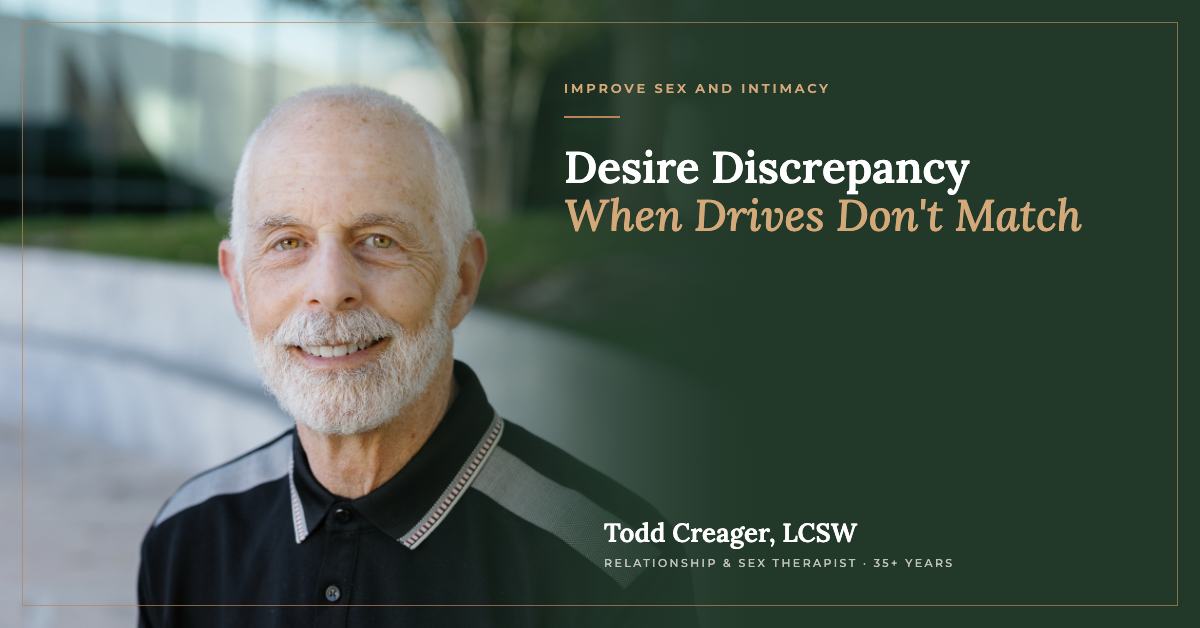

Desire Discrepancy: When Partners Want Different Amounts of Sex

Desire Discrepancy: When Partners Want Different Amounts of Sex

Picture of Todd Creager

Todd Creager

Todd Creager, LCSW, LMFT, is a marriage, relationship and sex therapist who helps couples heal from infidelity, betrayal and years of disconnection, so they can build a long, hot marriage instead of ending one.

35+ years in practice. Certified EMDR therapist. Adjunct lecturer, USC School of Social Work. Bestselling author of The Long, Hot Marriage and Love, Sex and Karaoke. Married, happily, for a long time.

Learn more about Todd: https://toddcreager.com/about/

Ready to talk? See how Todd works with couples and individuals or reach out for a 20-minute phone consult.

KEY TAKEAWAYS

If you and your partner want sex different amounts, here’s what actually matters:

  • Nearly every long-term couple experiences some gap in desire at some point — it’s closer to normal than exceptional.
  • A desire gap doesn’t automatically mean incompatibility, and it’s rarely fixed by simply trying harder.
  • Treating the higher-desire partner as demanding, or the lower-desire partner as broken, tends to make things worse for both.
  • Couples who talk about it openly, without blame, find a workable rhythm far faster than couples who let it stay unspoken.

“Is something wrong with us?” is usually the real question underneath “we want sex different amounts.” I’m Todd Creager, and after 35 years working with couples on exactly this, I can tell you: almost certainly not. This is one of the most common things I address in my practice, and one of the most manageable.

Why Desire Discrepancy Is So Common

Desire is influenced by far more than attraction to your partner — stress, hormones, medication, body image, unresolved conflict, exhaustion, even the season of life you’re in. Two people rarely have identical levels of all these factors at the same time, which means some gap in desire is closer to the norm than the exception.

It’s also not fixed — desire fluctuates for each partner over the course of a relationship, sometimes over the course of a year, sometimes week to week. The couple with matched desire in year two may have a real gap by year twelve, and that’s not a sign anything has gone wrong.

What most people don’t expect: desire discrepancy doesn’t have to mean lower overall satisfaction. Some of the most satisfied couples I work with have a real, ongoing gap — they’ve simply learned to navigate it well.

The Blame Trap Both Partners Fall Into

The higher-desire partner often starts to feel rejected, undesired, or like a burden for wanting what they want. The lower-desire partner often starts to feel pressured, inadequate, or broken for not matching their partner’s drive. Both framings cause real pain, and neither one is accurate.

Wanting sex more often isn’t a character flaw, and not wanting it as often isn’t either. Once couples stop assigning blame to either side, the actual conversation — about what each of you needs and how to meet in the middle — becomes possible.

In my experience, the couples who struggle most with desire discrepancy aren’t the ones with the biggest gap — they’re the ones who’ve let it become an unspoken resentment instead of an open conversation.

How Couples Actually Manage This Well

The goal isn’t matching desire exactly — it’s finding a rhythm that works for both of you, which usually means some compromise from both sides rather than one partner simply adjusting to match the other.

Talking directly about what initiation and connection look like for each of you, without it turning into a negotiation or a scorecard, tends to work far better than either partner silently hoping the other will change. Sometimes this means redefining what intimacy includes beyond intercourse specifically.

If the gap feels significant or is causing real distress, it’s worth exploring whether something specific — stress, a medical factor, unresolved resentment — is driving it, rather than treating the gap itself as the whole problem.

What to Do Next

If desire discrepancy is part of your relationship right now, try this:

  • Have one conversation about it without blame on either side — name it as a gap to navigate together, not a problem either of you caused.
  • Consider what else might be driving the gap: stress, a medical factor, or unresolved tension.
  • Redefine intimacy together beyond just intercourse — there’s more room to connect than either partner might assume.
  • If it feels stuck, that’s a reasonable time to bring in outside support.

Your first step: have one honest, blame-free conversation about what each of you actually needs.

A gap in desire isn’t a verdict on your relationship — it’s something most long-term couples navigate. For the fuller picture on rebuilding intimacy, my complete guide walks through what else helps.

For a deeper guide to navigating intimacy differences as a couple, my resources can help.

Frequently Asked Questions

Q: Is it normal for one partner to want sex more than the other?

A: Yes, very common. Nearly every long-term couple experiences some gap in desire at some point, influenced by stress, hormones, and many other factors unrelated to attraction to the partner.

Q: Does desire discrepancy mean something is wrong with the relationship?

A: Not automatically. Some of the most satisfied long-term couples have an ongoing desire gap — what matters is how openly and blame-free they navigate it together.

Q: How do we talk about mismatched sex drives without hurt feelings?

A: Start by removing blame from the conversation on both sides — name it as a gap to navigate together rather than a flaw in either partner, then talk directly about what each of you needs.

Q: Can desire discrepancy be fixed?

A: The goal isn’t usually eliminating the gap entirely, but finding a workable rhythm that respects both partners’ needs — which is very achievable with open, blame-free communication.

Desire Discrepancy: When Partners Want Different Amounts of Sex

Desire Discrepancy: When Partners Want Different Amounts of Sex

KEY TAKEAWAYS

If you and your partner want sex different amounts, here’s what actually matters:

  • Nearly every long-term couple experiences some gap in desire at some point — it’s closer to normal than exceptional.
  • A desire gap doesn’t automatically mean incompatibility, and it’s rarely fixed by simply trying harder.
  • Treating the higher-desire partner as demanding, or the lower-desire partner as broken, tends to make things worse for both.
  • Couples who talk about it openly, without blame, find a workable rhythm far faster than couples who let it stay unspoken.

“Is something wrong with us?” is usually the real question underneath “we want sex different amounts.” I’m Todd Creager, and after 35 years working with couples on exactly this, I can tell you: almost certainly not. This is one of the most common things I address in my practice, and one of the most manageable.

Why Desire Discrepancy Is So Common

Desire is influenced by far more than attraction to your partner — stress, hormones, medication, body image, unresolved conflict, exhaustion, even the season of life you’re in. Two people rarely have identical levels of all these factors at the same time, which means some gap in desire is closer to the norm than the exception.

It’s also not fixed — desire fluctuates for each partner over the course of a relationship, sometimes over the course of a year, sometimes week to week. The couple with matched desire in year two may have a real gap by year twelve, and that’s not a sign anything has gone wrong.

What most people don’t expect: desire discrepancy doesn’t have to mean lower overall satisfaction. Some of the most satisfied couples I work with have a real, ongoing gap — they’ve simply learned to navigate it well.

The Blame Trap Both Partners Fall Into

The higher-desire partner often starts to feel rejected, undesired, or like a burden for wanting what they want. The lower-desire partner often starts to feel pressured, inadequate, or broken for not matching their partner’s drive. Both framings cause real pain, and neither one is accurate.

Wanting sex more often isn’t a character flaw, and not wanting it as often isn’t either. Once couples stop assigning blame to either side, the actual conversation — about what each of you needs and how to meet in the middle — becomes possible.

In my experience, the couples who struggle most with desire discrepancy aren’t the ones with the biggest gap — they’re the ones who’ve let it become an unspoken resentment instead of an open conversation.

How Couples Actually Manage This Well

The goal isn’t matching desire exactly — it’s finding a rhythm that works for both of you, which usually means some compromise from both sides rather than one partner simply adjusting to match the other.

Talking directly about what initiation and connection look like for each of you, without it turning into a negotiation or a scorecard, tends to work far better than either partner silently hoping the other will change. Sometimes this means redefining what intimacy includes beyond intercourse specifically.

If the gap feels significant or is causing real distress, it’s worth exploring whether something specific — stress, a medical factor, unresolved resentment — is driving it, rather than treating the gap itself as the whole problem.

What to Do Next

If desire discrepancy is part of your relationship right now, try this:

  • Have one conversation about it without blame on either side — name it as a gap to navigate together, not a problem either of you caused.
  • Consider what else might be driving the gap: stress, a medical factor, or unresolved tension.
  • Redefine intimacy together beyond just intercourse — there’s more room to connect than either partner might assume.
  • If it feels stuck, that’s a reasonable time to bring in outside support.

Your first step: have one honest, blame-free conversation about what each of you actually needs.

A gap in desire isn’t a verdict on your relationship — it’s something most long-term couples navigate. For the fuller picture on rebuilding intimacy, my complete guide walks through what else helps.

For a deeper guide to navigating intimacy differences as a couple, my resources can help.

Frequently Asked Questions

Q: Is it normal for one partner to want sex more than the other?

A: Yes, very common. Nearly every long-term couple experiences some gap in desire at some point, influenced by stress, hormones, and many other factors unrelated to attraction to the partner.

Q: Does desire discrepancy mean something is wrong with the relationship?

A: Not automatically. Some of the most satisfied long-term couples have an ongoing desire gap — what matters is how openly and blame-free they navigate it together.

Q: How do we talk about mismatched sex drives without hurt feelings?

A: Start by removing blame from the conversation on both sides — name it as a gap to navigate together rather than a flaw in either partner, then talk directly about what each of you needs.

Q: Can desire discrepancy be fixed?

A: The goal isn’t usually eliminating the gap entirely, but finding a workable rhythm that respects both partners’ needs — which is very achievable with open, blame-free communication.

Reader Interactions

Leave a Reply

Your email address will not be published. Required fields are marked *