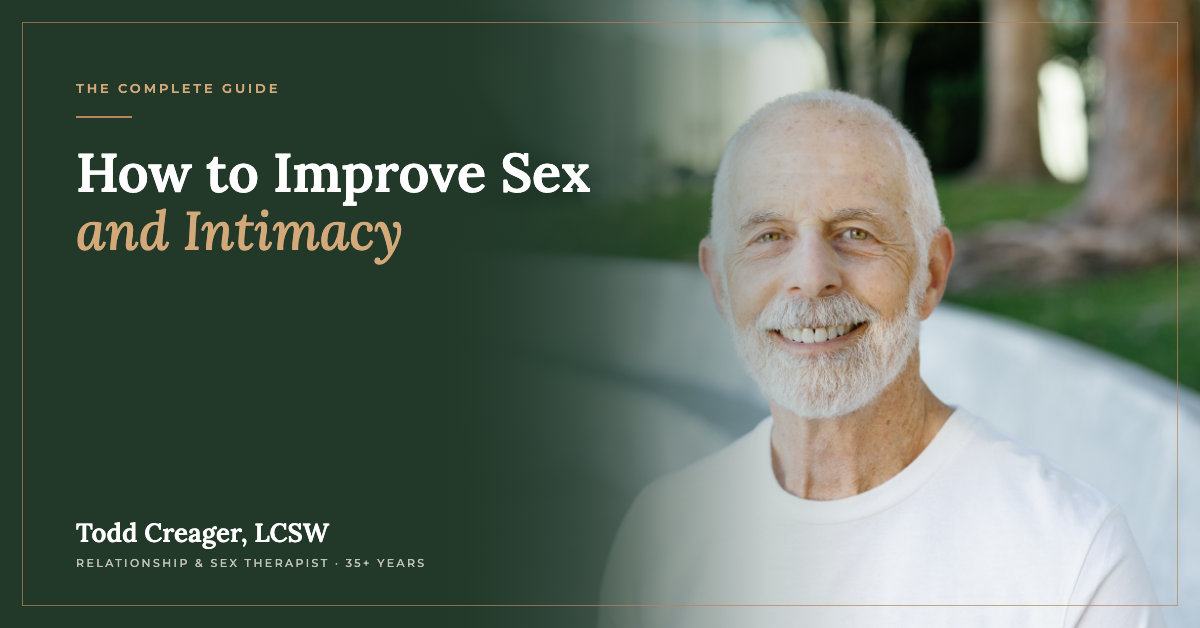

How to Improve Sex and Intimacy

How to Improve Sex and Intimacy

Picture of Todd Creager

Todd Creager

Todd Creager, LCSW, LMFT, is a marriage, relationship and sex therapist who helps couples heal from infidelity, betrayal and years of disconnection, so they can build a long, hot marriage instead of ending one.

35+ years in practice. Certified EMDR therapist. Adjunct lecturer, USC School of Social Work. Bestselling author of The Long, Hot Marriage and Love, Sex and Karaoke. Married, happily, for a long time.

Learn more about Todd: https://toddcreager.com/about/

Ready to talk? See how Todd works with couples and individuals or reach out for a 20-minute phone consult.

KEY TAKEAWAYS

If intimacy has faded or never quite clicked in your relationship, here’s the core of what actually rebuilds it:

  • Sexual intimacy and emotional connection are deeply linked — trying to fix one without the other rarely holds long-term.
  • A gap in desire between partners is common and workable — it’s not automatically a sign something is fundamentally wrong.
  • Intimacy tends to fade through gradual disconnection, not one dramatic event, which means it can be rebuilt the same gradual way.
  • The couples who successfully rebuild intimacy treat it as an ongoing practice, not a problem to solve once and forget.

In more than 35 years as a sex and relationship therapist, I’ve talked with hundreds of couples who love each other and still feel disconnected in the bedroom — or haven’t been in it together in longer than either of them wants to admit.

If that’s you, I want you to know this is one of the most common things I work with, and one of the most workable. This page walks through what actually rebuilds sexual and emotional intimacy, based on what I’ve seen work again and again.

Why Sexual and Emotional Intimacy Can’t Really Be Separated

Couples often try to address a fading sex life in isolation — more effort, more initiation, sometimes just more pressure on themselves to want it more. In my experience, that rarely works for long, because sexual intimacy and emotional connection are far more linked than most people expect.

When emotional connection has quietly faded — through busyness, unresolved resentment, or just years of parallel living — physical intimacy usually fades right along with it, even if neither partner can point to a single reason why. And the reverse is true too: couples who rebuild emotional closeness often find physical intimacy returns with far less effort than they expected.

What surprises people most: pushing for more sex without addressing the emotional distance underneath rarely creates lasting change. It’s treating a symptom while the actual cause keeps running underneath it.

Desire Discrepancy Is Common — and Rarely Means What Couples Fear

Almost every long-term couple experiences some gap in desire at some point — one partner wanting sex more often or differently than the other. This is closer to normal than exceptional, and it doesn’t automatically mean incompatibility or a failing relationship.

The mistake I see most is treating the higher-desire partner as the problem, or the lower-desire partner as broken. Neither framing helps. Desire is influenced by stress, hormones, unresolved conflict, body image, and dozens of other factors that have nothing to do with how much someone loves their partner.

What most couples don’t realize: managing desire discrepancy well is a skill couples build together, not a gap that magically closes on its own. Couples who talk openly about it, without blame, tend to find a workable rhythm far faster than couples who let it become an unspoken tension.

How Intimacy Actually Gets Rebuilt — At Any Stage

Intimacy rarely disappears in one dramatic moment. It fades the way most things fade in long relationships — gradually, through busyness and routine. Which means it gets rebuilt the same way: gradually, through consistent small efforts rather than one big romantic reset.

Rebuilding non-sexual touch and emotional connection first tends to work better than pushing straight back into a full sex life. Affection without an agenda, real conversations about what each of you actually wants, and simply making space for connection again — these lay the groundwork physical intimacy depends on.

This looks different depending on your stage of life and relationship — rebuilding intimacy after decades together, after infidelity, or after a major life change like a new baby or menopause, all call for slightly different approaches, though the underlying principles are the same.

What to Do Next

If you want to start rebuilding intimacy this week, here’s where to begin:

  • Reintroduce non-sexual affection — touch without an agenda — before focusing on rebuilding a full sex life.
  • Have one honest, blame-free conversation about desire differences, rather than letting it stay unspoken.
  • Notice whether emotional distance, not physical disinterest, might be the real thing to address first.
  • Don’t treat this as a one-time fix — intimacy is an ongoing practice, not a problem solved once.

Your first step: pick one evening this week for affectionate, no-agenda connection — no expectation it leads anywhere.

Intimacy that’s faded can be rebuilt — often more fully than couples expect, once both the emotional and physical sides get real attention. I offer sex and relationship therapy in my Huntington Beach office and virtually, anywhere. Book a free consultation.

For a deeper guide to rebuilding intimacy in a long-term relationship, my resources can help.

Frequently Asked Questions

Q: Why has intimacy faded in my long-term relationship?

A: Most often through gradual disconnection — busyness, unresolved resentment, or years of parallel living — rather than one dramatic event. Because it fades gradually, it can also be rebuilt gradually, through consistent effort.

Q: Is it normal for partners to want sex different amounts?

A: Yes, extremely common. A gap in desire between partners doesn’t automatically signal incompatibility — it’s influenced by stress, hormones, and many other factors, and it’s a workable difference for most couples.

Q: Can emotional connection actually improve your sex life?

A: Yes. Sexual and emotional intimacy are closely linked, and rebuilding emotional closeness often brings physical intimacy back with far less effort than trying to fix the physical side in isolation.

Q: Is it too late to rebuild intimacy after years of distance?

A: No. Intimacy can be rebuilt at any stage, including after decades of distance — it typically takes consistent small efforts over time rather than one dramatic reset.

How to Improve Sex and Intimacy

How to Improve Sex and Intimacy

KEY TAKEAWAYS

If intimacy has faded or never quite clicked in your relationship, here’s the core of what actually rebuilds it:

  • Sexual intimacy and emotional connection are deeply linked — trying to fix one without the other rarely holds long-term.
  • A gap in desire between partners is common and workable — it’s not automatically a sign something is fundamentally wrong.
  • Intimacy tends to fade through gradual disconnection, not one dramatic event, which means it can be rebuilt the same gradual way.
  • The couples who successfully rebuild intimacy treat it as an ongoing practice, not a problem to solve once and forget.

In more than 35 years as a sex and relationship therapist, I’ve talked with hundreds of couples who love each other and still feel disconnected in the bedroom — or haven’t been in it together in longer than either of them wants to admit.

If that’s you, I want you to know this is one of the most common things I work with, and one of the most workable. This page walks through what actually rebuilds sexual and emotional intimacy, based on what I’ve seen work again and again.

Why Sexual and Emotional Intimacy Can’t Really Be Separated

Couples often try to address a fading sex life in isolation — more effort, more initiation, sometimes just more pressure on themselves to want it more. In my experience, that rarely works for long, because sexual intimacy and emotional connection are far more linked than most people expect.

When emotional connection has quietly faded — through busyness, unresolved resentment, or just years of parallel living — physical intimacy usually fades right along with it, even if neither partner can point to a single reason why. And the reverse is true too: couples who rebuild emotional closeness often find physical intimacy returns with far less effort than they expected.

What surprises people most: pushing for more sex without addressing the emotional distance underneath rarely creates lasting change. It’s treating a symptom while the actual cause keeps running underneath it.

Desire Discrepancy Is Common — and Rarely Means What Couples Fear

Almost every long-term couple experiences some gap in desire at some point — one partner wanting sex more often or differently than the other. This is closer to normal than exceptional, and it doesn’t automatically mean incompatibility or a failing relationship.

The mistake I see most is treating the higher-desire partner as the problem, or the lower-desire partner as broken. Neither framing helps. Desire is influenced by stress, hormones, unresolved conflict, body image, and dozens of other factors that have nothing to do with how much someone loves their partner.

What most couples don’t realize: managing desire discrepancy well is a skill couples build together, not a gap that magically closes on its own. Couples who talk openly about it, without blame, tend to find a workable rhythm far faster than couples who let it become an unspoken tension.

How Intimacy Actually Gets Rebuilt — At Any Stage

Intimacy rarely disappears in one dramatic moment. It fades the way most things fade in long relationships — gradually, through busyness and routine. Which means it gets rebuilt the same way: gradually, through consistent small efforts rather than one big romantic reset.

Rebuilding non-sexual touch and emotional connection first tends to work better than pushing straight back into a full sex life. Affection without an agenda, real conversations about what each of you actually wants, and simply making space for connection again — these lay the groundwork physical intimacy depends on.

This looks different depending on your stage of life and relationship — rebuilding intimacy after decades together, after infidelity, or after a major life change like a new baby or menopause, all call for slightly different approaches, though the underlying principles are the same.

What to Do Next

If you want to start rebuilding intimacy this week, here’s where to begin:

  • Reintroduce non-sexual affection — touch without an agenda — before focusing on rebuilding a full sex life.
  • Have one honest, blame-free conversation about desire differences, rather than letting it stay unspoken.
  • Notice whether emotional distance, not physical disinterest, might be the real thing to address first.
  • Don’t treat this as a one-time fix — intimacy is an ongoing practice, not a problem solved once.

Your first step: pick one evening this week for affectionate, no-agenda connection — no expectation it leads anywhere.

Intimacy that’s faded can be rebuilt — often more fully than couples expect, once both the emotional and physical sides get real attention. I offer sex and relationship therapy in my Huntington Beach office and virtually, anywhere. Book a free consultation.

For a deeper guide to rebuilding intimacy in a long-term relationship, my resources can help.

Frequently Asked Questions

Q: Why has intimacy faded in my long-term relationship?

A: Most often through gradual disconnection — busyness, unresolved resentment, or years of parallel living — rather than one dramatic event. Because it fades gradually, it can also be rebuilt gradually, through consistent effort.

Q: Is it normal for partners to want sex different amounts?

A: Yes, extremely common. A gap in desire between partners doesn’t automatically signal incompatibility — it’s influenced by stress, hormones, and many other factors, and it’s a workable difference for most couples.

Q: Can emotional connection actually improve your sex life?

A: Yes. Sexual and emotional intimacy are closely linked, and rebuilding emotional closeness often brings physical intimacy back with far less effort than trying to fix the physical side in isolation.

Q: Is it too late to rebuild intimacy after years of distance?

A: No. Intimacy can be rebuilt at any stage, including after decades of distance — it typically takes consistent small efforts over time rather than one dramatic reset.

Reader Interactions

Leave a Reply

Your email address will not be published. Required fields are marked *