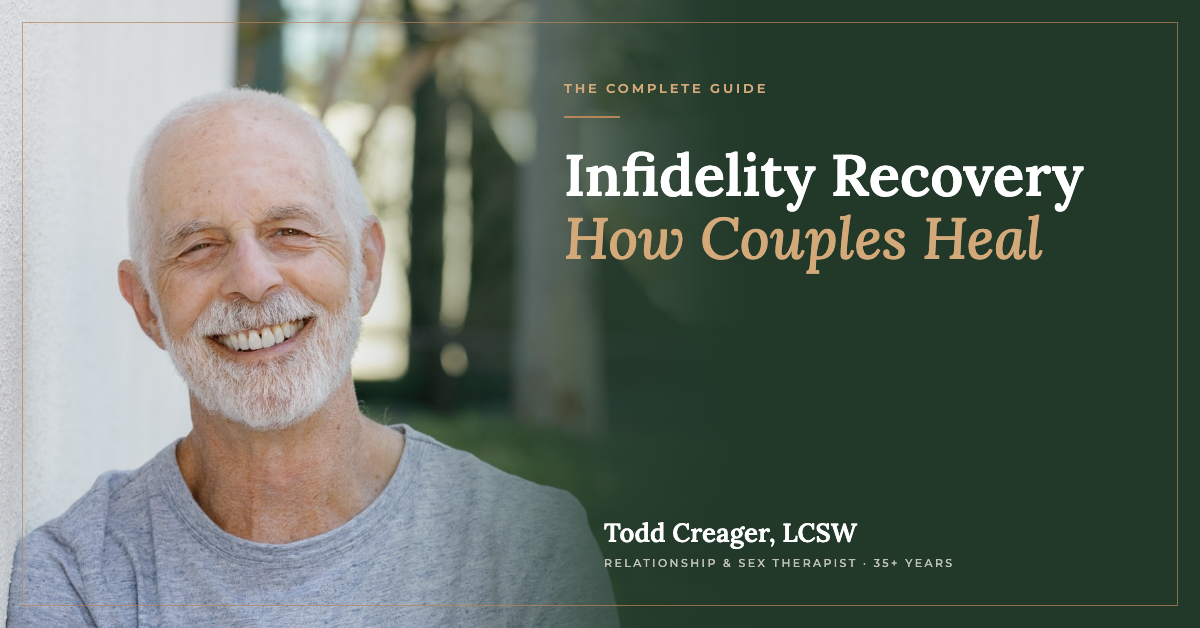

Infidelity Recovery: How Couples Heal After an Affair

Infidelity Recovery: How Couples Heal After an Affair

Picture of Todd Creager

Todd Creager

Todd Creager, LCSW, LMFT, is a marriage, relationship and sex therapist who helps couples heal from infidelity, betrayal and years of disconnection, so they can build a long, hot marriage instead of ending one.

35+ years in practice. Certified EMDR therapist. Adjunct lecturer, USC School of Social Work. Bestselling author of The Long, Hot Marriage and Love, Sex and Karaoke. Married, happily, for a long time.

Learn more about Todd: https://toddcreager.com/about/

Ready to talk? See how Todd works with couples and individuals or reach out for a 20-minute phone consult.

KEY TAKEAWAYS

Infidelity recovery is possible for most couples who commit to it — but it follows a real process, not a pep talk. Here’s the core of it:

  •  In Todd Creager’s practice, roughly 90% of couples who commit to structured infidelity recovery stay together — often in a stronger, more honest relationship than before.
  • Recovery moves through five stages: crisis stabilization, understanding, rebuilding trust, reconnecting, and post-traumatic growth — and it’s rarely a straight line.
  • Healing requires both the betrayed partner and the partner who betrayed to do their own work — not just one person changing while the other waits.
  • Pain can’t be bypassed on the way to healing. Couples who try to skip it by rushing to “move on” tend to end up back in crisis later.

If you’re reading this, you or someone you love is probably in one of the hardest weeks of a relationship’s life. I want to say the thing you need to hear first: infidelity recovery is possible. Not guaranteed, not automatic — but possible, and more common than the panic in your chest is telling you right now.

I’ve spent more than 35 years sitting with partners in pain on both sides of an affair, and about 90% of the couples who commit to the process I use in my practice don’t just survive — they build something more honest than what they had before. This page is the roadmap for how that actually happens: the real stages, the mistakes that stall healing, and where to start today.

Yes, Marriages Can Survive Infidelity — Here’s What Actually Determines It

Survival after an affair isn’t a coin flip, and it isn’t guaranteed either — it’s determined by specific, learnable behaviors, not by how bad the affair was. I’ve worked with couples who survived brief affairs and couples who didn’t survive an emotional connection that never became physical. The severity of the betrayal matters less than what both partners do next.

In my practice, the couples who heal share a pattern: the partner who betrayed ends the affair completely, with no ambiguous “closure” contact. Both partners stay curious about what happened instead of only defending or only attacking. And — this is the part almost nobody expects — the affair eventually stops being the only story of the relationship. It becomes a chapter, a hard one, not the whole book.

Here’s what surprises people most: couples who look the strongest in week one sometimes stall by month three, because they skip the pain instead of moving through it. I call this a pain bypass — rushing to “be okay” or “move on” before the betrayed partner has actually processed what happened. It looks like progress. It’s usually a delay. The couples with the real advantage aren’t the calmest ones — they’re the ones willing to stay present in the discomfort together.

The 5 Stages of Infidelity Recovery — and Why Skipping One Backfires

Every couple’s path looks different on the surface, but underneath, infidelity recovery moves through five predictable stages. Knowing them doesn’t make the pain smaller, but it makes it less frightening — you can recognize where you are instead of feeling like you’re lost in it.

Stage one is crisis and stabilization — the first days and weeks, where the only job is to stop the bleeding: end the affair, establish basic safety, and function day to day.

Stage two is understanding — not an interrogation of every detail, but an honest look at how this became possible in the relationship or in the partner who betrayed.

Stage three is rebuilding trust, which happens through consistency, not promises.

Stage four is reconnecting — affection, friendship, and eventually sexual intimacy start coming back, usually awkwardly at first.

Stage five is post-traumatic growth — the stage most couples don’t believe exists until they’re standing in it, where the relationship becomes more consciously chosen than it ever was before.

The mistake I see constantly is couples treating these stages as a checklist to complete quickly. They’re not linear. Couples loop back to earlier stages after a trigger — an anniversary, an unexpected reminder — and that’s not failure, that’s how healing from a real wound actually works. Expect one to two years to move through the full arc, with the sharpest pain easing well before that.

What Most Couples Get Wrong About Healing From an Affair

The single biggest mistake I see is one or both partners trying to escape from pain instead of moving through it — whether that’s the betrayed partner going numb and hyper-focused on logistics, or the partner who betrayed rushing apologies to avoid sitting with their own shame.

It shows up in specific, recognizable ways: demanding or offering every graphic detail of the affair, which retraumatizes rather than heals. Pretending it never happened and going silent. Secret contact with the affair partner “to be polite.” Using the affair as a permanent weapon in every future argument. Making the divorce decision in week one, when the nervous system is in no state to choose anything permanent.

What most people don’t realize is that both partners have real healing to do — not just the betrayed partner. The partner who betrayed is often carrying shame, fear, and sometimes an untreated pattern underneath the affair itself — unresolved trauma, an addiction, or a habit of using an escape from pain instead of facing it directly. Recovery that only focuses on rebuilding the betrayed partner’s trust, without addressing what drove the partner who betrayed, tends to relapse. Both people need to build new emotional muscles — the capacity to stay present with each other in discomfort instead of shutting down or running.

What to Do Next

If you’re in the middle of this right now, here’s where to actually start — not everything at once, just the next right step:

  • Don’t make permanent decisions this week. Let the acute crisis settle before deciding anything about the future of the relationship.
  • Get curious, not just defensive or accusatory — about what the affair might be revealing about the relationship or about the partner who betrayed.
  • Choose one or two genuinely safe people to talk to — not the whole family. You can’t untell people later.
  • Get support sooner than feels necessary. A guide who’s walked this road hundreds of times can shortcut months of wrong turns.

Your first step today: download the free checklist below — it’s the same first ten steps I give my private clients in crisis.

You don’t have to have this figured out today. Six months ago, the couples I’m currently watching heal were exactly where you are right now — in the panic, not sure survival was even possible. Most of them are still together. Many of them will tell you, a year or two out, that this became the turning point rather than the ending.

If you want a guide through this instead of navigating it blind, I offer infidelity therapy in my Huntington Beach office and virtually, anywhere.

For the same first steps I give my private clients in crisis, grab the free checklist below — it’s a good place to start today, whether or not you ever work with me.
Frequently Asked Questions

Q: Can a marriage survive infidelity?

A: Yes, in most cases where both partners commit to the recovery process. In Todd Creager’s practice, roughly 90% of couples who do the work stay together and report a stronger relationship than before the affair. The deciding factor isn’t the affair itself — it’s whether both partners engage.

Q: How long does infidelity recovery take?

A: Most couples doing genuine work move through the stages of recovery over one to two years, though the sharpest pain typically eases well before that. Recovery isn’t linear — expect to loop back to earlier stages after triggers like anniversaries.

Q: Do both partners need therapy after an affair?

A: Ideally, yes. The betrayed partner needs support processing the trauma of discovery, and the partner who betrayed often has their own underlying patterns — shame, avoidance, or unresolved wounds — that need attention for recovery to hold long-term.

Q: What’s the first step after discovering an affair?

A: Stabilize before you decide anything permanent. In the first days, the goal is safety and function — not solving the marriage’s future. A structured first-steps guide, like a checklist built for the first 30 days, can help you avoid the most common early mistakes.

Infidelity Recovery: How Couples Heal After an Affair

Infidelity Recovery: How Couples Heal After an Affair

KEY TAKEAWAYS

Infidelity recovery is possible for most couples who commit to it — but it follows a real process, not a pep talk. Here’s the core of it:

  •  In Todd Creager’s practice, roughly 90% of couples who commit to structured infidelity recovery stay together — often in a stronger, more honest relationship than before.
  • Recovery moves through five stages: crisis stabilization, understanding, rebuilding trust, reconnecting, and post-traumatic growth — and it’s rarely a straight line.
  • Healing requires both the betrayed partner and the partner who betrayed to do their own work — not just one person changing while the other waits.
  • Pain can’t be bypassed on the way to healing. Couples who try to skip it by rushing to “move on” tend to end up back in crisis later.

If you’re reading this, you or someone you love is probably in one of the hardest weeks of a relationship’s life. I want to say the thing you need to hear first: infidelity recovery is possible. Not guaranteed, not automatic — but possible, and more common than the panic in your chest is telling you right now.

I’ve spent more than 35 years sitting with partners in pain on both sides of an affair, and about 90% of the couples who commit to the process I use in my practice don’t just survive — they build something more honest than what they had before. This page is the roadmap for how that actually happens: the real stages, the mistakes that stall healing, and where to start today.

Yes, Marriages Can Survive Infidelity — Here’s What Actually Determines It

Survival after an affair isn’t a coin flip, and it isn’t guaranteed either — it’s determined by specific, learnable behaviors, not by how bad the affair was. I’ve worked with couples who survived brief affairs and couples who didn’t survive an emotional connection that never became physical. The severity of the betrayal matters less than what both partners do next.

In my practice, the couples who heal share a pattern: the partner who betrayed ends the affair completely, with no ambiguous “closure” contact. Both partners stay curious about what happened instead of only defending or only attacking. And — this is the part almost nobody expects — the affair eventually stops being the only story of the relationship. It becomes a chapter, a hard one, not the whole book.

Here’s what surprises people most: couples who look the strongest in week one sometimes stall by month three, because they skip the pain instead of moving through it. I call this a pain bypass — rushing to “be okay” or “move on” before the betrayed partner has actually processed what happened. It looks like progress. It’s usually a delay. The couples with the real advantage aren’t the calmest ones — they’re the ones willing to stay present in the discomfort together.

The 5 Stages of Infidelity Recovery — and Why Skipping One Backfires

Every couple’s path looks different on the surface, but underneath, infidelity recovery moves through five predictable stages. Knowing them doesn’t make the pain smaller, but it makes it less frightening — you can recognize where you are instead of feeling like you’re lost in it.

Stage one is crisis and stabilization — the first days and weeks, where the only job is to stop the bleeding: end the affair, establish basic safety, and function day to day.

Stage two is understanding — not an interrogation of every detail, but an honest look at how this became possible in the relationship or in the partner who betrayed.

Stage three is rebuilding trust, which happens through consistency, not promises.

Stage four is reconnecting — affection, friendship, and eventually sexual intimacy start coming back, usually awkwardly at first.

Stage five is post-traumatic growth — the stage most couples don’t believe exists until they’re standing in it, where the relationship becomes more consciously chosen than it ever was before.

The mistake I see constantly is couples treating these stages as a checklist to complete quickly. They’re not linear. Couples loop back to earlier stages after a trigger — an anniversary, an unexpected reminder — and that’s not failure, that’s how healing from a real wound actually works. Expect one to two years to move through the full arc, with the sharpest pain easing well before that.

What Most Couples Get Wrong About Healing From an Affair

The single biggest mistake I see is one or both partners trying to escape from pain instead of moving through it — whether that’s the betrayed partner going numb and hyper-focused on logistics, or the partner who betrayed rushing apologies to avoid sitting with their own shame.

It shows up in specific, recognizable ways: demanding or offering every graphic detail of the affair, which retraumatizes rather than heals. Pretending it never happened and going silent. Secret contact with the affair partner “to be polite.” Using the affair as a permanent weapon in every future argument. Making the divorce decision in week one, when the nervous system is in no state to choose anything permanent.

What most people don’t realize is that both partners have real healing to do — not just the betrayed partner. The partner who betrayed is often carrying shame, fear, and sometimes an untreated pattern underneath the affair itself — unresolved trauma, an addiction, or a habit of using an escape from pain instead of facing it directly. Recovery that only focuses on rebuilding the betrayed partner’s trust, without addressing what drove the partner who betrayed, tends to relapse. Both people need to build new emotional muscles — the capacity to stay present with each other in discomfort instead of shutting down or running.

What to Do Next

If you’re in the middle of this right now, here’s where to actually start — not everything at once, just the next right step:

  • Don’t make permanent decisions this week. Let the acute crisis settle before deciding anything about the future of the relationship.
  • Get curious, not just defensive or accusatory — about what the affair might be revealing about the relationship or about the partner who betrayed.
  • Choose one or two genuinely safe people to talk to — not the whole family. You can’t untell people later.
  • Get support sooner than feels necessary. A guide who’s walked this road hundreds of times can shortcut months of wrong turns.

Your first step today: download the free checklist below — it’s the same first ten steps I give my private clients in crisis.

You don’t have to have this figured out today. Six months ago, the couples I’m currently watching heal were exactly where you are right now — in the panic, not sure survival was even possible. Most of them are still together. Many of them will tell you, a year or two out, that this became the turning point rather than the ending.

If you want a guide through this instead of navigating it blind, I offer infidelity therapy in my Huntington Beach office and virtually, anywhere.

For the same first steps I give my private clients in crisis, grab the free checklist below — it’s a good place to start today, whether or not you ever work with me.

Frequently Asked Questions

Q: Can a marriage survive infidelity?

A: Yes, in most cases where both partners commit to the recovery process. In Todd Creager’s practice, roughly 90% of couples who do the work stay together and report a stronger relationship than before the affair. The deciding factor isn’t the affair itself — it’s whether both partners engage.

Q: How long does infidelity recovery take?

A: Most couples doing genuine work move through the stages of recovery over one to two years, though the sharpest pain typically eases well before that. Recovery isn’t linear — expect to loop back to earlier stages after triggers like anniversaries.

Q: Do both partners need therapy after an affair?

A: Ideally, yes. The betrayed partner needs support processing the trauma of discovery, and the partner who betrayed often has their own underlying patterns — shame, avoidance, or unresolved wounds — that need attention for recovery to hold long-term.

Q: What’s the first step after discovering an affair?

A: Stabilize before you decide anything permanent. In the first days, the goal is safety and function — not solving the marriage’s future. A structured first-steps guide, like a checklist built for the first 30 days, can help you avoid the most common early mistakes.

Reader Interactions

Leave a Reply

Your email address will not be published. Required fields are marked *