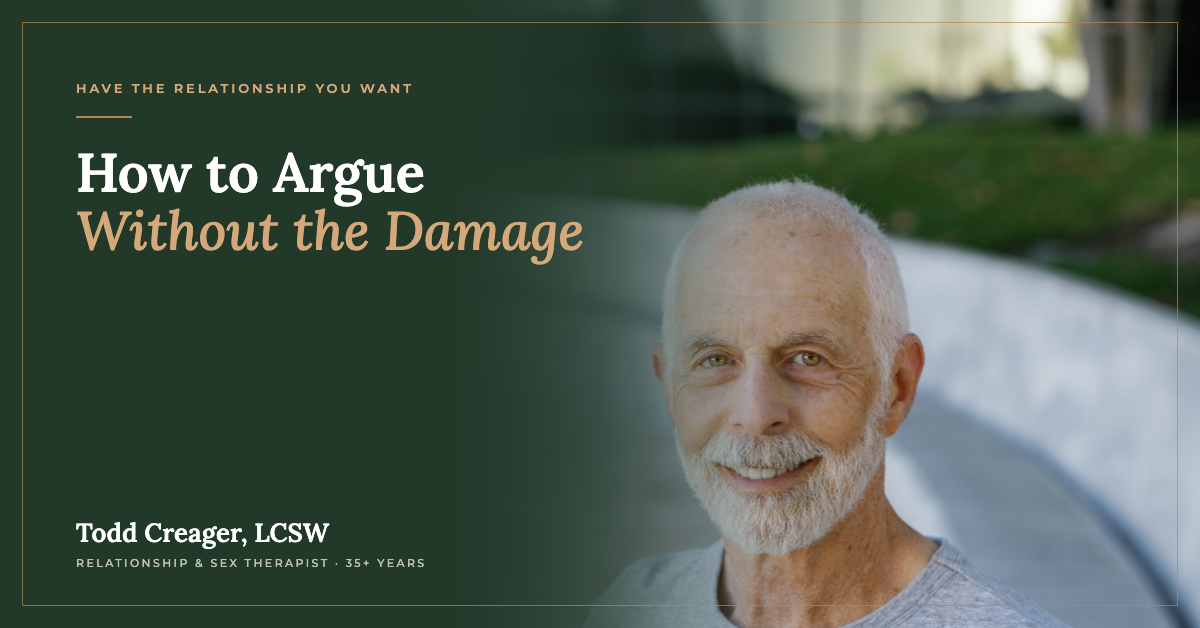

How to Argue Without Damaging Your Relationship

How to Argue Without Damaging Your Relationship

Picture of Todd Creager

Todd Creager

Todd Creager, LCSW, LMFT, is a marriage, relationship and sex therapist who helps couples heal from infidelity, betrayal and years of disconnection, so they can build a long, hot marriage instead of ending one.

35+ years in practice. Certified EMDR therapist. Adjunct lecturer, USC School of Social Work. Bestselling author of The Long, Hot Marriage and Love, Sex and Karaoke. Married, happily, for a long time.

Learn more about Todd: https://toddcreager.com/about/

Ready to talk? See how Todd works with couples and individuals or reach out for a 20-minute phone consult.

KEY TAKEAWAYS

Arguing isn’t the problem in a relationship — how you argue is. Here’s what actually matters:

  • Healthy couples argue just as often as struggling couples — the real difference is whether they know how to repair afterward.
  • A repair attempt — any small gesture that says “let’s not be at odds” — is one of the strongest predictors of a lasting relationship.
  • Arguments that stay focused on one specific issue do far less damage than arguments that spiral into everything at once.
  • Taking a break during a heated moment only helps if you come back to finish the conversation — otherwise it’s avoidance wearing a healthier costume.

I want to say something that surprises a lot of couples in my office: I’m not trying to help you argue less. I’m Todd Creager, and after 35 years of watching relationships up close, I can tell you that healthy couples argue plenty. What predicts whether a relationship lasts isn’t how often you disagree — it’s what happens in the minutes after.

Healthy Couples Still Argue — Here’s What’s Actually Different

Struggling couples and thriving couples argue about remarkably similar things — money, chores, time, family. The frequency isn’t the differentiator. What separates them is whether the argument stays contained to the actual issue, or spirals into a referendum on the whole relationship.

In a healthy argument, both partners are still, underneath the disagreement, on the same team trying to solve a shared problem. In a damaging one, it becomes you-versus-me instead of us-versus-the-problem. That shift is subtle in the moment and enormous in its effect.

What most people don’t expect: the goal isn’t to never feel flooded or frustrated during conflict. It’s to notice it happening and know how to bring the conversation back before it does lasting damage.

The Repair Attempt: The Single Most Important Skill

A repair attempt is any small gesture, in the middle of or after conflict, that signals “let’s not be at odds.” It can be an apology, a hand on the shoulder, even humor — “can we start this over?” said with a small smile.

What matters isn’t how polished the repair attempt is. It’s whether it gets offered, and whether it gets received. Couples in distress often miss each other’s repair attempts entirely, because they’re too flooded to notice the olive branch being extended.

This is where practicing outside of conflict pays off — agreeing in advance on a phrase or gesture that signals repair, so it’s recognizable even in the heat of a hard moment, rather than something you’re inventing on the spot.

Rules for Fighting Fair — What to Actually Do Differently

Stay on the one issue you started with. The moment an argument becomes “and another thing,” it stops being solvable and starts being overwhelming for both of you.

If you need a break, name it and commit to returning: “I need 20 minutes, and I want to come back to this” — not walking away and hoping it dissolves on its own, which usually just delays the same fight to next week.

And watch for the four patterns that predict real relationship damage — criticism, contempt, defensiveness, and stonewalling. Contempt in particular, the eye-roll or the sarcastic dig, is the one I watch most closely in my office, because it communicates disrespect in a way partners rarely fully recover from without real repair work.

What to Do Next

Next time you’re in a disagreement, try this:

  • Notice if the argument is staying on one issue or starting to spiral — name it if it’s spiraling.
  • Offer or accept a repair attempt, even a small one — don’t wait for the “perfect” apology.
  • If you take a break, commit out loud to coming back to finish the conversation.
  • Watch for contempt specifically — it does more damage than almost anything else said in an argument.

Your first step: agree together, outside of conflict, on a phrase you’ll both use to signal a repair attempt.

Arguing well is a skill, not a personality trait — and like any skill, it gets easier with practice. For the fuller picture on building lasting connection, my complete guide walks through what comes next.

For the core habits that build lasting connection, including how to fight fair, grab my free guide, the 7 Keys to a Satisfying, Sexy Life.

Frequently Asked Questions

Q: Is it bad to argue a lot in a relationship?

A: Not necessarily. Healthy couples argue about as often as struggling couples — what predicts a lasting relationship is whether both partners know how to repair afterward, not how often disagreements happen.

Q: What is a repair attempt in a relationship?

A: A repair attempt is any small gesture during or after conflict that signals a desire to reconnect — an apology, humor, or physical affection. Couples who notice and accept each other’s repair attempts recover from conflict far faster.

Q: Should we take a break during an argument?

A: Yes, if it’s genuinely needed to avoid flooding — but name it and commit to returning, such as “I need 20 minutes and then I want to finish this.” A break without a return plan tends to function as avoidance.

Q: What’s the most damaging thing said in arguments?

A: Contempt — sarcasm, eye-rolling, or mockery aimed at your partner — tends to cause the deepest and longest-lasting damage of any conflict pattern, more than raised voices or disagreement itself.

How to Argue Without Damaging Your Relationship

How to Argue Without Damaging Your Relationship

KEY TAKEAWAYS

Arguing isn’t the problem in a relationship — how you argue is. Here’s what actually matters:

  • Healthy couples argue just as often as struggling couples — the real difference is whether they know how to repair afterward.
  • A repair attempt — any small gesture that says “let’s not be at odds” — is one of the strongest predictors of a lasting relationship.
  • Arguments that stay focused on one specific issue do far less damage than arguments that spiral into everything at once.
  • Taking a break during a heated moment only helps if you come back to finish the conversation — otherwise it’s avoidance wearing a healthier costume.

I want to say something that surprises a lot of couples in my office: I’m not trying to help you argue less. I’m Todd Creager, and after 35 years of watching relationships up close, I can tell you that healthy couples argue plenty. What predicts whether a relationship lasts isn’t how often you disagree — it’s what happens in the minutes after.

Healthy Couples Still Argue — Here’s What’s Actually Different

Struggling couples and thriving couples argue about remarkably similar things — money, chores, time, family. The frequency isn’t the differentiator. What separates them is whether the argument stays contained to the actual issue, or spirals into a referendum on the whole relationship.

In a healthy argument, both partners are still, underneath the disagreement, on the same team trying to solve a shared problem. In a damaging one, it becomes you-versus-me instead of us-versus-the-problem. That shift is subtle in the moment and enormous in its effect.

What most people don’t expect: the goal isn’t to never feel flooded or frustrated during conflict. It’s to notice it happening and know how to bring the conversation back before it does lasting damage.

The Repair Attempt: The Single Most Important Skill

A repair attempt is any small gesture, in the middle of or after conflict, that signals “let’s not be at odds.” It can be an apology, a hand on the shoulder, even humor — “can we start this over?” said with a small smile.

What matters isn’t how polished the repair attempt is. It’s whether it gets offered, and whether it gets received. Couples in distress often miss each other’s repair attempts entirely, because they’re too flooded to notice the olive branch being extended.

This is where practicing outside of conflict pays off — agreeing in advance on a phrase or gesture that signals repair, so it’s recognizable even in the heat of a hard moment, rather than something you’re inventing on the spot.

Rules for Fighting Fair — What to Actually Do Differently

Stay on the one issue you started with. The moment an argument becomes “and another thing,” it stops being solvable and starts being overwhelming for both of you.

If you need a break, name it and commit to returning: “I need 20 minutes, and I want to come back to this” — not walking away and hoping it dissolves on its own, which usually just delays the same fight to next week.

And watch for the four patterns that predict real relationship damage — criticism, contempt, defensiveness, and stonewalling. Contempt in particular, the eye-roll or the sarcastic dig, is the one I watch most closely in my office, because it communicates disrespect in a way partners rarely fully recover from without real repair work.

What to Do Next

Next time you’re in a disagreement, try this:

  • Notice if the argument is staying on one issue or starting to spiral — name it if it’s spiraling.
  • Offer or accept a repair attempt, even a small one — don’t wait for the “perfect” apology.
  • If you take a break, commit out loud to coming back to finish the conversation.
  • Watch for contempt specifically — it does more damage than almost anything else said in an argument.

Your first step: agree together, outside of conflict, on a phrase you’ll both use to signal a repair attempt.

Arguing well is a skill, not a personality trait — and like any skill, it gets easier with practice. For the fuller picture on building lasting connection, my complete guide walks through what comes next.

For the core habits that build lasting connection, including how to fight fair, grab my free guide, the 7 Keys to a Satisfying, Sexy Life.

Frequently Asked Questions

Q: Is it bad to argue a lot in a relationship?

A: Not necessarily. Healthy couples argue about as often as struggling couples — what predicts a lasting relationship is whether both partners know how to repair afterward, not how often disagreements happen.

Q: What is a repair attempt in a relationship?

A: A repair attempt is any small gesture during or after conflict that signals a desire to reconnect — an apology, humor, or physical affection. Couples who notice and accept each other’s repair attempts recover from conflict far faster.

Q: Should we take a break during an argument?

A: Yes, if it’s genuinely needed to avoid flooding — but name it and commit to returning, such as “I need 20 minutes and then I want to finish this.” A break without a return plan tends to function as avoidance.

Q: What’s the most damaging thing said in arguments?

A: Contempt — sarcasm, eye-rolling, or mockery aimed at your partner — tends to cause the deepest and longest-lasting damage of any conflict pattern, more than raised voices or disagreement itself.

Reader Interactions

Leave a Reply

Your email address will not be published. Required fields are marked *