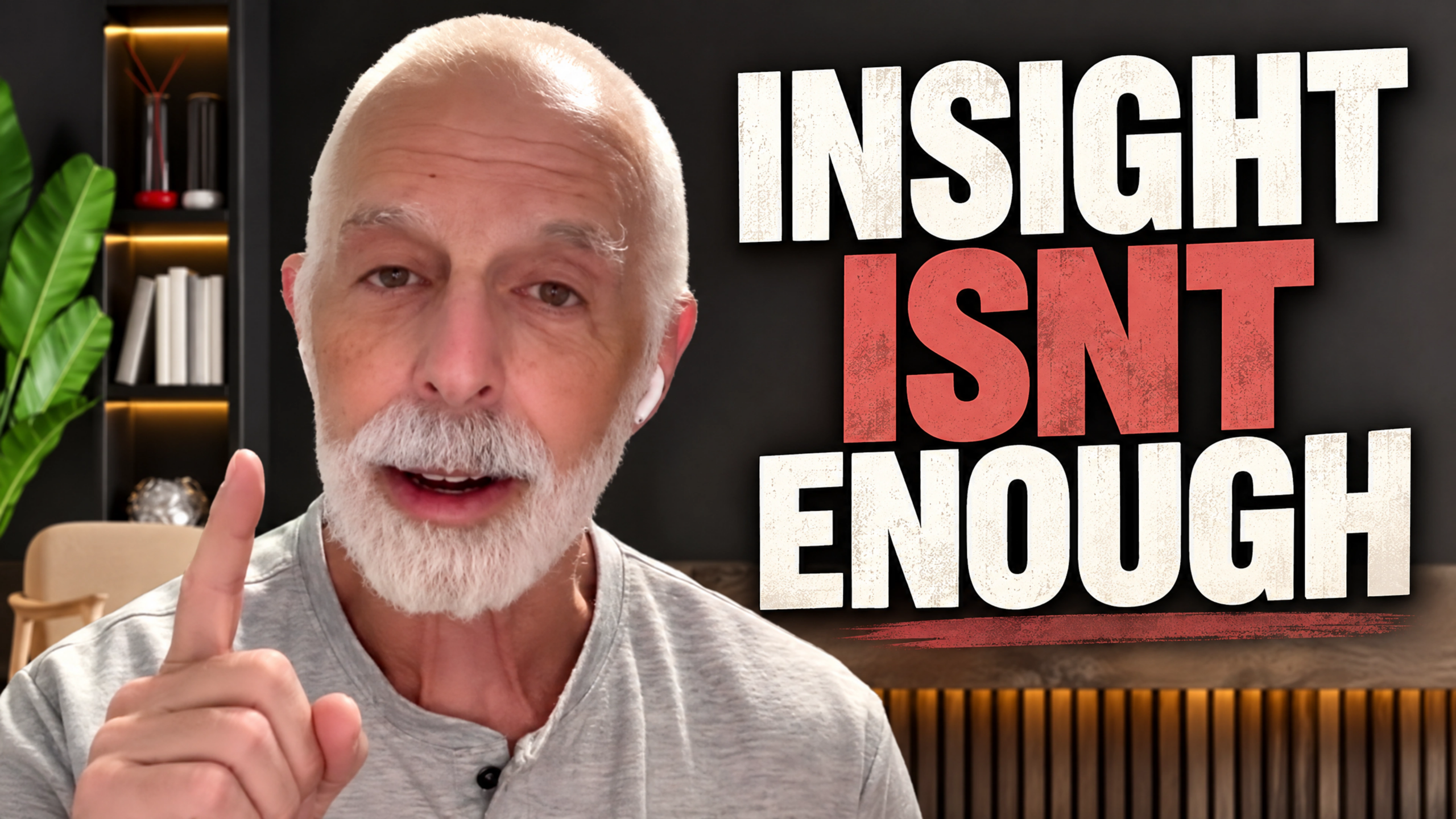

Why Talk Therapy Alone Doesn't Work

Why Talk Therapy Doesn’t Work (And What Does)

Key Takeaways

Why Talk Therapy Doesn’t Work — And What Your Parts Are Actually Waiting For

  • Understanding a pattern and changing a pattern are two different things. Years of therapy can give you the first without ever giving you the second.
  • Your protective parts and your wounded parts don’t live in your story. They live in your body and your nervous system, which is why narrative alone rarely reaches them.
  • Talking about a part isn’t the same as being with a part. Being with it is what allows the burden to lift.
  • Protectors don’t step aside because you analyzed them. They step aside when they trust that the Self can handle what’s underneath.
  • If you’ve done the work and you’re still stuck, the problem wasn’t your effort. Nobody helped you get to the parts.

There’s something I hear in my office almost every week, usually said with a kind of exhausted shrug: “I’ve been in therapy for years.”

And they have. They can name the wound. They can trace it back to the exact year it started. They can explain, in detail, why they react the way they do. Then their partner hits that one nerve, and they flood the same way they flooded at twenty-five. The protector fires. The wounded part still runs the show in the background.

Nothing in the system moved.

I want to walk you through why that happens, what traditional talk therapy tends to miss, and what actually reaches a part that’s been carrying something for thirty years. Because being stuck after all that work does not mean you failed at it.


Why Talk Therapy Doesn’t Work When You Already Understand Yourself

Understanding yourself is a good thing. It’s just not enough on its own.

Traditional talk therapy tends to stay in the narrative — your story, your history, what happened and why it made sense. That has real value. I taught this material for years as a professor and I’d never tell you that understanding your history is wasted time. But the parts of you that keep the pattern alive were never living in that narrative to begin with.

Internal family systems gives us a way to describe what’s really happening in there. We carry wounded, exiled parts. We exile them because to function in life, we have to get them out of the way. And we do that with protective parts. There’s the manager who keeps the wound at a distance while you go be successful. There’s the people-pleaser who works overtime making sure everybody likes you, usually because the exiled part underneath never felt good enough. And there’s the firefighter, who shows up whenever anything gets a little too close to the wound.

The firefighter acts out. Spends. Eats carbohydrates. Has an affair. Escapes into whatever device it has available. It’s not there to hurt you. It’s there to put out a fire.

Here’s what most people miss after years of good therapy: none of those parts are impressed by your understanding of them. You can describe your firefighter with real accuracy and it will still light up the next time your partner’s tone changes. Description isn’t contact. And contact is what these parts have been waiting for.


Talking About a Part Isn’t the Same as Being With a Part

This is the whole thing right here. Talking about a part isn’t the same as being with a part.

When I taught my students, we spent a lot of time on attunement — tuning in to a child as a parent or caregiver. Not explaining the child. Not analyzing the child’s behavior in the other room. Being with them, present, actually there. We have to do the same thing internally. Some of those parts of you are very young. Some have been on the job a long time and are tired.

The exile carrying “I’m not safe” from when you were five doesn’t respond to you understanding the story of why you feel that way. It responds to being found. Found by Self, with a capital S — that part of every one of us with the capacity to be loving, present, calm, curious, connecting and compassionate.

The five-year-old wants to be witnessed. It wants the burden it has been hauling around finally acknowledged. And as it gets acknowledged, it can lift.

Something I’d add from watching this happen in the room, over and over, with a lot of couples: the moment is usually quiet. People expect a big cathartic scene, and sometimes there is one. More often there’s a pause, and a softening, and the person says something like “huh.” Then two weeks later their partner mentions that they didn’t react the way they always react. That’s the shift. It rarely announces itself.


Why Your Protectors Won’t Stand Down for an Argument

Protectors don’t step aside because you analyzed them. They step aside because they trust that Self can handle what’s underneath.

Think about what you’re really asking. That defensive part, the one that shuts down or numbs out or goes straight to fight or flight, has been holding a line for decades. It has one job: make sure nobody, including you, gets near the wound. Now you show up with a well-reasoned explanation of why it isn’t necessary anymore. Of course it doesn’t stand down. You’ve given it an argument, not a reason to trust you.

Trust is built the way trust is always built — by showing up and not flinching. When a protector sees that Self can be present with the exile’s pain without collapsing, without rushing it, without trying to talk it out of anything, it starts to loosen its grip. Slowly. On its own timeline.

That’s what IFS does differently. It doesn’t stop at helping you understand your parts. It helps you be with them, in relationship, from Self.

And when an exile that’s been holding a wound for thirty years finally feels seen by the one person who was never able to see it — you — something releases that no amount of talking about it could touch.

Two honest notes. First, this isn’t a replacement for good clinical judgment. Some parts are protecting real trauma, and the pacing matters enormously. Second, this work rarely runs in a straight line. Protectors come back. A part you thought was settled shows up again during a stressful season, and that’s not failure, that’s a part checking whether you’re still trustworthy.


What To Do Next

If you recognize yourself in this, here’s where I’d start:

  • Notice the fire, not the story. Next time you flood, skip the analysis. Where is it in your body? What’s the temperature, the tightness, the age of it?
  • Ask what the protector is afraid would happen if it stopped doing its job. Ask it directly, and then be quiet long enough to get an answer.
  • Get curious instead of critical about the parts you like least. The one you’re most ashamed of is usually the firefighter, and it’s working harder than any other part you’ve got.
  • Stop measuring progress by understanding. The question isn’t “do I get why I do this.” It’s “did anything soften.”
  • Work with someone trained in parts work if you keep hitting the same wall alone. That’s not a weakness. Most people can’t reach an exile without help.

The first step you can take today is smaller than you think. Pick one reaction you’ve already explained to yourself a hundred times. Instead of explaining it again, sit with it for two minutes and let it be a part of you that has a reason.


You spent years getting to know yourself. That wasn’t wasted — it was the map. What’s been missing is the visit.

If you’ve done all that work and you’re still stuck in the same patterns, the problem wasn’t your effort. Nobody helped you get to the parts. That’s the work I do, and I’ve watched it reach places that decades of talking never did.

If any of this landed, leave a comment or reach out. There is hope here, and IFS is a wonderful vehicle to carry that hope all the way to fruition.

Frequently Asked Questions

Q: Why doesn’t talk therapy work for everyone? A: Talk therapy tends to stay in the narrative — your history, your patterns, why you are the way you are. That understanding is genuinely useful, but your wounded and protective parts live in your body and nervous system, not in your story. Understanding a part and being in relationship with a part are two different experiences, and only the second one tends to shift the pattern.

Q: I’ve been in therapy for years and nothing has changed. Did I do it wrong? A: No. Being stuck after years of work almost never comes down to effort or willingness. It usually means nobody helped you make contact with the parts underneath the pattern. Those parts respond to being found and witnessed, not to being analyzed.

Q: What is internal family systems therapy? A: IFS is an approach that recognizes we all carry parts — exiled parts holding old wounds, and protective parts like managers, people-pleasers, and firefighters that keep those wounds at a distance. The work involves being with those parts from Self, the calm, curious, compassionate core in each of us, so the burdens they carry can lift.

Q: What’s the difference between a manager and a firefighter in IFS? A: A manager keeps the wound away in advance, usually through control, achievement, or making sure everyone approves of you. A firefighter reacts after the fact, once something gets too close to the wound, through acting out, spending, eating, affairs, or escaping into a device. Same goal, different timing.

Q: Can IFS help couples after infidelity? A: Yes, and it often reaches something couples work alone can’t. After a betrayal, both partners are usually flooded by parts that are much older than the relationship. When each person can be with their own parts instead of being run by them, they can finally stay present for each other’s pain rather than escaping it.


Popular Post

Contact Us

Why Talk Therapy Alone Doesn't Work

Why Talk Therapy Doesn’t Work (And What Does)

Key Takeaways

Why Talk Therapy Doesn’t Work — And What Your Parts Are Actually Waiting For

  • Understanding a pattern and changing a pattern are two different things. Years of therapy can give you the first without ever giving you the second.
  • Your protective parts and your wounded parts don’t live in your story. They live in your body and your nervous system, which is why narrative alone rarely reaches them.
  • Talking about a part isn’t the same as being with a part. Being with it is what allows the burden to lift.
  • Protectors don’t step aside because you analyzed them. They step aside when they trust that the Self can handle what’s underneath.
  • If you’ve done the work and you’re still stuck, the problem wasn’t your effort. Nobody helped you get to the parts.

There’s something I hear in my office almost every week, usually said with a kind of exhausted shrug: “I’ve been in therapy for years.”

And they have. They can name the wound. They can trace it back to the exact year it started. They can explain, in detail, why they react the way they do. Then their partner hits that one nerve, and they flood the same way they flooded at twenty-five. The protector fires. The wounded part still runs the show in the background.

Nothing in the system moved.

I want to walk you through why that happens, what traditional talk therapy tends to miss, and what actually reaches a part that’s been carrying something for thirty years. Because being stuck after all that work does not mean you failed at it.


Why Talk Therapy Doesn’t Work When You Already Understand Yourself

Understanding yourself is a good thing. It’s just not enough on its own.

Traditional talk therapy tends to stay in the narrative — your story, your history, what happened and why it made sense. That has real value. I taught this material for years as a professor and I’d never tell you that understanding your history is wasted time. But the parts of you that keep the pattern alive were never living in that narrative to begin with.

Internal family systems gives us a way to describe what’s really happening in there. We carry wounded, exiled parts. We exile them because to function in life, we have to get them out of the way. And we do that with protective parts. There’s the manager who keeps the wound at a distance while you go be successful. There’s the people-pleaser who works overtime making sure everybody likes you, usually because the exiled part underneath never felt good enough. And there’s the firefighter, who shows up whenever anything gets a little too close to the wound.

The firefighter acts out. Spends. Eats carbohydrates. Has an affair. Escapes into whatever device it has available. It’s not there to hurt you. It’s there to put out a fire.

Here’s what most people miss after years of good therapy: none of those parts are impressed by your understanding of them. You can describe your firefighter with real accuracy and it will still light up the next time your partner’s tone changes. Description isn’t contact. And contact is what these parts have been waiting for.


Talking About a Part Isn’t the Same as Being With a Part

This is the whole thing right here. Talking about a part isn’t the same as being with a part.

When I taught my students, we spent a lot of time on attunement — tuning in to a child as a parent or caregiver. Not explaining the child. Not analyzing the child’s behavior in the other room. Being with them, present, actually there. We have to do the same thing internally. Some of those parts of you are very young. Some have been on the job a long time and are tired.

The exile carrying “I’m not safe” from when you were five doesn’t respond to you understanding the story of why you feel that way. It responds to being found. Found by Self, with a capital S — that part of every one of us with the capacity to be loving, present, calm, curious, connecting and compassionate.

The five-year-old wants to be witnessed. It wants the burden it has been hauling around finally acknowledged. And as it gets acknowledged, it can lift.

Something I’d add from watching this happen in the room, over and over, with a lot of couples: the moment is usually quiet. People expect a big cathartic scene, and sometimes there is one. More often there’s a pause, and a softening, and the person says something like “huh.” Then two weeks later their partner mentions that they didn’t react the way they always react. That’s the shift. It rarely announces itself.


Why Your Protectors Won’t Stand Down for an Argument

Protectors don’t step aside because you analyzed them. They step aside because they trust that Self can handle what’s underneath.

Think about what you’re really asking. That defensive part, the one that shuts down or numbs out or goes straight to fight or flight, has been holding a line for decades. It has one job: make sure nobody, including you, gets near the wound. Now you show up with a well-reasoned explanation of why it isn’t necessary anymore. Of course it doesn’t stand down. You’ve given it an argument, not a reason to trust you.

Trust is built the way trust is always built — by showing up and not flinching. When a protector sees that Self can be present with the exile’s pain without collapsing, without rushing it, without trying to talk it out of anything, it starts to loosen its grip. Slowly. On its own timeline.

That’s what IFS does differently. It doesn’t stop at helping you understand your parts. It helps you be with them, in relationship, from Self.

And when an exile that’s been holding a wound for thirty years finally feels seen by the one person who was never able to see it — you — something releases that no amount of talking about it could touch.

Two honest notes. First, this isn’t a replacement for good clinical judgment. Some parts are protecting real trauma, and the pacing matters enormously. Second, this work rarely runs in a straight line. Protectors come back. A part you thought was settled shows up again during a stressful season, and that’s not failure, that’s a part checking whether you’re still trustworthy.


What To Do Next

If you recognize yourself in this, here’s where I’d start:

  • Notice the fire, not the story. Next time you flood, skip the analysis. Where is it in your body? What’s the temperature, the tightness, the age of it?
  • Ask what the protector is afraid would happen if it stopped doing its job. Ask it directly, and then be quiet long enough to get an answer.
  • Get curious instead of critical about the parts you like least. The one you’re most ashamed of is usually the firefighter, and it’s working harder than any other part you’ve got.
  • Stop measuring progress by understanding. The question isn’t “do I get why I do this.” It’s “did anything soften.”
  • Work with someone trained in parts work if you keep hitting the same wall alone. That’s not a weakness. Most people can’t reach an exile without help.

The first step you can take today is smaller than you think. Pick one reaction you’ve already explained to yourself a hundred times. Instead of explaining it again, sit with it for two minutes and let it be a part of you that has a reason.


You spent years getting to know yourself. That wasn’t wasted — it was the map. What’s been missing is the visit.

If you’ve done all that work and you’re still stuck in the same patterns, the problem wasn’t your effort. Nobody helped you get to the parts. That’s the work I do, and I’ve watched it reach places that decades of talking never did.

If any of this landed, leave a comment or reach out. There is hope here, and IFS is a wonderful vehicle to carry that hope all the way to fruition.

Frequently Asked Questions

Q: Why doesn’t talk therapy work for everyone? A: Talk therapy tends to stay in the narrative — your history, your patterns, why you are the way you are. That understanding is genuinely useful, but your wounded and protective parts live in your body and nervous system, not in your story. Understanding a part and being in relationship with a part are two different experiences, and only the second one tends to shift the pattern.

Q: I’ve been in therapy for years and nothing has changed. Did I do it wrong? A: No. Being stuck after years of work almost never comes down to effort or willingness. It usually means nobody helped you make contact with the parts underneath the pattern. Those parts respond to being found and witnessed, not to being analyzed.

Q: What is internal family systems therapy? A: IFS is an approach that recognizes we all carry parts — exiled parts holding old wounds, and protective parts like managers, people-pleasers, and firefighters that keep those wounds at a distance. The work involves being with those parts from Self, the calm, curious, compassionate core in each of us, so the burdens they carry can lift.

Q: What’s the difference between a manager and a firefighter in IFS? A: A manager keeps the wound away in advance, usually through control, achievement, or making sure everyone approves of you. A firefighter reacts after the fact, once something gets too close to the wound, through acting out, spending, eating, affairs, or escaping into a device. Same goal, different timing.

Q: Can IFS help couples after infidelity? A: Yes, and it often reaches something couples work alone can’t. After a betrayal, both partners are usually flooded by parts that are much older than the relationship. When each person can be with their own parts instead of being run by them, they can finally stay present for each other’s pain rather than escaping it.

Reader Interactions

Leave a Reply

Your email address will not be published. Required fields are marked *