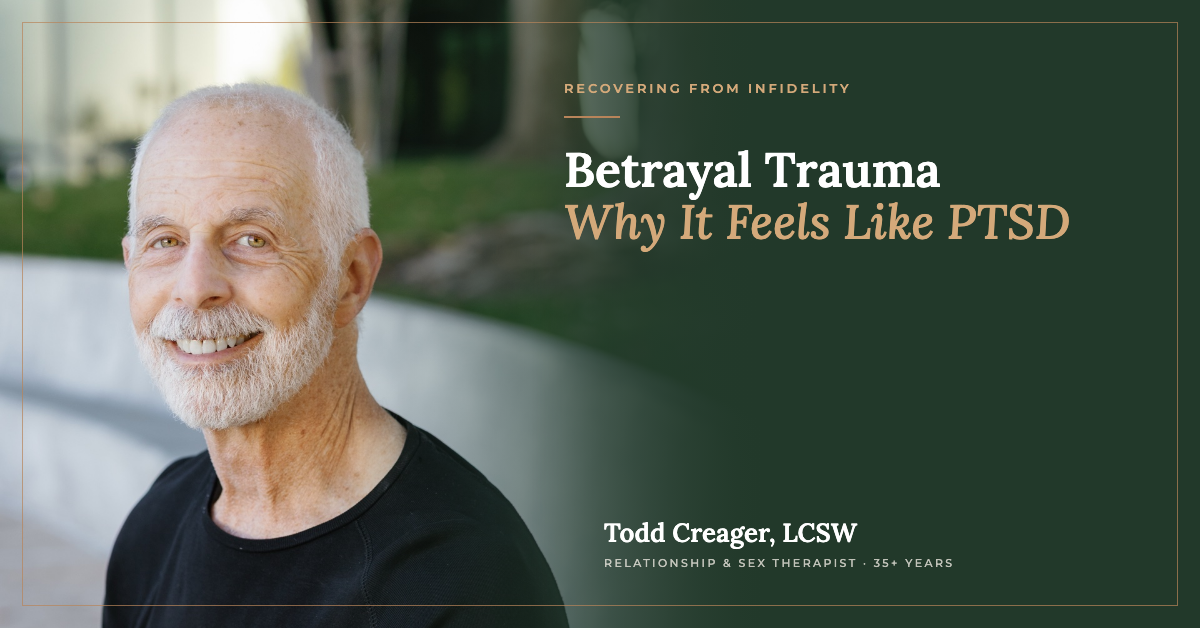

Betrayal Trauma Symptoms: Why Affairs Feel Like PTSD

Betrayal Trauma Symptoms: Why Affairs Feel Like PTSD

Picture of Todd Creager

Todd Creager

Todd Creager, LCSW, LMFT, is a marriage, relationship and sex therapist who helps couples heal from infidelity, betrayal and years of disconnection, so they can build a long, hot marriage instead of ending one.

35+ years in practice. Certified EMDR therapist. Adjunct lecturer, USC School of Social Work. Bestselling author of The Long, Hot Marriage and Love, Sex and Karaoke. Married, happily, for a long time.

Learn more about Todd: https://toddcreager.com/about/

Ready to talk? See how Todd works with couples and individuals or reach out for a 20-minute phone consult.

KEY TAKEAWAYS

If discovering an affair has left you feeling like you’re losing your mind, here’s what’s actually happening — and why it has a name:

  •   Betrayed partners commonly experience intrusive images, hypervigilance, obsessive checking, sleep disruption, and a shattered sense of safety — real trauma symptoms, not overreaction.
  •   Discovering an affair is what trauma researchers call an attachment injury — the brain treats relational danger the same way it treats physical danger.
  •   EMDR therapy is designed specifically to help the brain finish processing a traumatic memory so it stops replaying on a loop, often faster than talk therapy alone.
  •   If symptoms haven’t eased at all after several weeks, or if you’re having thoughts of harming yourself, that’s a sign to bring in professional support.

If you’ve found yourself flinching at a notification sound, replaying the discovery moment on a loop, or feeling like you’re watching your own life from outside your body — I want you to hear this clearly: what you’re experiencing has a name, and it isn’t weakness.

I’m Todd Creager, a marriage therapist and certified EMDR practitioner, and I want to walk you through why betrayal trauma feels exactly like the trauma responses I treat in my clinical work — because clinically, it often is one.

The Symptom Checklist Every Betrayed Partner Should Know

Betrayed partners commonly describe: intrusive images of the affair that appear uninvited, hypervigilance — scanning for danger signs in ordinary moments — obsessive checking of phones, locations, or accounts, sleep disruption and nightmares, sudden waves of panic or rage with no clear trigger, emotional numbness or a shutdown reaction especially in the early weeks, and a shattered sense of safety even in situations that have nothing to do with the relationship.

If several of these sound familiar, you’re not overreacting — you’re having a trauma response. I say this directly to almost every betrayed partner in my office in the first session, because the fear of “what’s wrong with me” often causes more distress than the symptoms themselves.

What most people don’t realize is that these symptoms can also show up as their opposite — numbness instead of panic, avoidance instead of vigilance, even a fear-induced libido spike in some partners as the nervous system searches for any way to feel in control. There’s no single “correct” way this shows up.

Why the Brain Responds This Way

Discovering an affair is what trauma researchers call an attachment injury — the person who was supposed to be your safety became, in that moment, the source of danger. Your brain’s alarm system, the amygdala, doesn’t distinguish neatly between physical danger and relational danger; it treats both as threats to survival.

That’s why the body reacts with the same fight-flight-freeze response you’d expect from a car accident, not just “hurt feelings.” Basic nervous-system care matters more than it sounds like it should: sleep, food, movement, and reducing exposure to unnecessary triggers, like re-reading old messages on a loop.

Naming what’s happening — “this is a trauma response” — can itself lower the intensity, because it stops the added fear layered on top of the original injury. Talking helps, but talking alone doesn’t always resolve trauma, which is where a different kind of therapy comes in.

How EMDR Resolves What Talking Alone Can’t

EMDR — Eye Movement Desensitization and Reprocessing — is designed specifically to help the brain finish processing a traumatic memory so it stops replaying on a loop. Unlike traditional talk therapy, it doesn’t require reliving every detail out loud.

In my own practice, I’ve seen betrayal trauma symptoms ease significantly faster with EMDR than with talk therapy alone, because it works with how the brain actually stores and unsticks traumatic memory, rather than just talking around it.

If it’s been several weeks and the intrusive images, hypervigilance, or sleep disruption aren’t easing at all — or if you’re having thoughts of harming yourself — that’s your sign to bring in support rather than wait it out. If you’re in crisis right now, call or text 988.

What to Do Next

If you recognize these symptoms in yourself right now, here’s where to start:

  • Name it: “this is a trauma response” — out loud, to yourself or someone safe.
  • Prioritize basic nervous-system care today: sleep, food, movement, less doomscrolling old messages.
  • Track whether symptoms are easing at all after a few weeks — if not, that’s your signal to get support.
  • Consider EMDR specifically if talk therapy alone hasn’t touched the intrusive images or hypervigilance.

Your first step: if you’re in crisis right now, call or text 988 to talk with someone immediately.

You are not broken, and you are not overreacting. Your brain is doing exactly what brains do after a real injury — and real injuries can heal. I offer both couples work and individual EMDR therapy for betrayal trauma, in my Huntington Beach office and virtually.

For the full roadmap through every stage of healing, my complete guide to infidelity recovery walks you through what comes next.
Frequently Asked Questions

Q: Is betrayal trauma the same as PTSD?

A: Betrayal trauma shares the same core mechanisms as PTSD — intrusive images, hypervigilance, and a disrupted sense of safety — because discovering an affair is a genuine attachment injury the brain treats as a threat to survival.

Q: How long do betrayal trauma symptoms last?

A: It varies widely, but symptoms often begin easing within a few weeks with basic nervous-system care. If they’re not easing at all after several weeks, that’s a sign to seek professional support such as EMDR therapy.

Q: Can EMDR help with infidelity trauma?

A: Yes. EMDR is specifically designed to help the brain finish processing traumatic memories so they stop replaying on a loop, and many betrayed partners see faster relief with EMDR than talk therapy alone.

Q: Why do I feel numb instead of upset after finding out about an affair?

A: Emotional numbness or a shutdown reaction is a common trauma response, not a sign you don’t care. The nervous system sometimes protects itself through numbness rather than panic — both are normal trauma responses.

Betrayal Trauma Symptoms: Why Affairs Feel Like PTSD

Betrayal Trauma Symptoms: Why Affairs Feel Like PTSD

KEY TAKEAWAYS

If discovering an affair has left you feeling like you’re losing your mind, here’s what’s actually happening — and why it has a name:

  •   Betrayed partners commonly experience intrusive images, hypervigilance, obsessive checking, sleep disruption, and a shattered sense of safety — real trauma symptoms, not overreaction.
  •   Discovering an affair is what trauma researchers call an attachment injury — the brain treats relational danger the same way it treats physical danger.
  •   EMDR therapy is designed specifically to help the brain finish processing a traumatic memory so it stops replaying on a loop, often faster than talk therapy alone.
  •   If symptoms haven’t eased at all after several weeks, or if you’re having thoughts of harming yourself, that’s a sign to bring in professional support.

If you’ve found yourself flinching at a notification sound, replaying the discovery moment on a loop, or feeling like you’re watching your own life from outside your body — I want you to hear this clearly: what you’re experiencing has a name, and it isn’t weakness.

I’m Todd Creager, a marriage therapist and certified EMDR practitioner, and I want to walk you through why betrayal trauma feels exactly like the trauma responses I treat in my clinical work — because clinically, it often is one.

The Symptom Checklist Every Betrayed Partner Should Know

Betrayed partners commonly describe: intrusive images of the affair that appear uninvited, hypervigilance — scanning for danger signs in ordinary moments — obsessive checking of phones, locations, or accounts, sleep disruption and nightmares, sudden waves of panic or rage with no clear trigger, emotional numbness or a shutdown reaction especially in the early weeks, and a shattered sense of safety even in situations that have nothing to do with the relationship.

If several of these sound familiar, you’re not overreacting — you’re having a trauma response. I say this directly to almost every betrayed partner in my office in the first session, because the fear of “what’s wrong with me” often causes more distress than the symptoms themselves.

What most people don’t realize is that these symptoms can also show up as their opposite — numbness instead of panic, avoidance instead of vigilance, even a fear-induced libido spike in some partners as the nervous system searches for any way to feel in control. There’s no single “correct” way this shows up.

Why the Brain Responds This Way

Discovering an affair is what trauma researchers call an attachment injury — the person who was supposed to be your safety became, in that moment, the source of danger. Your brain’s alarm system, the amygdala, doesn’t distinguish neatly between physical danger and relational danger; it treats both as threats to survival.

That’s why the body reacts with the same fight-flight-freeze response you’d expect from a car accident, not just “hurt feelings.” Basic nervous-system care matters more than it sounds like it should: sleep, food, movement, and reducing exposure to unnecessary triggers, like re-reading old messages on a loop.

Naming what’s happening — “this is a trauma response” — can itself lower the intensity, because it stops the added fear layered on top of the original injury. Talking helps, but talking alone doesn’t always resolve trauma, which is where a different kind of therapy comes in.

How EMDR Resolves What Talking Alone Can’t

EMDR — Eye Movement Desensitization and Reprocessing — is designed specifically to help the brain finish processing a traumatic memory so it stops replaying on a loop. Unlike traditional talk therapy, it doesn’t require reliving every detail out loud.

In my own practice, I’ve seen betrayal trauma symptoms ease significantly faster with EMDR than with talk therapy alone, because it works with how the brain actually stores and unsticks traumatic memory, rather than just talking around it.

If it’s been several weeks and the intrusive images, hypervigilance, or sleep disruption aren’t easing at all — or if you’re having thoughts of harming yourself — that’s your sign to bring in support rather than wait it out. If you’re in crisis right now, call or text 988.

What to Do Next

If you recognize these symptoms in yourself right now, here’s where to start:

  • Name it: “this is a trauma response” — out loud, to yourself or someone safe.
  • Prioritize basic nervous-system care today: sleep, food, movement, less doomscrolling old messages.
  • Track whether symptoms are easing at all after a few weeks — if not, that’s your signal to get support.
  • Consider EMDR specifically if talk therapy alone hasn’t touched the intrusive images or hypervigilance.

Your first step: if you’re in crisis right now, call or text 988 to talk with someone immediately.

You are not broken, and you are not overreacting. Your brain is doing exactly what brains do after a real injury — and real injuries can heal. I offer both couples work and individual EMDR therapy for betrayal trauma, in my Huntington Beach office and virtually.

For the full roadmap through every stage of healing, my complete guide to infidelity recovery walks you through what comes next.

Frequently Asked Questions

Q: Is betrayal trauma the same as PTSD?

A: Betrayal trauma shares the same core mechanisms as PTSD — intrusive images, hypervigilance, and a disrupted sense of safety — because discovering an affair is a genuine attachment injury the brain treats as a threat to survival.

Q: How long do betrayal trauma symptoms last?

A: It varies widely, but symptoms often begin easing within a few weeks with basic nervous-system care. If they’re not easing at all after several weeks, that’s a sign to seek professional support such as EMDR therapy.

Q: Can EMDR help with infidelity trauma?

A: Yes. EMDR is specifically designed to help the brain finish processing traumatic memories so they stop replaying on a loop, and many betrayed partners see faster relief with EMDR than talk therapy alone.

Q: Why do I feel numb instead of upset after finding out about an affair?

A: Emotional numbness or a shutdown reaction is a common trauma response, not a sign you don’t care. The nervous system sometimes protects itself through numbness rather than panic — both are normal trauma responses.

Reader Interactions

Leave a Reply

Your email address will not be published. Required fields are marked *