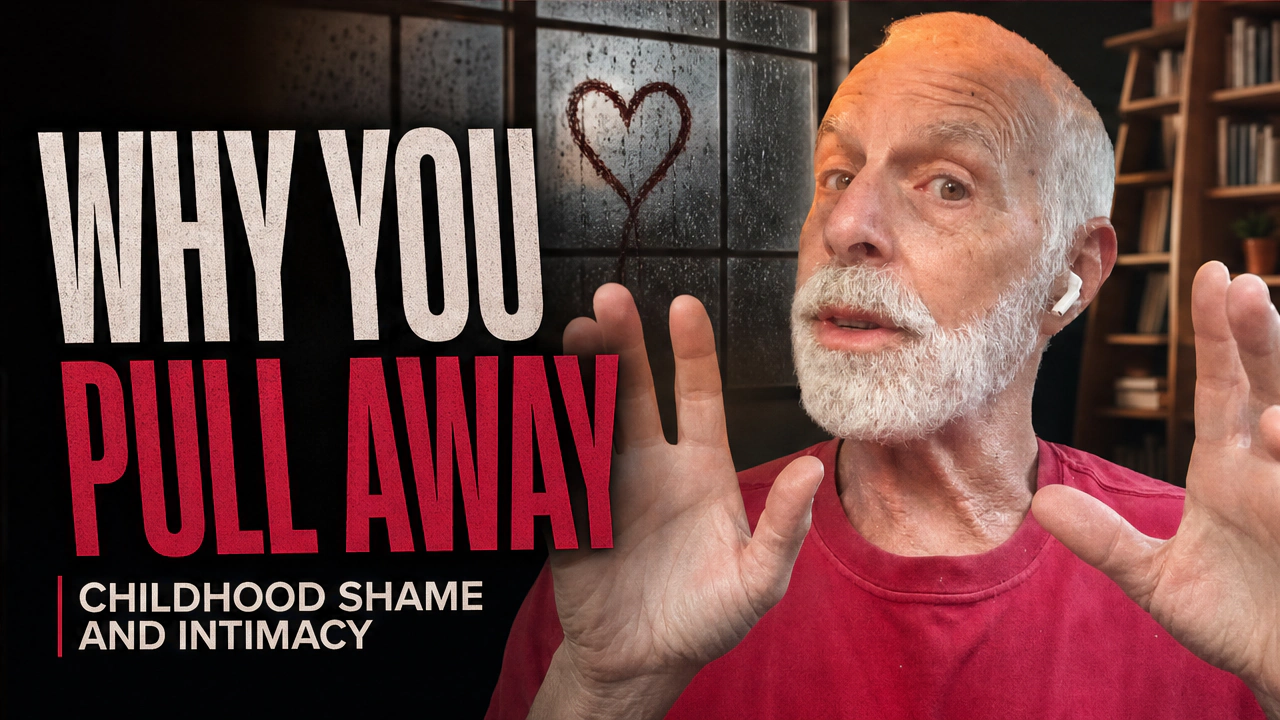

WHY YOU PULL AWAY

Childhood Shame and Intimacy: Why You Pull Away

Key Takeaways

Childhood Shame and Intimacy: Why a Part of You Pulls Back When Your Partner Gets Close

  • The pullback isn’t rejection of your partner. It’s a protector part doing the job it was hired for decades ago.
  • Underneath that protector sits an exile — a young part still carrying a childhood conclusion like I’m not worth attention or something is wrong with me.
  • Closeness is the one thing that could expose that shame, so protectors are built specifically to keep closeness out.
  • Forcing yourself to be more open doesn’t work. Your protectors won’t allow it.
  • The way through is turning toward the exile with your Self and letting that young part be witnessed without judgment. When the burden of I’m defective lifts, protectors relax, and the love that’s been offered can finally get in.

Your partner reaches for you and something inside you pulls back. Not all of you. A part of you.

That part decided a long time ago that if anyone got close enough to really see you, they wouldn’t like what they found. And it has been running the show in your relationship ever since — deflecting compliments, keeping sex physical but emotionally empty, picking a fight the moment things get good.

I’ve sat with couples for decades watching this exact pattern, and I want to be clear about something right up front. None of it is a character flaw. Those parts are doing precisely what they were built to do.

Here’s what’s actually happening underneath, why the usual advice about “being more vulnerable” backfires, and what genuinely frees people from it.

What Childhood Shame Does to Adult Intimacy

Childhood shame doesn’t stay in childhood. It goes underground and becomes an exile — a young part of you that absorbed a message and has been carrying it ever since.

The messages vary. I’m not worth attention. Something is wrong with me. I’m too much. The child didn’t sit down and choose that belief. They lived in conditions where that was the only conclusion that made sense. Children need to make sense of their lives, same as adults do. So they build an explanation, and if the environment gives them nothing else to work with, the explanation becomes it must be me.

Then protectors form around that exile. And here’s the part most people miss when they’re trying to figure out why their marriage feels distant: the protectors are aimed at closeness specifically. Not at conflict. Not at work stress. At closeness. Because closeness is the one condition under which the shame the exile is holding could get exposed.

Which means the healthier your relationship gets, the harder your protectors work. That’s the piece that confuses couples the most. They finally have a good week, they finally feel connected, and one of them blows it up. They read that as proof the relationship is broken. It’s usually the opposite — proof the system is under threat and doing its job.

Most of this is not conscious. Almost never conscious, in my experience. People aren’t choosing to sabotage. They’re being protected by parts that never got the memo that the danger passed.

The Protectors That Keep Your Partner at a Distance

Protector parts have signature moves. Once you can name yours, you stop taking the behavior at face value.

Some of the most common ones I see in my office:

  • The deflector. Every compliment gets waved off before it can land. Your partner says something loving and you make a joke, change the subject, or point out the exception. I’ve seen this one a lot.
  • The physical-only part. Sex happens. Emotional presence doesn’t. The body shows up, the person stays hidden.
  • The fight-picker. Things are going really well, something good is happening, and suddenly there’s an argument about the dishwasher.
  • The accommodator. This one becomes whatever the partner needs. Pleasant, agreeable, easy. And because the real self never has to show up, nothing genuine is ever at risk.

That last one fools everybody, including therapists. It looks like generosity. It looks like a great partner. It’s a protector — and often the most stubborn of the bunch, because nobody in the couple is complaining about it.

What I’d add from years of watching these parts operate: they frequently work in shifts. Somebody deflects for a while, and when deflection stops working because the partner keeps offering love anyway, a meaner part steps in. Escalation isn’t failure. Escalation means the closeness is getting through and the system is compensating.

Why Forcing Yourself to Be Open Doesn’t Work

You cannot willpower your way into intimacy. The protector parts won’t let you, and they’ll win, because they’ve been at this longer than your intention has.

The way through is turning toward the exile with your Self. Self with a capital S — the part of you that isn’t a part at all. It’s who you really are at your core. Courageous, clear, connected, calm, all those C words. You were born with it. It’s your essence, and it doesn’t need repair.

You let the young part be seen by you first. Not by your partner. By you.

When that young part finally feels witnessed without judgment, and the burden of I’m defective starts to lift, the protectors don’t need to keep your partner out anymore. The closeness that’s been offered to you all along can finally get in. That’s the whole mechanism. Nothing about it requires you to perform vulnerability you don’t feel.

I had a client years back — one of four brothers, all with different fathers. His biological father was the one his mother truly detested. She couldn’t consciously help herself; she projected that hatred onto her son. He was always going to be the bad one, because of how she’d been treated by his father before he was even born.

He got the message directly and indirectly, and he internalized enormous shame. Then he acted the program out. He did what he understood bad people do. Juvenile delinquency, and jail time as a young adult.

He eventually found his way to a wonderful woman who became his wife and, later, my client too. He sabotaged it every way he could. Wouldn’t accept her love in any real way. Great at the beginning, and then once there was actual intimacy, his protective parts got mean, made him less appetizing, less attractive, until she pulled away. On the surface, a disaster. Underneath, mission accomplished — the shame stayed buried.

We worked on recognizing those protective parts first. Then the exile underneath. We eventually did EMDR with the part carrying the shame, and he was freed from it. He recognized that the belief was his mother’s material, something he’d bought into. A lie he’d been telling himself unconsciously. Not his fault.

Once he knew he wasn’t bad, the protectors could relax. They could take a break. They didn’t have to work so hard keeping the shame down, because he’d faced it and healed it. Their relationship became exponentially better, because closeness could finally happen.

I’ll be honest about the limits here. This isn’t a weekend fix, and I don’t think most people get all the way there alone. A therapist who works with parts can help enormously, particularly at the stage where you’re turning toward the exile, because that’s the moment protectors get loudest.

Where To Start This Week

Nothing here requires you to be more open with your partner tomorrow. Start inside.

  • Catch the moment. The next time your partner reaches for you and something contracts, pause and notice it. Don’t fix it. Notice it.
  • Name the protector. Which one is it? Deflector, fight-picker, accommodator, the one who keeps things physical? Give it a name.
  • Ask what it’s afraid would happen. Protectors will usually tell you, if you’re curious instead of critical. The answer points straight at the exile.
  • Extend some gentleness. Toward that young part, and toward your partner, whose parts are running their own program right alongside yours.
  • Get help for the exile work. Turning toward a wounded young part with real Self energy is the step where most people need a witness who knows the territory.

If your protectors have been running your marriage for years, that first pause is the whole beginning. You don’t have to be open. You have to be curious.

Intimacy is possible. Not by forcing yourself past your own defenses, but by going in and healing what those defenses were built to hide. Every couple I’ve watched make this shift describes the same thing afterward — the love was always being offered, they just couldn’t take delivery.

If any of this landed, reach out. Talking it through with someone who understands parts work will get you further, faster, than another year of trying harder.

This is Todd Creager, making the world safe for love.

What if your next argument could bring you closer instead of driving you apart?


Learn how in Todd Creager’s Loving & Connecting Masterclass.
Lifetime access. Real results.

Frequently Asked Questions

Q: What does childhood shame have to do with problems in my marriage?

A: Childhood shame lives on as an exile — a young part carrying a belief like I’m not worth attention or something is wrong with me. Protective parts form around it to keep intimacy at a distance, since closeness is what could expose the shame. The result is emotional distance, deflection, or conflict that shows up right when things are going well.

Q: Why do I pick a fight when things are going well with my partner?

A: That’s a protector part responding to closeness as a threat. Good moments increase the chance of being truly seen, which increases the chance the exile’s shame gets exposed. The fight isn’t about the subject you’re fighting about — it’s a system restoring safe distance.

Q: Can I heal this without therapy?

A: You can begin. Noticing the protector, naming it, and asking what it’s afraid of are things you can do on your own. The exile work — turning toward the wounded young part with real Self energy — is where most people benefit from a therapist trained in parts work, sometimes combined with EMDR.

Q: What is Self in this framework, and how do I access it?

A: Self with a capital S is the part of you that isn’t a part. Courageous, clear, connected, calm. You were born with it; it’s your essence rather than something you build. You access it by getting curious about your parts instead of judging or fighting them.

Q: My partner shuts down every time I get close. Is this the same thing?

A: Very likely. Withdrawal in the face of affection is one of the most common protector patterns. Pushing harder generally strengthens the protector. Naming the pattern gently, without blame, gives their system room to relax.

Popular Post

Contact Us

WHY YOU PULL AWAY

Childhood Shame and Intimacy: Why You Pull Away

Key Takeaways

Childhood Shame and Intimacy: Why a Part of You Pulls Back When Your Partner Gets Close

  • The pullback isn’t rejection of your partner. It’s a protector part doing the job it was hired for decades ago.
  • Underneath that protector sits an exile — a young part still carrying a childhood conclusion like I’m not worth attention or something is wrong with me.
  • Closeness is the one thing that could expose that shame, so protectors are built specifically to keep closeness out.
  • Forcing yourself to be more open doesn’t work. Your protectors won’t allow it.
  • The way through is turning toward the exile with your Self and letting that young part be witnessed without judgment. When the burden of I’m defective lifts, protectors relax, and the love that’s been offered can finally get in.

Your partner reaches for you and something inside you pulls back. Not all of you. A part of you.

That part decided a long time ago that if anyone got close enough to really see you, they wouldn’t like what they found. And it has been running the show in your relationship ever since — deflecting compliments, keeping sex physical but emotionally empty, picking a fight the moment things get good.

I’ve sat with couples for decades watching this exact pattern, and I want to be clear about something right up front. None of it is a character flaw. Those parts are doing precisely what they were built to do.

Here’s what’s actually happening underneath, why the usual advice about “being more vulnerable” backfires, and what genuinely frees people from it.

What Childhood Shame Does to Adult Intimacy

Childhood shame doesn’t stay in childhood. It goes underground and becomes an exile — a young part of you that absorbed a message and has been carrying it ever since.

The messages vary. I’m not worth attention. Something is wrong with me. I’m too much. The child didn’t sit down and choose that belief. They lived in conditions where that was the only conclusion that made sense. Children need to make sense of their lives, same as adults do. So they build an explanation, and if the environment gives them nothing else to work with, the explanation becomes it must be me.

Then protectors form around that exile. And here’s the part most people miss when they’re trying to figure out why their marriage feels distant: the protectors are aimed at closeness specifically. Not at conflict. Not at work stress. At closeness. Because closeness is the one condition under which the shame the exile is holding could get exposed.

Which means the healthier your relationship gets, the harder your protectors work. That’s the piece that confuses couples the most. They finally have a good week, they finally feel connected, and one of them blows it up. They read that as proof the relationship is broken. It’s usually the opposite — proof the system is under threat and doing its job.

Most of this is not conscious. Almost never conscious, in my experience. People aren’t choosing to sabotage. They’re being protected by parts that never got the memo that the danger passed.

The Protectors That Keep Your Partner at a Distance

Protector parts have signature moves. Once you can name yours, you stop taking the behavior at face value.

Some of the most common ones I see in my office:

  • The deflector. Every compliment gets waved off before it can land. Your partner says something loving and you make a joke, change the subject, or point out the exception. I’ve seen this one a lot.
  • The physical-only part. Sex happens. Emotional presence doesn’t. The body shows up, the person stays hidden.
  • The fight-picker. Things are going really well, something good is happening, and suddenly there’s an argument about the dishwasher.
  • The accommodator. This one becomes whatever the partner needs. Pleasant, agreeable, easy. And because the real self never has to show up, nothing genuine is ever at risk.

That last one fools everybody, including therapists. It looks like generosity. It looks like a great partner. It’s a protector — and often the most stubborn of the bunch, because nobody in the couple is complaining about it.

What I’d add from years of watching these parts operate: they frequently work in shifts. Somebody deflects for a while, and when deflection stops working because the partner keeps offering love anyway, a meaner part steps in. Escalation isn’t failure. Escalation means the closeness is getting through and the system is compensating.

Why Forcing Yourself to Be Open Doesn’t Work

You cannot willpower your way into intimacy. The protector parts won’t let you, and they’ll win, because they’ve been at this longer than your intention has.

The way through is turning toward the exile with your Self. Self with a capital S — the part of you that isn’t a part at all. It’s who you really are at your core. Courageous, clear, connected, calm, all those C words. You were born with it. It’s your essence, and it doesn’t need repair.

You let the young part be seen by you first. Not by your partner. By you.

When that young part finally feels witnessed without judgment, and the burden of I’m defective starts to lift, the protectors don’t need to keep your partner out anymore. The closeness that’s been offered to you all along can finally get in. That’s the whole mechanism. Nothing about it requires you to perform vulnerability you don’t feel.

I had a client years back — one of four brothers, all with different fathers. His biological father was the one his mother truly detested. She couldn’t consciously help herself; she projected that hatred onto her son. He was always going to be the bad one, because of how she’d been treated by his father before he was even born.

He got the message directly and indirectly, and he internalized enormous shame. Then he acted the program out. He did what he understood bad people do. Juvenile delinquency, and jail time as a young adult.

He eventually found his way to a wonderful woman who became his wife and, later, my client too. He sabotaged it every way he could. Wouldn’t accept her love in any real way. Great at the beginning, and then once there was actual intimacy, his protective parts got mean, made him less appetizing, less attractive, until she pulled away. On the surface, a disaster. Underneath, mission accomplished — the shame stayed buried.

We worked on recognizing those protective parts first. Then the exile underneath. We eventually did EMDR with the part carrying the shame, and he was freed from it. He recognized that the belief was his mother’s material, something he’d bought into. A lie he’d been telling himself unconsciously. Not his fault.

Once he knew he wasn’t bad, the protectors could relax. They could take a break. They didn’t have to work so hard keeping the shame down, because he’d faced it and healed it. Their relationship became exponentially better, because closeness could finally happen.

I’ll be honest about the limits here. This isn’t a weekend fix, and I don’t think most people get all the way there alone. A therapist who works with parts can help enormously, particularly at the stage where you’re turning toward the exile, because that’s the moment protectors get loudest.

Where To Start This Week

Nothing here requires you to be more open with your partner tomorrow. Start inside.

  • Catch the moment. The next time your partner reaches for you and something contracts, pause and notice it. Don’t fix it. Notice it.
  • Name the protector. Which one is it? Deflector, fight-picker, accommodator, the one who keeps things physical? Give it a name.
  • Ask what it’s afraid would happen. Protectors will usually tell you, if you’re curious instead of critical. The answer points straight at the exile.
  • Extend some gentleness. Toward that young part, and toward your partner, whose parts are running their own program right alongside yours.
  • Get help for the exile work. Turning toward a wounded young part with real Self energy is the step where most people need a witness who knows the territory.

If your protectors have been running your marriage for years, that first pause is the whole beginning. You don’t have to be open. You have to be curious.

Intimacy is possible. Not by forcing yourself past your own defenses, but by going in and healing what those defenses were built to hide. Every couple I’ve watched make this shift describes the same thing afterward — the love was always being offered, they just couldn’t take delivery.

If any of this landed, reach out. Talking it through with someone who understands parts work will get you further, faster, than another year of trying harder.

This is Todd Creager, making the world safe for love.

What if your next argument could bring you closer instead of driving you apart?


Learn how in Todd Creager’s Loving & Connecting Masterclass.
Lifetime access. Real results.

Frequently Asked Questions

Q: What does childhood shame have to do with problems in my marriage?

A: Childhood shame lives on as an exile — a young part carrying a belief like I’m not worth attention or something is wrong with me. Protective parts form around it to keep intimacy at a distance, since closeness is what could expose the shame. The result is emotional distance, deflection, or conflict that shows up right when things are going well.

Q: Why do I pick a fight when things are going well with my partner?

A: That’s a protector part responding to closeness as a threat. Good moments increase the chance of being truly seen, which increases the chance the exile’s shame gets exposed. The fight isn’t about the subject you’re fighting about — it’s a system restoring safe distance.

Q: Can I heal this without therapy?

A: You can begin. Noticing the protector, naming it, and asking what it’s afraid of are things you can do on your own. The exile work — turning toward the wounded young part with real Self energy — is where most people benefit from a therapist trained in parts work, sometimes combined with EMDR.

Q: What is Self in this framework, and how do I access it?

A: Self with a capital S is the part of you that isn’t a part. Courageous, clear, connected, calm. You were born with it; it’s your essence rather than something you build. You access it by getting curious about your parts instead of judging or fighting them.

Q: My partner shuts down every time I get close. Is this the same thing?

A: Very likely. Withdrawal in the face of affection is one of the most common protector patterns. Pushing harder generally strengthens the protector. Naming the pattern gently, without blame, gives their system room to relax.
Reader Interactions

Leave a Reply

Your email address will not be published. Required fields are marked *